
-
Welcome to Photrio!Registration is fast and free. Join today to unlock search, see fewer ads, and access all forum features.Click here to sign up
- Home
- Forums
- General Discussion (Mixed Workflow Forums)
- Antiques, Collecting and Photographic History
You are using an out of date browser. It may not display this or other websites correctly.
You should upgrade or use an alternative browser.
You should upgrade or use an alternative browser.
What is the oldest functional camera you have?
-
A
- Thread starter Theo Sulphate
- Start date

Recent Classifieds
-
For Sale Omega 6.5" inch Condenser for 4x5 format, D series, D2, DII etc
- Started by Jon Shiu
-
For Sale 5 GE 15w frosted white Safelight Bulbs
- Started by Jon Shiu
-
For Sale Omega D parts
- Started by mgb74
-
For Sale Zone VI 5x7 Enlarger & Accessories $1500 obo
- Started by oficinouno
Forum statistics


For my part, my oldest working camera is a Kodak Tourist 
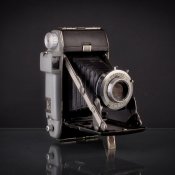


Zeiss Super Ikonta C, about 1936 or '39. Works well.
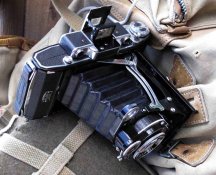

baachitraka
Member
Rolleicord IIb

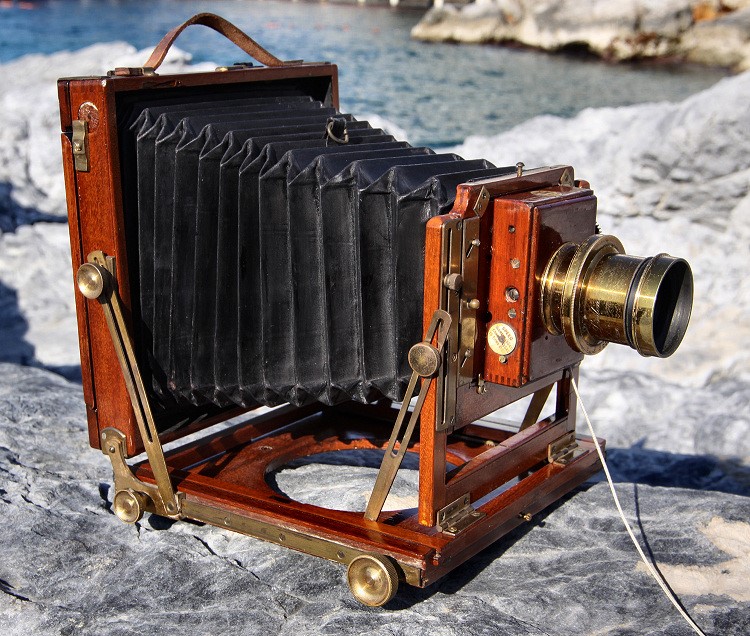
Un-named 1890's Whole plate camera, Houghton Duches Half plate approx 1904-10, Houghton Victo Quarter plate 1904-1910. 110 (roll film 5x4" camera made by The Alliance Roll-film Camera Co. Ltd 1898-1904.
Here's the Duchess:
Ian
Here's the Duchess:
Ian
I have two from '36
Fed I toilet seat (think that is a 1b)
Contax II
They are both shooters the Fed kit lens (uncoated Tessar clone) nice with Velvia or mono and deep hood.
The Contax whisper quiet for street with 28 mm at 1m.
Fed I toilet seat (think that is a 1b)
Contax II
They are both shooters the Fed kit lens (uncoated Tessar clone) nice with Velvia or mono and deep hood.
The Contax whisper quiet for street with 28 mm at 1m.

I've got a very early FED from 1935 or -36 that actually still works. It is a pain to load but the shutter works on all speeds (not too precise though) and the cloth shutter is light proof. For a camera of Soviet quality that is not bad.
I have two from '36
Fed I toilet seat (think that is a 1b)
Contax II
They are both shooters the Fed kit lens (uncoated Tessar clone) nice with Velvia or mono and deep hood.
The Contax whisper quiet for street with 28 mm at 1m.
Didn't see your post until I pressed "submit". Maybe early FED's are better than expected.
Didn't see your post until I pressed "submit". Maybe early FED's are better than expected.
You do need to buy a FISON or make a paper mache clone.
http://www.l-camera-forum.com/leica-wiki.en/index.php/FISON
The shutter speeds on mine seem ok.
The Soviet's WWII battle tanks were as good as the Nazi's.

1907 Gundlach Criterion View Whole Plate. Unused until I bought it a few months ago. Literally NOS!
Works perfectly (as it should being "new").

RR
Works perfectly (as it should being "new").
RR
1907 Gundlach Criterion View Whole Plate. Unused until I bought it a few months ago. Literally NOS!
Works perfectly (as it should being "new").
RR
I hope you're using a Turner Reich with it
 I bough one for a whole plate camera a couple of years ago for £5.
Ian
- Joined
- Sep 28, 2012
- Messages
- 440
- Format
- Multi Format
Autographic Special
I've wanted an Autographic Special ever since I read an article about it and realized I could have a roll film rangefinder on the cheap, but I've yet to commit to buying one. How usable do you find the rangefinder? What kind of film do you put through it?
My oldest functioning camera is a 1917 Kodak Autographic 1A Special (on the left). I use it a few times a year, and have gotten some nice images from it.
I've wanted an Autographic Special ever since I read an article about it and realized I could have a roll film rangefinder on the cheap, but I've yet to commit to buying one. How usable do you find the rangefinder? What kind of film do you put through it?

A Six -16 Kodak assembled in Toronto, Ontario Canada by Canadian Kodak Ltd. in or about 1935.
It was given to me by my father 47 years ago, for my 11th birthday. He had had it mechanically refurbished, with a new bellows and leatherette covering. The negative size is big enough to contact print in a satisfactory manner, and a dedicated contact printer was included as part of the birthday gift.
He used it to introduce me to darkroom work.
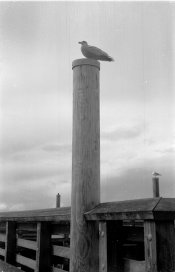
Here is a shot from 4 years ago:
It was given to me by my father 47 years ago, for my 11th birthday. He had had it mechanically refurbished, with a new bellows and leatherette covering. The negative size is big enough to contact print in a satisfactory manner, and a dedicated contact printer was included as part of the birthday gift.
He used it to introduce me to darkroom work.
Here is a shot from 4 years ago:
Attachments

You have to draw a line somewhere, and I call a camera old if it's older than I ammanufactured before 1951. I have lots of them. The one that actually got me started is a Rochester Camera Manufacturing Co. Poco, made in Rochester, NY. between 1891 and 1895, during the hey-day of American mastery of hard wood and soft metal. The company kept that name for a very short time period. That sets the date. It belonged to this man, Rudolf Rudner, my wife's great grandfather. He bought it used in 1902, when he came to America from Germany. The colors are artifacts from scanning a glass plate in color- I never fixed it because it worked so well with this image. I have the plate and have printed it as well. I believe the plate was taken with this camera.
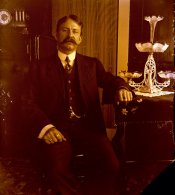

You have to draw a line somewhere, and I call a camera old if it's older than I ammanufactured before 1951. I have lots of them. The one that actually got me started is a Rochester Camera Manufacturing Co. Poco, made in Rochester, NY. between 1891 and 1895, during the hey-day of American mastery of hard wood and soft metal. The company kept that name for a very short time period. That sets the date. It belonged to this man, Rudolf Rudner, my wife's great grandfather. He bought it used in 1902, when he came to America from Germany. The colors are artifacts from scanning a glass plate in color- I never fixed it because it worked so well with this image. I have the plate and have printed it as well. I believe the plate was taken with this camera.
View attachment 97695
beautiful story, beautiful photo!

Chrismat
Subscriber
I've wanted an Autographic Special ever since I read an article about it and realized I could have a roll film rangefinder on the cheap, but I've yet to commit to buying one. How usable do you find the rangefinder? What kind of film do you put through it?
The rangefinder on the Autographic is just barely usable. Lucky for me I'm near sighted and I can look very closely at the rangefinder. Supposedly some models of the Autographic Special had a mirror prism system that you could use for focusing but some of the glass on mine is gone. Always use a level, that helps a lot. You might want to consider a Kodak 1A folder. It only has two shutter speeds, 1/25 and 1/50, but they have a metal spring plate which helps keep the film flat. The Autographic doesn't have the plate, but it does have more shutter speeds (if they are working). Either way, only advance the film when you are ready to make an exposure no matter which folder you're using. It's very easy to use 120 film with minor modifications.
A very good resource for the Autographic is Mike Connealy at http://mconnealy.com/ He has some great tips on using these folders.
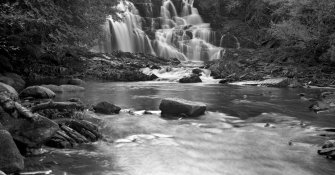
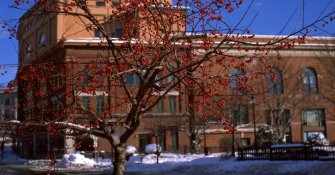
The black and white shot I took with my first roll through the Autographic. The color shot I took with some slightly expired Velvia on a Kodak 1A pocket. Either way, the size of the negs are about 2.25 X 4.5 inches. Mostly I shoot with black and white. With the limited shutter speeds on the 1A pocket, I usually use 400 speed film in order to use smaller f-stops, with the Autographic I both 100 or 400 speed. I use Acros quite often, Tri-X mostly for 400.
Attachments
Last edited by a moderator:

Another prewar (1938 or 1939) FED NKVD here! It was a good condition when I bought it apart from the shutter curtains and the cloudy FED lens. I repaired both years ago and it is still going strong even if I don't use it as often as I would like.

A near-NOS Graflex 4x5 Pacemaker Crown Graphic. It glistens in as-new condition and works perfectly throughout. Not as cool as Regular Rod's NOS 1907 Gundlach Criterion View Whole Plate. But still pretty nice.
Have had the shutter CLACed by Carol Flutot. Added a clean and correct Graflite with 5- and 7-inch reflectors (the 5-inch guys were also NOS), a new Paramount flash cord, and one of those heavy-duty left-hand form-fitting grips to keep my dirty paws off the camera when using it.
Also added a NOS Sunpak 622 Super flash for those times when I don't want to use any of my 1,600+ Press 25/GE #5 flashbulbs. Or my stash of #22 flashbulbs.
Maybe one of you Graflex guys can confirm something for me. The underside of the focusing rail crossbar (the forward one) is stamped with the manufacturer's code "E8A". According to this chart that means a manufacture date of May, 1968. But the 'A' character would also mean this camera version is as initially released. Meaning no manufacturing modifications to the product line. It's the A-revision.
Is that possible given that the top-mounted Graflex RFs supposedly began in 1955? Thirteen years without a single change? Mine has the top-mounted RF with interchangeable cams, and according to the original owner came out of the box that way.
Ken
Have had the shutter CLACed by Carol Flutot. Added a clean and correct Graflite with 5- and 7-inch reflectors (the 5-inch guys were also NOS), a new Paramount flash cord, and one of those heavy-duty left-hand form-fitting grips to keep my dirty paws off the camera when using it.
Also added a NOS Sunpak 622 Super flash for those times when I don't want to use any of my 1,600+ Press 25/GE #5 flashbulbs. Or my stash of #22 flashbulbs.
Maybe one of you Graflex guys can confirm something for me. The underside of the focusing rail crossbar (the forward one) is stamped with the manufacturer's code "E8A". According to this chart that means a manufacture date of May, 1968. But the 'A' character would also mean this camera version is as initially released. Meaning no manufacturing modifications to the product line. It's the A-revision.
Is that possible given that the top-mounted Graflex RFs supposedly began in 1955? Thirteen years without a single change? Mine has the top-mounted RF with interchangeable cams, and according to the original owner came out of the box that way.
Ken

ozphoto
Subscriber
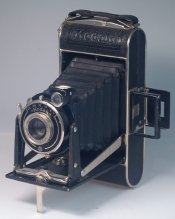
I was given a 1933 Kodak Junior 620, that had seen action during WW2 - the case still has the name of the (Australian?) soldier to whom it belonged.
I absolutely love it! It lets me really wind down and just think about the process - taking the time to determine an f-stop and shutter speed (not to mention focus in feet!!!), just me, the camera and exposing the film.
Is identical to this one, although in considerably more worn condition . . . .
I absolutely love it! It lets me really wind down and just think about the process - taking the time to determine an f-stop and shutter speed (not to mention focus in feet!!!), just me, the camera and exposing the film.
Is identical to this one, although in considerably more worn condition . . . .
Attachments

DWThomas
Subscriber
Wow -- after reading some of these I feel like a mere trifler! I have a Kodak Brownie Target Six-20 I've owned since it was new, a gift from my parents circa 1949 or 1950 -- I think -- it still works. My collection also includes a Burke&James 4x5 Press that could go back to the early 1940s, and works, last i tried, but does show some effects of age and storage under less than museum conditions. There's also a 1948-ish? Flexaret III not in real good shape, a Perkeo II, and Ercona II, both 1952-ish, acquired in the last five or six years and quite functional. And the camera I personally bought new sometime after Christmas in 1957, an Argus C3. It works, and I still shoot with it at least once a year.
But alas, no 110 year old classics of rosewood and brass!
But alas, no 110 year old classics of rosewood and brass!
I hope you're using a Turner Reich with it
Ian
It's a Ross of similar vintage to the camera but definitely NOT NOS!
RR
| Photrio.com contains affiliate links to products. We may receive a commission for purchases made through these links. To read our full affiliate disclosure statement please click Here. |
PHOTRIO PARTNERS EQUALLY FUNDING OUR COMMUNITY:  |