For example, quoting from a report entitled "SPECTRAL SIGNATURES OF NIGHTTIME LIGHTS":
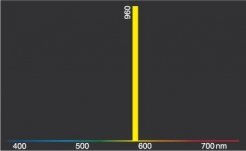
"High and low pressure sodium vapor lamps have very little variability. Both have strong emission
lines at 819 nm. The low pressure sodium lamp has only one additional emission line of any
consequence, at 589 nm." (emphasis mine)
Hi Leigh,
Real world observations always trump theory. So I went down to my darkroom and fired up my Thomas Duplex and let it stablize. It has a reasonably low mileage tube. I removed all filters so I could see the bare bulb. Then I located my copy of
The Hunt for Red October. (Appropriate for safelight testing?) I held up the DVD at an oblique angle to the bulb and observed with my own eyes the color bands generated tangentially to the recording tracks. This happened about 15 minutes ago.
In addition to the overwhelming sodium D-line I was also able to easily make out additional blue, green and red bands. These corresponded very closely in both color and relative brightness levels to the three non-sodium emission spectra documented in Brian Niece's LPS discharge tube
image and
graph. The blue was very deep and the faintest of the three. The red was a bit brighter, but not nearly as bright as the green. But all three were unmistakable.
I then refitted the
Roscoe #19 Fire filter and looked again. As expected, the blue and green bands had disappeared, but the red was still visible. In other words, the Duplex was now converted into a truly safe light.
If you look at the transmission chart at the above Roscoe link you'll see that in addition to cutting off the shorter wavelengths the #19 also transmits only about 35% of the sodium orange light. This also appeared to correspond visually with what I was seeing.
Where do the additional emissions come from? I'm still speculating from impurities introduced inadvertently into the tube by the manufacturing process or materials, or on purpose as a consequence of the engineering required to create a commercially viable product. For example,
this article describes the neon and argon Penning mixture added to LPS tubes to assist with the inital striking of the lamp.
I would
strongly suggest that you try the above first-person observation for yourself.
Ken