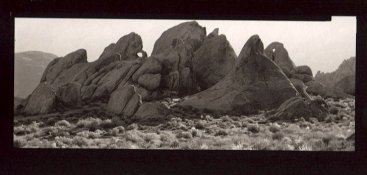
Strong words indeed but I disagree.Rules for composition are poison to your mind
Only if you learn the rules can you then know when to break them and why.
Strong words indeed but I disagree.Rules for composition are poison to your mind


Looking where you want the viewer to look does not confine that process to a single point in the frame. It could be a single point, or it could be a path through the image, or a series of points, or a fluid movement. But it is where I as the photographer want you to look, and how I want you to think about the image. If you're not seeing what I want you to see, then the image is a failure. This also does not preclude your seeing other things that may exist within the frame that I never intended or planned, but you should be able to see what I want at a bare minimum.I agree with the first part, but the second part is too limiting (to just eye movement). As 138S mentioned composition is also used to create moods/tension moods -- part of that is eye movement.
To borrow a phrase from Pirates of the Caribbean, "The Pirate Code isn't a set of laws, it's more like guidelines".They shouldn't be called "rules" of composition.
They are observations and maxims. They collect common experiences, and provide a useful vocabulary. If you are familiar with their effect, you can either choose to employ them for a particular result, or to flaunt them.
This discussion reminds me of a conversation with a late friend - a wonderful photographer himself, right into his 80s - who related a discussion he had had with a friend of similar vintage who had moved into a senior living facility. He asked her how she liked it. She responded that it was fairly simple: "Just learn the rules, then circumvent them!"
With age comes wisdom.
Yuk That's why I know the rules (more or less) but ignore them. The composition has been seriously 'weakened'.
Brad made a point I have been thinking of since this thread started. A 'strong' composition is not necessarily graphic in nature, bold, or strilking.
Taking strong literally would be trying to see it as a measureable force, literal force of which Newton or Einstein might want to discuss.You’re putting too much emphasis on ‘strong’ - taking it too literally. I think probably the people who mentioned ‘strong composition’ did not mean to imply such overwhelming superiority but rather that something about the composition adds to or improves upon the subject of the photo.

Taking strong literally would be trying to see it as a measureable force, literal force of which Newton or Einstein might want to discuss.
Looks like we're still on the same side of the fence. Strong implies strength, if applied to an image, that ought to make that image ... stronger ... or isn't it with implied better, hence improved?
Most comments to me fall into the same barrel. What I am saying is only that this is beyond subjective, cannot be discussed objectively, and I brought up Kenna, because his images are from same factory, same assembly line, and could easily be done with PS pre-sets by a truck load, yet are so widely considered impactful (yes, stronger, outspoken compositions), and on further examination, IMO, they are anything but. Yet I don't argue with those who see Kenna as a bloke to follow, or aspire to. I could say same thing about a number of well known names in arts, and I know I would offend their fans. So I won't mention Springsteen, Dion, or Hootie & the Blowfish.
The arrangement of the image supports the image's message rather than detracts from it.It's organization. And of course that doesn't mean organized like necessarily orderly. So maybe "arrangement" is better.
I really like Kenna's Holga book.hat I am saying is only that this is beyond subjective, cannot be discussed objectively, and I brought up Kenna, because his images are from same factory, same assembly line, and could easily be done with PS pre-sets by a truck load, yet are so widely considered impactful (yes, stronger, outspoken compositions), and on further examination, IMO, they are anything but.
It's organization. And of course that doesn't mean organized like necessarily orderly. So maybe "arrangement" is better.
 )) it's more difficult to define "composition" than enumerating the techniques, effects and styles that allow to work it !!
I agree. But the aesthetic message could create awe. Great art makes us feel insignificant. There's power in humility.Maybe, if there is a message. There doesn't have to be (unless you believe Picasso). I am of the opinion that a work in any visual artform can stand on pure aesthetics.
However, putting an honest, aesthetic idea onto paper, canvas etc. does in a way constitute a communication of sorts, so it can easily be argued there is always a "message" of some kind.
This is a problem with discussions about art. Defining terms is difficult, if not impossible in some cases. What is strong composition? Well, it depends on how you define strong. Ok never mind, what is composition? Some arrangement that supports the message? Perhaps, but what do we mean by message?
You often end up in this vortex of reduction until eventually there isn't much to say except that it is materially subjective.
What makes a pretty girl look pretty or a man handsome? Our brains are wired a certain way. Sure we can point to certain features to support our feelings. Same with art and aesthetics, I believe. Our wired brains made the rules, not the other way around.Amazingly
IMO "arrangement" is good, as direct meaning is "putting together"...
The wiki article has to say an indirect definition while having an easy job in describing composition techniques: https://en.wikipedia.org/wiki/Composition_(visual_arts)

I think you got it wrong TFCTo borrow a phrase from Pirates of the Caribbean, "The Pirate Code isn't a set of laws, it's more like guidelines".


My point, poorly stated, is that composition is far more than eye-movement. For example, the placement of soft-rounded forms amongst hard angular forms -- how they are placed relative to one another can create tension. Placing a point of attention close to an edge can create tension beyond just eye movement.Looking where you want the viewer to look does not confine that process to a single point in the frame. It could be a single point, or it could be a path through the image, or a series of points, or a fluid movement. But it is where I as the photographer want you to look, and how I want you to think about the image. If you're not seeing what I want you to see, then the image is a failure. This also does not preclude your seeing other things that may exist within the frame that I never intended or planned, but you should be able to see what I want at a bare minimum.
I think you got it wrong TFC
should be " The gentleman o' fortune code isn't a set o' laws, it be more like guidelines. "
https://lingojam.com/PirateSpeak
This is what I meant when posted in post #23:“Now to consult the rules of composition before making a picture is a little like consulting the law of gravitation before going for a walk. Such rules and laws are deduced from the accomplished fact; they are the products of reflection.”
I have always heard that the pirate motto was, "God helps thems that helps themselves."First of all, ye haftah be a pirate for the code to apply.


It's Art Speak if you can't clearly define what makes it a "Strong Composition". It's like saying "It taste good" without describing the flavor profiles and tasting notes. In both cases, there are no right and wrong about what taste good or what is a strong composition.Reading through the recently resurrected thread asking about photographic turn-ons and turn-offs, I noticed several responders mention "Strong Composition"...and I realize, I haven't a clue what, specifically, that is. I mean, what does "strong composition" look like? or what the lack of it look like?
Our brains are wired a certain way. Sure we can point to certain features to support our feelings. Same with art and aesthetics, I believe. Our wired brains made the rules, not the other way around.
| Photrio.com contains affiliate links to products. We may receive a commission for purchases made through these links. To read our full affiliate disclosure statement please click Here. |
PHOTRIO PARTNERS EQUALLY FUNDING OUR COMMUNITY:  |