• Welcome to Photrio!
    Registration is fast and free. Join today to unlock search, see fewer ads, and access all forum features.
    Click here to sign up

What Can I Do With This? - Screen-print photo polymer

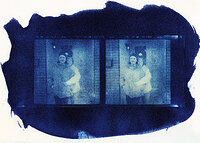
An tSráid Mhór

A
An tSráid Mhór

  • 1
  • 0
  • 36
IMG_1285.jpeg

D
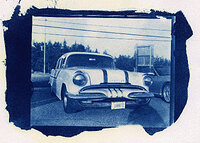
IMG_1285.jpeg

  • 0
  • 0
  • 33

Forum statistics

Threads
203,125
Messages
2,850,214
Members
101,690
Latest member
nisherii
Recent bookmarks
0
If it was a liquid emulsion, you could try to coat it onto paper as it is basically a gum bichromate emulsion. However, I can't think of anything to do with this other than its intended use which is to attach it to a screen.


Steve.
 
I'm open to anything really, I just don't fully understand what it is.

I understand that it's a UV sensitive emulsion but what exactly is it coated onto?? Does it have an incorporated screen for screen-printing? Does it develop in hot water, or some required chemical?
 
Traditionnally it is squeegeed across a carefully cleaned/degreased mesh screen that is laid over custom sized platten to suit the screen frame, or the screen is inverted, and the coating is done from the reverse so that the emulsion pressed thoughthe screen can be recycled back to the storage bottle.

Mask with a high contrast negative, rubylith, or whatever else, and apply a liberal amount of UV for a relatively short time, or more pedestrain amounts for a longer time (sometimes days).

Yes, wash gently with water.

I think some shops would uv expose agian to toughen any edges up.

It can be removed after to reuse the screen, but a lot of shops would just re-mesh the reusable frame.

Frames can be trade specific round aluminum bars that crank to tighten the screen, or wood frames which the screen would be stretched over, and then stapled or clamped into the frame.

I have an automated pneumatic powered screen screen stretcher pressure regulator and auto recycler controller (of mid 70's era I estimate) and four 6" wide clamps and all hoses bought for $20 a few months ago at an auction, open for sale to anyome for the $20 and shippng costs.

Then use the washed and hardened screen as a mask to squeegee ink/paint through.

 
It sounds like I could just treat the photopolymer like a carbon transfer, no?
 
I dont know but you can print your little graphics on to glass milk bottle :smile: Screen printing is best for curved surfaces:smile:
 
Following up on (there was a url link here which no longer exists), maybe I can label all my chemicals! :laugh:
 
It's emulsion that has been coated onto acetate. Once you transfer it after it has been exposed and dried, you peel away the acetate. Then you gently wash away with luke warm water the areas that received no exposure. Just like in carbon printing, areas of the tissue that received exposure are hardened and will not wash away. For screen printing, you work with a positive image rather than a negative image.
So, yes you could treat it like you would a carbon transfer print, except that you image would be the colour of the emulsion.
 
Screen printing emulsion is used as a stencil for silk-screen printing (everything from T-shirts to circuit boards as well as the curved surfaces spoken of above.) The sensitivity of the emulsion is not quite what photographers use, but I have done quite a bit of it using high contrast positives laid on a regular florescent light table for an exposure of 15 minutes or so and gotten good screens. Since screen printing needs dots of ink variously sized and spaced to give the impression of shading, litho film and a half tone screen is necessary. There are liquid versions of this material, meant to be coated right onto the screen - in fact, I have some downstairs in my basement. Perhaps I'll give it a try as a photo emulsion on glass...

Hmmm, he thinks. Another project... : >)
 
in fact, I have some downstairs in my basement. Perhaps I'll give it a try as a photo emulsion on glass...

I have some from work (we screen print flexible circuits, medical sensors and membrane switches). I have been meaning to coat it onto paper to try it out but have not got round to it yet.

It's basically PVA glue with a potassium dichromate sensitiser in it so it should work to some extent.


Steve.
 
Photrio.com contains affiliate links to products. We may receive a commission for purchases made through these links.
To read our full affiliate disclosure statement please click Here.

PHOTRIO PARTNERS EQUALLY FUNDING OUR COMMUNITY:


Ilford ADOX Freestyle Photographic Stearman Press Weldon Color Lab Blue Moon Camera & Machine
Top Bottom