
• Welcome to Photrio!
    Registration is fast and free. Join today to unlock search, see fewer ads, and access all forum features.
    Click here to sign up

Wetting Agent vs Plastics

Recent Classifieds

Forum statistics

Threads
201,727
Messages
2,829,181
Members
100,916
Latest member
mikenickmann99
Recent bookmarks
0

Dr Croubie

Member
Allowing Ads
Joined
Mar 21, 2013
Messages
1,986
Location
rAdelaide
Format
Multi Format
So to start with, I've been developing B+W at home for maybe a bit more than a year, 135/120 in a (new) Paterson tank, and 4x5 in a mod54 in said tank. I'm still on my first bottle of Ilfotol, and always use the same method: after fixing, I wash the film (using the Ilford 10/20/30 method or near enough), then take the lid off, fill the tank with water, add a few drops of Ilfotol, swish it through a bit, then hang up to dry. Then I thoroughly rinse all the tank and reels, and I've never had a problem with any sort of residue.

Recently, I got a Jobo or two, with a 2509n and a few 1500 reels and tanks. I did some B+W 4x5s in the 2509n, after the washing I took the tank off the Jobo, then did the same as above with regards to Ilfotol, again no problems.

Then I did some E6 4x5s with a Tetenal 3-bath kit. Inamongst all the blurb on which I read up, there was this quote on the Jobo website:
"Caution:Stabilizer (or final rinse, or any Photo-Flo type surfactant) should always be used in the following way: Use a dedicated container for the solution. This solution should be stored and used off the processor (at room temperature). Remove the film from the reels before immersing the film in the solution. If reels or tanks are immersed in these solutions, they will eventually cause processing contamination effects. The reels will become difficult to load. Rinsing or cleaning the reels or tanks after processing will not eliminate this problem.".
In short, Stabilizer and/or Wetting Agents will (eventually) bork your gear.

So the first set of E6 4x5s that I did was before I read this, so I just poured the Stab into the Jobo as with any other chemical (probably not the best idea with the sloshing, I might go back and re-stabilise these 4 sheets). Anyway, the next time I found a take-out tray and used that (and marked it so that E6 Stab is all that I'll ever use it for).
Still, no problem with the 2509n reel, even after the first oops.


Finally, I did some 120 rolls in the 1500 tank on the weekend. Did the same as before, after rinse I took the tank off, took the lid off, filled with water and added some Ilfotol. This time, however, when I went to wash them after removing the film, the reels were all goopy, sticky and such, just as Jobo has said they would.

So here's the question, why only now? The Paterson reels have never had a problem, after a lot more Ilfotol than the single 1500 reels had. The 2509n never had a problem either, with Ilfotol nor E6 Stab. Is there just something about the 1500-reels and the Ilfotol that makes them react, that isn't present in the 2509n and Paterson reels? And finally, is there anything I can do about it? Immersing 4x5 E6s in Stab is easy in a tray, rollfilm not so much. I know I can theoretically dry the film without Ilfotol, then reload it onto a sacrificial-reel for Ilfotoling and re-drying, but that's a whole lot of work that I'd rather not do...
 

KenS

Member
Allowing Ads
Joined
Jan 2, 2005
Messages
941
Location
Lethbridge, S. Alberta ,
Format
Multi Format
In my 'early' darkroom years, some 60 years ago, I had the choice of using either plastic reels or 'see-sawing' in a tray. Using trays I never, ever, had the occasional problems with the 'increased edge density' that would appear using reels that had been used 'through' to the surfactant step before hanging for drying. My mentor indicated that the problem was caused by the 'small amount of the emulsion gelatin build-up remaining on the plastic reels that were not really 'eliminated' by a quick rinsing/washing. The cure, he insisted. was to give the reel 'channels' a good soak in the hottest of water with a small amount of chlorine bleach to get did of the 'gelatin'. He would give my reels a gentle scrub with what he claimed was his mother-in-law's 'soft' tooth-brush. After my eventual 'graduation' to Hewes stainless steel reels for both 35 and 120 film I have never had the problem 're-appear'.

Ken
 

AgX

Member
Allowing Ads
Joined
Apr 5, 2007
Messages
29,972
Location
Germany
Format
Multi Format
I'm surprised that Jobo put that on their website. The source for their warning might be a warning by Gigabitfilm on this issue.

I do not see why surfactants of that kind could not be rinsed off even after drying. Especially as any residue would be washed of in the subsequent processing. A hint at good cleaning after each use may have been the better message.

Of course there are reasons for doing the final rinse off the reels, but that would be handling issues, everyone should sort out with his own workflow.

I would like to find hard evidence on a build up of surfactants or on residues of surfactants causing ill effect in spite of rinsing reels and tank.
 
Last edited by a moderator:

Ronald Moravec

Member
Allowing Ads
Joined
Jan 17, 2005
Messages
1,355
Location
Downers Grov
Photo Flo and Stabilizer can not be rinsed off the plastic reel 100%. Over time they get sticky and difficult to load and that is the reason for the caution.

I hand the film after wash and use a hand sprayer for the required time.

If you use stainless, hot water is all you need.

Your goo is some other problem.
 

dkonigs

Subscriber
Joined
Sep 17, 2009
Messages
387
Location
Mountain View, CA
Format
Multi Format
I know this is an old thread, but this is a topic I've actually been thinking about a lot lately. One big problem I have with "final rinsing" film off-reel is actually being confident that the film got a good immersion. It doesn't always roll back up by itself, and often ends up touching itself when I do roll it to immerse.

Another issue is that it takes a lot more liquid volume to properly immerse the film off-processor than it does on-processor. For B&W this isn't much of an issue, since one bottle of Photo-Flo concentrate can make (on demand) an almost limitless supply of the final rinsing solution. For color, however, kits often sell the stabilizer (or whatever its called in your chemistry of choice) in the same volume as all the other chemicals. Since Kodak's guidelines on C-41 rotary processing recommend basically one-shotting the chemistry (including that final rinse), this kinda causes a problem.
 

mshchem

Subscriber
Allowing Ads
Joined
Nov 26, 2007
Messages
15,963
Location
Iowa City, Iowa USA
Format
Medium Format
I do final rinses or photo flo on my Jobo reels. I completely immerse the film on the individual reel for 1 minute, snap a film clip on the end of the film and pull it off the reel, I then toss the reel into a bucket of hot water, and hang the film to dry. Never have had a problem.
Before I got the Jobo I followed same method with Paterson. The plastic Paterson used in the 70's eventually yellowed. I refuse to wrestle with a precious roll of film to try to "see saw" the film to "save" a reel from very dilute surfactant.
 

Ariston

Member
Allowing Ads
Joined
Jan 20, 2019
Messages
1,658
Location
Atlanta
Format
Multi Format
I use a Paterson tank and never rinse the Photo Flo off the tank or reels when I'm done. I trust the Photo Flo to dry the film as cleanly as possible, why would it not do the same for the tank and reels? I'm sure it is my ignorance... what am I missing? I have only been doing this for a year and a half, but have had no issues.
 
  • Deleted member 2924
  • Deleted

MattKing

Moderator
Moderator
Joined
Apr 24, 2005
Messages
55,104
Location
Delta, BC Canada
Format
Medium Format
It's a non problem. Many films (especially Ilford) have surfactant embedded and even some developers have it.
Both stop bath and fixer are likely to do an excellent job of cleaning out the tiny amounts of surfactant that are used there.
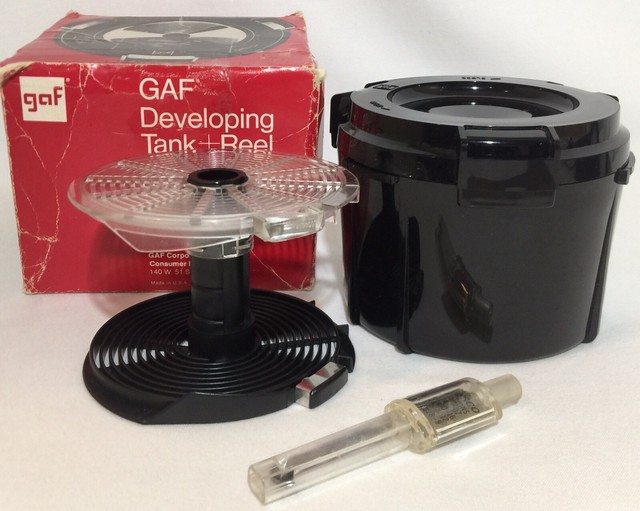
I make a point of keeping surfactant away from plastic reels. That practice began early on - when I was using either Kodak film developing aprons or a tank like these:
s-l640.jpg


Both of those have all sorts of nooks and crannies where surfactant could be trapped and then later gum up film loading.
 

mshchem

Subscriber
Allowing Ads
Joined
Nov 26, 2007
Messages
15,963
Location
Iowa City, Iowa USA
Format
Medium Format
I use a Paterson tank and never rinse the Photo Flo off the tank or reels when I'm done. I trust the Photo Flo to dry the film as cleanly as possible, why would it not do the same for the tank and reels? I'm sure it is my ignorance... what am I missing? I have only been doing this for a year and a half, but have had no issues.
I am not afraid of my reels coming into contact with properly diluted photo flo or rinse aids. I use photo flo very sparingly in demineralized water, it probably won't hurt a thing any more than rinse aides used in dishwashers.
Having said that I've always rinsed my reels and tanks in hot water, and patted them dry with an old t-shirt, the left to air dry. Hard water is miserable, scales up everything. If that's the case a wee bit of Photoflo may be helpful.
Developer, especially color developer have always been, in my experience what has damaged my reels.
If you have a standard practice that's working, stick with it.
Dishwasher detergent will dissolve flesh it's so alkaline. If plastic will survive a dishwasher, I would suspect a little photo flo isn't going to kill it.
 

Arklatexian

Member
Allowing Ads
Joined
Jul 28, 2014
Messages
1,777
Location
Shreveport,
Format
Multi Format
I am not afraid of my reels coming into contact with properly diluted photo flo or rinse aids. I use photo flo very sparingly in demineralized water, it probably won't hurt a thing any more than rinse aides used in dishwashers.
Having said that I've always rinsed my reels and tanks in hot water, and patted them dry with an old t-shirt, the left to air dry. Hard water is miserable, scales up everything. If that's the case a wee bit of Photoflo may be helpful.
Developer, especially color developer have always been, in my experience what has damaged my reels.
If you have a standard practice that's working, stick with it.
Dishwasher detergent will dissolve flesh it's so alkaline. If plastic will survive a dishwasher, I would suspect a little photo flo isn't going to kill it.
I've (until now) never heard of all the reasons "to" use "PhotoFlo" on film while it is still on the reel. The reason that I have heard "not to" is to keep from contaminating developers which come in contact with the photo Flo carried over on the reels and tanks and is almost impossible to completely get rid of by "washing" them. It was the contamination danger that made me treat the film in a very dilute Photoflo in a separate "special" container as the last step before hanging the film up and "after" the film was removed from the reel and tank (either plastic or stainless steel"). However I have never found that the way I treat film is in any way "onerous" If you do, you do it your way and I will continue to treat film as I have for over 50 years.........Regards!
 

mshchem

Subscriber
Allowing Ads
Joined
Nov 26, 2007
Messages
15,963
Location
Iowa City, Iowa USA
Format
Medium Format
I've (until now) never heard of all the reasons "to" use "PhotoFlo" on film while it is still on the reel. The reason that I have heard "not to" is to keep from contaminating developers which come in contact with the photo Flo carried over on the reels and tanks and is almost impossible to completely get rid of by "washing" them. It was the contamination danger that made me treat the film in a very dilute Photoflo in a separate "special" container as the last step before hanging the film up and "after" the film was removed from the reel and tank (either plastic or stainless steel"). However I have never found that the way I treat film is in any way "onerous" If you do, you do it your way and I will continue to treat film as I have for over 50 years.........Regards!
Absolutely agree. I'm over 50 years into this as well. We must be darn good at it by now :smile:.
 

RalphLambrecht

Subscriber
Allowing Ads
Joined
Sep 19, 2003
Messages
14,916
Location
K,Germany
Format
Medium Format
In my 'early' darkroom years, some 60 years ago, I had the choice of using either plastic reels or 'see-sawing' in a tray. Using trays I never, ever, had the occasional problems with the 'increased edge density' that would appear using reels that had been used 'through' to the surfactant step before hanging for drying. My mentor indicated that the problem was caused by the 'small amount of the emulsion gelatin build-up remaining on the plastic reels that were not really 'eliminated' by a quick rinsing/washing. The cure, he insisted. was to give the reel 'channels' a good soak in the hottest of water with a small amount of chlorine bleach to get did of the 'gelatin'. He would give my reels a gentle scrub with what he claimed was his mother-in-law's 'soft' tooth-brush. After my eventual 'graduation' to Hewes stainless steel reels for both 35 and 120 film I have never had the problem 're-appear'.

Ken
the only time reels become difficult to load is when they are not completely dry.As far as I can tell from using plastics and surfactants for 40 years,development tanks are pretty inert to all processing chemicals.
 

dkonigs

Subscriber
Joined
Sep 17, 2009
Messages
387
Location
Mountain View, CA
Format
Multi Format
Okay, now that you're all done boasting about how old you are (seriously, please stop doing that), one of my questions is actually still relevant regardless of whether or not you decide to remove the film from the reels before "final rinsing."

When C-41 processing in a rotary processor (i.e. Jobo), Kodak says you're supposed to one-shot all the C-41 chemicals (including stabilizer/final-rinse). However, it takes less chemistry volume to immerse on-processor than it does off-processor. Jobo says never to run this stuff through the processor itself.
Meanwhile, nearly all the C-41 chemistry kits sell everything in matching quantities. (e.g. 1L developer + 1L bleach/fix + 1L stabilizer).

Keeping all this in mind, the math really doesn't work out. (e.g. it takes ~270ml of developer/bleach/fix to run two rolls on-processor, but 500-600ml to one-shot immerse off-processor in a standing tank) So what's a good way to reconcile this?

Right now my planned approach is to do what I call a "one-shot equivalent". That means I'll re-use the same 1L bottle of stabilizer across multiple rolls of film, until I've one-shot used a full 1L of developer. Does that make any sense?
 

mshchem

Subscriber
Allowing Ads
Joined
Nov 26, 2007
Messages
15,963
Location
Iowa City, Iowa USA
Format
Medium Format
Okay, now that you're all done boasting about how old you are (seriously, please stop doing that), one of my questions is actually still relevant regardless of whether or not you decide to remove the film from the reels before "final rinsing."

When C-41 processing in a rotary processor (i.e. Jobo), Kodak says you're supposed to one-shot all the C-41 chemicals (including stabilizer/final-rinse). However, it takes less chemistry volume to immerse on-processor than it does off-processor. Jobo says never to run this stuff through the processor itself.
Meanwhile, nearly all the C-41 chemistry kits sell everything in matching quantities. (e.g. 1L developer + 1L bleach/fix + 1L stabilizer).

Keeping all this in mind, the math really doesn't work out. (e.g. it takes ~270ml of developer/bleach/fix to run two rolls on-processor, but 500-600ml to one-shot immerse off-processor in a standing tank) So what's a good way to reconcile this?

Right now my planned approach is to do what I call a "one-shot equivalent". That means I'll re-use the same 1L bottle of stabilizer across multiple rolls of film, until I've one-shot used a full 1L of developer. Does that make any sense?
Yes, you are correct that Kodak recommends one shot for "everything" when using a rotary processor. Great advice for developer, even fixer. I reuse the bleach and replenish. Bleach loves oxygen. Stabilizer is used in wash less machines. A minilab uses 3 counter current stabilizer baths, then out through the dryer. With a Jobo or any small tank, no stabilizer,. I wash off the machine, 3 minutes, fill and dump, at 85-100F. Then finally I immerse 1 reel at a time, in final rinse, made with pure water. Gently agitate for 45 seconds hang to dry. I make up 1 liter at a time of the rinse.
 

Ian Grant

Subscriber
Allowing Ads
Joined
Aug 2, 2004
Messages
23,408
Location
West Midland
Format
Multi Format
Photo Flo and Stabilizer can not be rinsed off the plastic reel 100%. Over time they get sticky and difficult to load and that is the reason for the caution.

I hand the film after wash and use a hand sprayer for the required time.

If you use stainless, hot water is all you need.

Your goo is some other problem.

I appreciate someone has revived a 5 year old thread.

You are wrong though, wetting agents won't wash of well in cold water or rather thee 20ºC water that's used for B&W washing but it rinses/washes off easily in warm water. I'm using sprials I've owned for 40-50 years without problems..

Ian
 
Last edited:

AgX

Member
Allowing Ads
Joined
Apr 5, 2007
Messages
29,972
Location
Germany
Format
Multi Format
It was the contamination danger that made me treat the film in a very dilute Photoflo in a separate "special" container as the last step before hanging the film up and "after" the film was removed from the reel and tank (either plastic or stainless steel").


What "contamination"?

I rinse my reels after use, but to avoid build-up of gelatin residues..
Any surfactant that would stay on the reels by not rinsing the reels would be extremely diluted by the next developing bath. In case one assumes that it would not be washed off in that stage, but a molecular layer remainung, there would be no effect by it staying on.
 

MattKing

Moderator
Moderator
Joined
Apr 24, 2005
Messages
55,104
Location
Delta, BC Canada
Format
Medium Format
Surfactant + gelatin + room temperature rinse sometimes = small amounts of "gunk" in the nooks and crannies in and on a developing reel.
Doesn't damage the reel, but doesn't do the film or the loading process any good.
 

Luckless

Member
Joined
Feb 9, 2016
Messages
1,367
Location
Canada
Format
Multi Format
Surfactant + gelatin + room temperature rinse sometimes = small amounts of "gunk" in the nooks and crannies in and on a developing reel.
Doesn't damage the reel, but doesn't do the film or the loading process any good.

I wonder if cold water equipment washups really all that common in darkrooms...

After I'm done and the film is hanging I'll wash everything down with hot water before setting to dry and put away. In all honesty the hot water is as much for encouraging it to dry off faster than anything else. - That it might clean better just seems like a bonus to me.
 

Anon Ymous

Member
Allowing Ads
Joined
Feb 7, 2008
Messages
3,679
Location
Greece
Format
35mm
I wonder if cold water equipment washups really all that common in darkrooms...

After I'm done and the film is hanging I'll wash everything down with hot water before setting to dry and put away. In all honesty the hot water is as much for encouraging it to dry off faster than anything else. - That it might clean better just seems like a bonus to me.
I always wash my equipment with tap water, whatever temperature it is. Actually, I don't really have any other choice. For the record, I don't put any reels/tanks in wetting agent solutions, I use a small bowl for it and remove the film from the reel. My plastic Jobo reels are stained, especially from E6 chemicals, but load as easily as the day I bought them. Perhaps I'm too cautious, but it's a better safe than sorry kind of thing.
 

pwitkop

Member
Allowing Ads
Joined
Aug 8, 2004
Messages
132
Location
Southern Maine
Format
Multi Format
I've heard horror stories of photo flow, etc as long as I've been doing darkroom work. The thing is I've never actually seen any on my equipment or anyone elses. I spent lots of years in school and community darkroom too. My preference has always been stainless but I've used lots of plastic tanks and reels, mostly jobo and a few Patterson. I'll be honest, I'm really lazy and busy so often rinse aid has dried on my equipment. Also having lots of family obligations helps me leave stuff in the sink too.

Perhaps concentrated surficants could leave a residue, but I'm sure it would always be able to be cleaned
 

dkonigs

Subscriber
Joined
Sep 17, 2009
Messages
387
Location
Mountain View, CA
Format
Multi Format
I don't currently have a hot water supply in my darkroom, unless I've explicitly heated that water with the Jobo or a Sous Vide (i.e. CineStill TCS-1000) stick. So immediate washing with steaming hot water (or whatever everyone claims to do) isn't all that practical for me.

I've also seen just as many people swear that wetting agent gunk is a problem as I've seen people swear that it isn't a problem, regardless of how many centuries of photo processing experience they claim to have.

I've also often wondered if different film/reel combinations stick more/less than others. Since no one actually talks about which film they're using in these discussions, that may very well be another major variable not being accounted for. (though its probably a topic for another thread, and one I've tried to have elsewhere in the past)

Finally, there are really 2-3 different chemical cocktails included under the "wetting agent" banner here. There's Photo-Flo/Ilfotol, Stabilizer (or whatever the non-Kodak C-41 kits call "stabilizer" these days), and Kodak's C-41 Final Rinse. Its entirely possible that each of these have different effects on the reels.
 
Photrio.com contains affiliate links to products. We may receive a commission for purchases made through these links.
To read our full affiliate disclosure statement please click Here.

PHOTRIO PARTNERS EQUALLY FUNDING OUR COMMUNITY:


Ilford ADOX Freestyle Photographic Stearman Press Weldon Color Lab Blue Moon Camera & Machine
Top Bottom