

• Welcome to Photrio!
    Registration is fast and free. Join today to unlock search, see fewer ads, and access all forum features.
    Click here to sign up

Wavy light stain on negatives

Procession

A
Procession

  • 0
  • 0
  • 10
Millers Lane

A
Millers Lane

  • 1
  • 2
  • 39

Recent Classifieds

Forum statistics

Threads
202,891
Messages
2,847,145
Members
101,531
Latest member
F2_User
Recent bookmarks
0

JeffreyR

Member
Allowing Ads
Joined
Mar 25, 2013
Messages
10
Location
Bradenton, F
Format
Multi Format
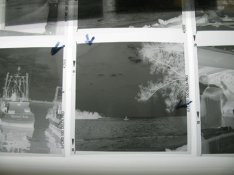
I have noticed a stain on my 120 negatives that I thought was caused by Photo Flo being too concentrated. I do not squeegee. I reduced the concentration to 5 drops Photo Flo to 400 ml distilled water for succeeding rolls, yet I still get stains. The stains appear lighter than the rest of the surrounding negative and have an amorphous edge like liquid.
Film: Ilford Delta100 exposed at 200ASA
Developer: Tank developed in D76 1+1 with 30 second initial agitation, then 5 seconds every minute.
Distilled water stop bath
Fixer: Fresh Ilford rapid fixer diluted 1+4 with distilled water. Three to four minutes.
Ilford wash method with distilled water (5, 10 & 15 inversions) then Sprint HCA diluted 1+9 for three minutes with one minute of constant agitation at the beginning. Continue with final Ilford wash method(10, 15, 20 inversions).
Photo Flo 5 drops in 400ml distilled water, holding film at an angle to let water drain off side edge of film before hanging to dry.

I do not presoak, but I think that is my next step.
 

Attachments

  • Latest Ilford 100 wave.jpg
    Latest Ilford 100 wave.jpg
    26.7 KB · Views: 200
Sounds to me like too little PhotoFlo.

Design strength is 1ml PhotoFlo to 200ml water so you should be using 2ml of PhotoFlo for your 400ml.

I'd suggest wiping the film after the PhotoFlo bath using two clean damp sponges, one pass with the film between them, then hang to dry.
 
Too little PhotoFlo. Follow the instructions exactly. There is a reason that they printed them.
 
Based on the picture that looks more like a development problem than a PhotoFlo problem to me. Especially on the middle frame (#10/11).

But it's easy to mis-dilute PhotoFlo using the drop method. I like to take a gallon of distilled and add 1/200'th gallon of PhotoFlo to it.
 
Last edited by a moderator:
I'm leaning toward that conclusion myself. It looks like the light area did not develop completely. Maybe presoaking will help the developer flow more evenly when it is poured into the tank. Thanks for everyone's advice.

Jeff
 
It could also be from using a water stop with insufficient agitation.

If you use a water stop, agitation should be vigorous and continuous.

How long was your development time?
 
I have found that if you follow Kodak's recommendation for Photo-Flo that it will leave a greasy residue on the film. All that you need to do is break the surface tension of the water. For 400 ml of rinse water 4 to 5 drops of Photo-Flo is enough. Using more has no advantage. Photo-Flo contains an anti-foaming agent that contains sodium tallowate. Think tallow as in grease. You can also substitute a final rinse of distilled water to which a small amount of isopropyl alcohol has been added.
 
Gerald, here is Kodak's MSDS for Photo-Flo (Version 1.8):
Dead Link Removed

Interesting that in Version 2.0, the propylene glycol is no longer listed:
Dead Link Removed

I see no mention of sodium tallowate. Am I missing something?

If you read further the propylene glycol is still there listed in Section 3. The tallowate is an ingredient of Antifoam B. The percentage of Antifoam B may be low enough that it need not be listed. MSDS's are for safety purposes only and need not list everything only potentially dangerous components.

http://www.hillbrothers.com/msds/pdf/antifoam-b-emulsion.pdf
 
Last edited by a moderator:
Sodium tallowate is just a simple soap.

As I understand it, soaps work by liking oils and greases at one end of the molecule and water at the other. It isn't about surface tension but actually getting oils suspended is solution.
 
I follow the time/temperature chart printed from Digital Truth, adjusting for my temperature, which is usually around 75 deg. F. So, nine minutes for D100 at 200. Stop bath is well shaken. I believe that I will begin agitating the tank more vigorously during its five second shake to insure fresh developer is in contact with all surfaces of the film after each agitation. I have a habit of tapping the tank after each agitation, and will continue to do so.
 
Welcome to APUG
 
How much is "a small amount"?

This was discussed on several previous threads. IIRC 1/2 oz to 8 oz of water. The exact amount is not that important. The isopropyl alcohol works to reduce the surface tension of the water.
 
Last edited by a moderator:
How much is "a small amount"?

Is it 200 concentration or 600 concentration? It makes a difference. That information is on the bottle.
 
I never had anything but problems using PhotoFlo. I stopped using it years ago in favor of LFN which never caused me any problems at all. These days I just take the film out of the wash, hang it up, and run a paper towel lightly down the back of the film to take the water off. Works great.
 
I follow the time/temperature chart printed from Digital Truth, adjusting for my temperature, which is usually around 75 deg. F. So, nine minutes for D100 at 200. Stop bath is well shaken. I believe that I will begin agitating the tank more vigorously during its five second shake to insure fresh developer is in contact with all surfaces of the film after each agitation. I have a habit of tapping the tank after each agitation, and will continue to do so.

Why not apply some simple logic to your case:

Take the negative, hold it up with a light source somewhere above you and film and inspect the surface of the film (shiny side) from the edges (at a low angle) while slightly twisting/turning it.

If the irregular density is caused by some kind of residue of photo-flo or mineral deposit from hard water or similar, this will be present on the outside of the film. In which case it should be spotted easily as some kind of whitish residue or build-up on the surface of the film.

If there is a development problem, it will result in areas of irregular density within the film's emulsion layer. In this case the surface of the film should appear evenly smooth and clean.
 
I use an acedic acid stop bath when not using an alkaline fixer. Could the distilled water only stop bath the OP is using contribute to that problem?
 
I never had anything but problems using PhotoFlo. I stopped using it years ago in favor of LFN which never caused me any problems at all. These days I just take the film out of the wash, hang it up, and run a paper towel lightly down the back of the film to take the water off. Works great.

Six of one or a half dozen of the other. One company profits or another. :cool:
 
nothing i could find on the web, including all the advice in this forum, ever made them disappear completely from my negatives. mostly ilford products as well. i think the problems started a few years back... one of the main reasons why i abandoned wet darkroom altogether after three decades of fun

oh well, i'll be watching this thread. best of luck!

:cool:
 
Photrio.com contains affiliate links to products. We may receive a commission for purchases made through these links.
To read our full affiliate disclosure statement please click Here.

PHOTRIO PARTNERS EQUALLY FUNDING OUR COMMUNITY:


Ilford ADOX Freestyle Photographic Stearman Press Weldon Color Lab Blue Moon Camera & Machine
Top Bottom
