• Welcome to Photrio!
    Registration is fast and free. Join today to unlock search, see fewer ads, and access all forum features.
    Click here to sign up

Viewing prints

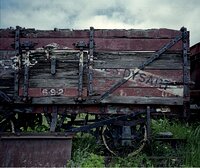
A coal wagon

A
A coal wagon

  • 3
  • 2
  • 32
Morning Birdie

D
Morning Birdie

  • 1
  • 2
  • 36

Forum statistics

Threads
203,142
Messages
2,850,479
Members
101,693
Latest member
Liftahorse
Recent bookmarks
0

cliveh

Subscriber
Allowing Ads
Joined
Oct 9, 2010
Messages
7,908
Format
35mm RF
When you produce a print in the darkroom and bring it out in to the light, do you view it upside down as well at right way up? I find it a useful way of judging if the forms and tones within the composition work. Try turning any HCB print upside down and you will see what I mean.
 
I don't think I'll ever be judging a wet HCB print for either tone or composition. Does standing on my head and holding it with my toes to let the fixer drain from my belly button count?
 
I turn it upside down and reverse it. That is how I saw it when I took the picture.
 
When you produce a print in the darkroom and bring it out in to the light, do you view it upside down as well at right way up? I find it a useful way of judging if the forms and tones within the composition work. Try turning any HCB print upside down and you will see what I mean.

No I don't look at the photographs I make in my darkroom upside down. But looking at a lens image upside down is the most familiar thing because I use a view camera. As cliveh suggests looking at an image upside down is a strong way of wrenching the eye away from the content of the image, the infatuation with subject matter, to better judge the formal qualities of the picture.

The H.C-B example cliveh proposes actually underlines the difficulty faced by all users of viewfinder cameras. They never get to see the lens image upside down or otherwise. All they have is a peephole approximately delimiting a segment of the visible world. So the only opportunity for upside down formal picture evaluation may well be in the darkroom. I think I have researched nearly everything available on H.C-B but I can't find any suggestion he looked at his contact sheets upside down. Certainly his mark-ups of those sheets are right-way-up.
 
I find it does nothing for my perception of how the print values are working in relation to each other.
 
I will sometimes place it in a tray and take it out into the natural light or/and look at it under the lights in the gallery, which just happens to be right out from the darkroom. I don't usually worry about dry down effect.
 
When you produce a print in the darkroom and bring it out in to the light, do you view it upside down as well at right way up? I find it a useful way of judging if the forms and tones within the composition work.

Its orientation makes no difference to me. What does make a difference is the intensity of the light. Don't take straight out of the darkroom; take it gradually out of the darkroom increasing the light in small increments.

After I think I may have gotten what I want I walk from a brightly lit room into a dark one with the print watching how the tones change as the light diminishes. A really glowing print will look more contrasty as its surroundings get darker, not less. Sometimes the highlights in my print will literally dance before my eyes as I walk from a lit room into the dark one.
 
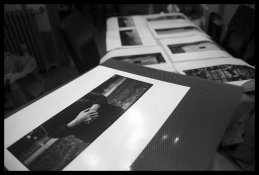
ANI_8394.jpgI splat mine all wet on the table and tear a few the next morning, when I realize the dry-down ravages.

Just back from a printing session, 21 16x20 fb prints laying everywhere in the house. Here are 9. Three are going in the Garbage can. That's one tough neg.
 
If you turn it upside down, the water will run on rather than off and it will never dry. :tongue:

- Leigh
 
I watch Hitchcock movies backwards and listen to Ozzy backwards too. Looking at HCB prints upside down is as good as the other two... Pretty pointless IMO :smile:
 
I only look at the picture right side up. For my own purposes either it works or it doesn't, and its orientation doesn't matter much to me. Tell me, those who do look at it upside down, what does it do for the final print, once you turn the print back around again?

When I evaluate a print I always look at it in exactly the same location, under exactly the same light, in the same tray of water, so that there are no undue lighting effects compromising how I view the tonality of the print. Since I always print on the same paper, I know what dry-down does compared to the wet print, so it's a good way for me to consistently judge the prints.
In all, I look at how the print values support the content, the gesture, the frame, and the mood. It's such a fascinating process.

Great thread.

 
I usually spot my prints upside down... that works to stop you looking at the picture and concentrate on the job at hand.
 
I usually spot my prints upside down... that works to stop you looking at the picture and concentrate on the job at hand.

That's the only time I do too and was going to write it before I read your post. I find more spots and do a better job when I find myself only concentrating on spotting and not the composition of the photograph. But turn it around and up close to analyze the results rather than keeping it upside down.
 
I'll agree with the OP - at least to the extent that I find that looking at a print from every angle helps me notice extraneous elements that I might prefer to deal with in a reprint.

Things like bright areas that would be best if printed down, and large areas of shadow that unless they are intentional could tend to distract.
 
Photrio.com contains affiliate links to products. We may receive a commission for purchases made through these links.
To read our full affiliate disclosure statement please click Here.

PHOTRIO PARTNERS EQUALLY FUNDING OUR COMMUNITY:


Ilford ADOX Freestyle Photographic Stearman Press Weldon Color Lab Blue Moon Camera & Machine
Top Bottom