• Welcome to Photrio!
    Registration is fast and free. Join today to unlock search, see fewer ads, and access all forum features.
    Click here to sign up

Very excited....just finished processing my first roll of B/W film!!!!

Valencia

A
Valencia

  • 0
  • 0
  • 45
Tied to the dock

D
Tied to the dock

  • 4
  • 0
  • 89

Recent Classifieds

Forum statistics

Threads
203,092
Messages
2,849,722
Members
101,659
Latest member
Dirksen
Recent bookmarks
1

cepwin

Member
Allowing Ads
Joined
May 26, 2012
Messages
336
Format
35mm
And there do indeed appear to be images on it!! :smile: The hardest bit was getting the film out of the cassette .... the tool I got to do it wasn't as easy to use as I thought and of course..after it popped open I fumbled around in the compete dark getting the film started on the reel. I tried to follow the instructions on the chemistry labels to a "t". A few things....I used a tank that had been given to me and it's older and you agitate by spinning the included thermometer. I might get a new one as I'm not sure it's as light-tight as one would like (chemistry came out the sides when I emptied it...not just the hole) but it did work. I also seed to get a squeegee when I'm done. I'm just so thrilled I didn't end up with a ruined roll :smile:
 
Welcome to the club.

I'm still amazed when the film and prints show up with images.
 
Congratulations! I just got done with my third roll. I've got a Patterson tank that was given to me. It's got the agitator stick as well. I decided not to use it and do inversions. It leaks liquid also, not a lot! but enough that I wear a rubber glove. I'll probably purchase a different one later. Instead of a squeegee I've been wetting my fingers with the Photo-Flo during the last step and lightly pinch the negatives between my index and second finger and draw down a couple times. So far it's worked for me. Good luck with your next batch. :smile:
 
Congratulations! It's been almost four decades since I processed my first roll of film, but I still get nervous until I see the first image on the reel.

Don't squeegee the film! Just get some Photo-Flo 200. You put a few drops in the tank when it's finished washing, swish it around a bit until it suds up, then take out the reel, remove the film, and hang it up to dry in a dust-free spot.

You'll probably get a better developing tank pretty soon, but for now, whatever works is fine.
 
Congrats guys and welcome to the dark side! Toss the agitator stick and if you squeegee, do it only once.

Oh, and show us some pics!
 
I love reading these accounts. Nice job - both of you.

The hardest part of any new task is taking that first step. Before that, everything is a bit of a hypothetical haze. It's supposed to work, right? But once that step is taken, you then have a concrete direction, a speed, and a destination. Now you know it works. And things only become more clear with each continuing step.

Regardless of your age or experience, you guys are the future of this original form of photography.

Ken

P.S. Agree with Valerie. Please show some results here, when you can. Doesn't need to be great art. Heck, none of mine are...

:smile:
 
Welcome to a whole new world. You'll never want to leave :smile:
 
Thanks all! And congrats to Kenton on his three successful rolls! I'll scan in some images tomorrow (letting film dry well) but I should add (and if you've seen my thread under 35mm about my first roll that I got back from processing you know) my scanner is a cheap consumer model so the scans may not be that good. (looking at getting an Espon.) You know there is a certain magic in pulling the film out of the tank that just can't be duplicated by putting the card in the card reader :smile: Tnx again!
 
Congratulations cepwin! I know what you mean about the difference between pulling a roll of film out of the tank and reading files from an sd card. Fifty rolls of film later, I'm still rapt when I hang a roll in the bathroom and see lovely little images just waiting to be printed.
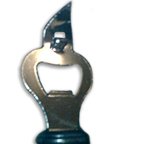
I don't know what you're using to open your cannisters, but I use one of these: BottleOpener.jpgI think it was all of $2 from the kitchen aisle at the supermarket. I also line up everything in front of me the same way in the darkroom every time: Tank, reels, bottle opener, scissors, film cannisters - so, even if I fumble a bit, I know where each of those things are in relation to each other.
With regard to squeegees, I do the same as others and just dip my fingers in the photoflo and run the film between two fingers. The only time I got drying marks I think was because I didn't put enough photoflo in the water.
Don't stress too much about having a low end scanner. Mine was $40 on eBay and it's nearly ten years old. It does the job in terms of digitising negatives for archival purposes and an idea of what I've shot/intend to print. Given that my scanner is so lame, I generally scan AFTER I've printed a proof sheet because the scanner introduces all sorts of variables in terms of contrast etc. and I NEED to know what will print at Grade 2 and what will need more/less exposure or a harder grade.
 
Yep, even though I "know" that I've done exposure and processing properly, it still is a relief when I can see the images, and know that evil spirits haven't snatched away my pictures!

A couple of hints: If you're loading the tank in the dark, that is without a changing bag! put all the required gubbins in a confined space, such as a 11x14 processing tray or a plastic dish pan. This keeps everything together. Trying to find something like the tank lid in the dark is no fun. Even a small counter seems huge in the dark. And if the lid falls on the floor....

This same tray or dishpan helps confine spills or leaks from tanks. Speeds cleanup.

BTW, St Ansel, He of the Adams clan, recommends wood spring closepins over the fancy metal (and much, much more expensive) metal negative clips for drying. He notes that the wood grips the wet, slippery negatives very well, and that the wood is less likely to scratch the film. This from the Sacred Text of St Ansel, The Negative. Seriously, I've used the pins for years 'cause I'm basically cheap, er, ah, economical. Always nice to be justified.

More seriously, I'd suggest mixing the developer, at least, with distilled or deionized water. Tap water, while potable and safe, may contain particulate matter you don't want on your film. Certainly dilute your Photo-Flo with distilled water. I once had a printing session wrecked by the tap water, it turned out that the water department was flushing the pipes with a dilute acid. Just like stop bath, and it deactivated my Dektol. It cost me a little printing paper, but had I diluted D-76 1 to 1...I'd have lost negatives.

Now a question for the group. My Paterson tank in addition to a little leaking, doesn't like to have the lid screwed on. This is not happy in the dark! My stainless steel tank leak a bit, and the top and the little cap can be hard to get off. I wonder if silicone grease smeared very sparingly on the threads might help. This is the stuff used in swimming pool filter threads, it is stable to temperatures far past pool or photo use. I suspect the only risk would be in getting it on the film.
 
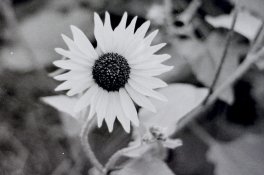
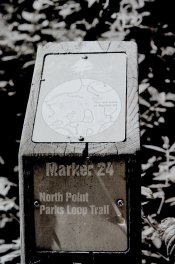
Thanks for the input! Yeah, Molli, I ended up spending $18 on a special tool and I should have bought a simple bottle opener as you did...I think it would have been simpler. As for the scanner, my purposes for scanning are to post my images on the web rather than archival purposes and after the chorus of "horrible scans" I got when I posted my first roll (that I had processed because it's color) I realized I probably made a mistake with choosing to go with a cheaper scanner rather than spend what is necessary and get something like an epson V600 (which is what I'm looking at.) I did use the aforementioned cheap scanner to scan in my images from the roll..here are a few samples which I did some adjustments in, in lightroom (as requested :smile:) Note that there were some water spotting issues so I'm going to order the photo-flo.
marcor-fd-1.jpgflower-fd-1.jpgtrailmkr-fd-1.jpg
 
A couple of hints: If you're loading the tank in the dark, that is without a changing bag! put all the required gubbins in a confined space, such as a 11x14 processing tray or a plastic dish pan. This keeps everything together. Trying to find something like the tank lid in the dark is no fun. Even a small counter seems huge in the dark. And if the lid falls on the floor....
Same applies if you are using a changing bag like I do. If it is not in the bag, you cannot use it - like the lid to the tank.
 
35mm? The tool I use to open the canister is a simple bottle opener. In the dark, of course.

In the old days, before they affixed the end caps on securely, we just took the cartridge in our hand, with the longer end of the spool facing down, and pressed hard on the countertop. The top end cap would pop off and the film was free, and you could reassemble the cartridge to use with bulk film. I miss the old Ilford cartridges where you could do this, actually, although you don't want to drop them on a hard surface in the light. :wink:
 
Hey! Those are pretty good for a first effort. Better than mine were, as I recall from long ago. Congratulations again. And thanks for posting.

Regarding scan quality - no worries. Believe me, everyone here is VERY good at making the mental adjustments required. We all know a scan is not a real print or a real negative or a real transparency. It's a virtual reproduction. And reproductions are never perfect. Most of us, especially those who don't bother calibrating our colorspaces and monitors because that's not why we're here or what we're after, can make the jump.

Ken
 
Thank you so much Ken! Yeah Jim...that was my mistake, buying a fancy tool :smile:
 
You can thank the invention of high speed auto-winders for 'crimped' cassette bodies ( they stressed cassette bodies so much that on rare occasions they 'pinged' ) before that a tap on the darkroom bench was sufficient......but we do sell a purpose designed very nice cassette opener....most bottle openers should work as well.

Congrats on your processing efforts....

Simon ILFORD photo / HARMAN technology Limited
 
You can thank the invention of high speed auto-winders for 'crimped' cassette bodies ( they stressed cassette bodies so much that on rare occasions they 'pinged' ) before that a tap on the darkroom bench was sufficient......but we do sell a purpose designed very nice cassette opener....most bottle openers should work as well.

Congrats on your processing efforts....

Simon ILFORD photo / HARMAN technology Limited

So that's the reason. As a cynic I'd long assumed it was merely an effort to discourage bulk film loading.
 
I had an Ilford end cap pop off when I opened a roll of film, too. I handled it a bit too roughly I suppose. (No compensation needed, Simon; this was in the early 1980s!)

I doubt Ilford would care if you used their cartridges for bulk film, especially if you bought their film to bulk load. You're saving them some manufacturing expense, after all, which is why you're paying less.
 
Photrio.com contains affiliate links to products. We may receive a commission for purchases made through these links.
To read our full affiliate disclosure statement please click Here.

PHOTRIO PARTNERS EQUALLY FUNDING OUR COMMUNITY:


Ilford ADOX Freestyle Photographic Stearman Press Weldon Color Lab Blue Moon Camera & Machine
Top Bottom