
• Welcome to Photrio!
    Registration is fast and free. Join today to unlock search, see fewer ads, and access all forum features.
    Click here to sign up

Very dark negative : wrong exposure or development?

MIT. 25:35

MIT. 25:35

  • 0
  • 0
  • 27
Lutheran Cemetery Angel

H
Lutheran Cemetery Angel

  • 0
  • 0
  • 33

Recent Classifieds

Forum statistics

Threads
202,948
Messages
2,848,014
Members
101,552
Latest member
rbaltman409
Recent bookmarks
0

zehner21

Member
Allowing Ads
Joined
May 28, 2014
Messages
143
Location
Sardinia, IT
Format
Multi Format
Hi!
Today I tried to take a photo of a little piece of silicon (square, side of 1.5 cm).
The piece was lying upon a white sheet of paper.
Using a tripod, ambient light and a TMAX 400@200 I metered the scene and found 1 second at f/22.
Then, I developed the film as usual using Rodinal at 1+50.
The water was hotter than 20°C/68°F, in fact was 24°C/75.2°F.
I used a generic time-temp chart and discovered that instead of 10 minutes, I had to develop for 3:30 minutes.

But, to my surprise I obtained bullet-proof negatives (picture below).

What do you think of it? It's so dense that I can't do a proper photo with my phone.

http://img264.imagevenue.com/loc355/th_020466185_foto_122_355lo.JPG
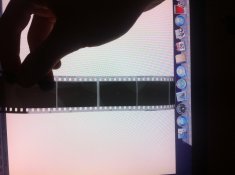
 

Attachments

  • foto.jpg
    foto.jpg
    543.2 KB · Views: 261
Exposure... but they look very printable.
 
I don't know what % of the scene was white v little piece of silicon, but it looks to me that the white background was dominant, hence gross over exposure.
 
I'm voting for over-exposure because the edge markings of the film look faint to normal. With that short a time, it might be unevenly developed, too.
If you have a loupe or an enlarger, can you see detail in the frames? I can see a little, but I don't know what the whole frame should look like.
 
Thank you for you answers.

1) I metered using a spot meter, so I think I'll have to learn how to master it
2) I can't try to test print, for now (run out of developer); I have tried to scan the frames and didn't have much trouble although I'm quite unsatisfied.

Are you guys interested in seeing an untouched scanned frame?
 
Usually meter readings of white subjects with white backgrounds result in under-exposure. The meter tries to make everything average out to mid-gray.

It is hard to tell from the image, but those negatives don't look all that dense to me. I'd be willing to bet that if you print those negatives, you will end up with a white subject on a white background - sort of what you want.

By the way, if you are going to meter a 400 ISO film at an EI of 200, you may find that the results will be unpredictable when the subject varies significantly from an "average" one.
 
Wait, I haven't metered a white subject.
It's light grey and acts as a mirror (reflects light).
Is it possible that some sort of reflection has fooled my meter?
 
Wait, I haven't metered a white subject.
It's light grey and acts as a mirror (reflects light).
Is it possible that some sort of reflection has fooled my meter?

No - but from personal experience I know that reflections may fool the operator:wink:.

Manual meters are never fooled. But the photographer who interprets the result may very well be.

In what zone did you place the result?

Are you sure that your reading wasn't affected by flare from the white background?
 
Did you meter off the dark spot in the middle? If so, should it have been black or nearly so? If so, then you should have underexposed to bring that dark spot down to proper exposure on film.
 
Usually meter readings of white subjects with white backgrounds result in under-exposure. The meter tries to make everything average out to mid-gray.

It is hard to tell from the image, but those negatives don't look all that dense to me. I'd be willing to bet that if you print those negatives, you will end up with a white subject on a white background - sort of what you want.

By the way, if you are going to meter a 400 ISO film at an EI of 200, you may find that the results will be unpredictable when the subject varies significantly from an "average" one.

Matt, you are correct and I'm thinking in reverse, well spotted.
 
Matt, you are correct and I'm thinking in reverse, well spotted.

I assumed that you assume he used an ambient meter and overexposed one stop (e.i. 200 vs. 400).
 
Overexposed, but try printing them and see. If it is severely over-exposed (so as to be un-printable) the highlights fall up on the shoulder. In trhis case, when you print the shadows as near paper black and the highlights as near paper white, the middle tones will be too light. If you print the shadows as near black and the middle tones correctly, then there will be no whites, only gray. This is very analogous to underexposed negatives, where the shadows print gray (instead of black). However in the case of severe over-exposure, the highlights print gray (instead of white).
 
So:

1) How did evaluate the scene? I thought that it was a high-contrast scene (white piece of paper and relatively dark grey piece of silicon)

2) Why did I shoot 400@200? See #1.

3) How did I meter? Using the T90's spot meter. I pointed at the piece of silicon and see what did the meter say; I also thought that being grey I should place it in Zone V. BUT. I think that I clearly did something wrong, because the piece of paper is rendered as grey and not white/near white


Matt, can you explain what do you mean with "By the way, if you are going to meter a 400 ISO film at an EI of 200, you may find that the results will be unpredictable when the subject varies significantly from an "average" one." ?


Thanks!


P.S. I will be able to print only in the weekend :/
 
I was taught that if there is details in the shadows, the exposure is correct and the development is off. Otherwise it's the exposure.
 
Presumably you have other negs on the film that were also shot at similar settings? Is it possible to show us frames that contain more than a piece of silicon? I bow to my fellow APUGers who seem to have better eyes or VDU screens than I but I can tell very little from the frames shown.

pentaxuser
 
I can see a difference in density that looks like the paper, and a further difference in the centre that I assume is the silicon. If the paper was white, you would expect it to be quite dense. What colour was the surface beneath the paper? From what I can see, I am assuming that the paper did not completely fill the frame. You won't know until you print the negatives whether or not they will produce acceptable results. The fact that there is at least three distinct areas of density seen on the negative suggests that you will achieve something when you print.
Alex
 
...
So:

1) How did evaluate the scene? I thought that it was a high-contrast scene (white piece of paper and relatively dark grey piece of silicon)

>>> So you overexposed one stop to compensate what reading? If you spot-read an area that should be Zone VI then +1 EV exposure is correct.

2) Why did I shoot 400@200? See #1.

>>> See remark #1.

3) How did I meter? Using the T90's spot meter. I pointed at the piece of silicon and see what did the meter say; I also thought that being grey I should place it in Zone V. BUT. I think that I clearly did something wrong, because the piece of paper is rendered as grey and not white/near white

How dark is the silicon chip... Zone 0, I, II, III, or IV? If metering an area of a subject that's darker than Zone V then you should "underexpose". For Zone III that means two EV less exposure, not more. If the chip is indeed Zone V then you could have just exposed at whatever is the film's normal speed for your proceesing habits.:smile:


Matt, can you explain what do you mean with "By the way, if you are going to meter a 400 ISO film at an EI of 200, you may find that the results will be unpredictable when the subject varies significantly from an "average" one." ?


Thanks!


P.S. I will be able to print only in the weekend :/

I inserted >>> remarks within the quote above. The bottom line is you overexposed 1 EV unnecessarily. That stated, they still look quite printable regardless of overexposure. You definitely did not overdevelop the film.
 
Last edited by a moderator:
So:

1) How did evaluate the scene? I thought that it was a high-contrast scene (white piece of paper and relatively dark grey piece of silicon)

2) Why did I shoot 400@200? See #1.

The 1-stop overexposure from shooting ISO 400 at EI 200 only makes sense to me if you intended to pull development to reduce the contrast. However according to your initial post you developed normally, so now the neg is one stop overexposed.

This was probably exacerbated by metering the "dark grey" piece of silicon. The meter will put that in Zone V but dark grey may well be Zone IV (or even III), resulting in another stop (or two) overexposure.

Fortunately 2-3 stops overexposed should print fine although with perhaps reduced contrast on the detail of the white background.
 
Last edited by a moderator:
Matt, can you explain what do you mean with "By the way, if you are going to meter a 400 ISO film at an EI of 200, you may find that the results will be unpredictable when the subject varies significantly from an "average" one." ?


Thanks!


P.S. I will be able to print only in the weekend :/

I think you may be intermixing EI adjustment and Zone System considerations.

Generally, people choose an EI that is different from the ISO ("box") speed of the film because the particulars of their equipment, process, metering technique and preferences leads them to prefer metering average scenes at that EI.

Whereas people choose underexposure and over-development (expansion) or overexposure and under-development (contraction) in order to match the Subject Brightness Range ("SBR") to the paper one is printing on.

Note that I referred to SBR rather than contrast. I try to avoid using the term contrast in this situation, because the term contrast is better used to refer to the slope of the film's curve, rather than the range between the negative's rendering of the brightest and darkest parts of the scene.

Your lighting on the original scene may actually have been low in contrast. Normally, you would make exposure and development decisions based on the nature and quality of that light, rather than the apparent range of brightness in the scene - deep dark blacks and highly specular highlights excluded.
 
Last edited by a moderator:
Matt... there's no such reference to contrast range nor the Zone System nor the OP's "normal" E.I. All we really have is a decent image of the film in question and that dark spot in the middle is "probably" overexposed even for Zone V let alone if it really should be Zone IV or III.
 
First: thank you guys for you replies.

Matt... there's no such reference to contrast range nor the Zone System nor the OP's "normal" E.I. All we really have is a decent image of the film in question and that dark spot in the middle is "probably" overexposed even for Zone V let alone if it really should be Zone IV or III.


Looking at the silicon piece, it seems a little bit darker than average grey.

So, I'm realizing that I may have overexposed about 1 stop. (Zone V instead of IV) :tongue:
 
Matt... there's no such reference to contrast range nor the Zone System nor the OP's "normal" E.I. All we really have is a decent image of the film in question and that dark spot in the middle is "probably" overexposed even for Zone V let alone if it really should be Zone IV or III.

I know that we don't have all of the details, but the OP did tell us that he metered at an EI of 200 because of the "contrast" between the background and the subject.
 
First: thank you guys for you replies.


Looking at the silicon piece, it seems a little bit darker than average grey.

So, I'm realizing that I may have overexposed about 1 stop. (Zone V instead of IV) :tongue:

And in what Zone did the background fall?
 
Photrio.com contains affiliate links to products. We may receive a commission for purchases made through these links.
To read our full affiliate disclosure statement please click Here.

PHOTRIO PARTNERS EQUALLY FUNDING OUR COMMUNITY:


Ilford ADOX Freestyle Photographic Stearman Press Weldon Color Lab Blue Moon Camera & Machine
Top Bottom
