• Welcome to Photrio!
    Registration is fast and free. Join today to unlock search, see fewer ads, and access all forum features.
    Click here to sign up

Versatile film developer combination needed.

Recent Classifieds

Forum statistics

Threads
202,980
Messages
2,848,369
Members
101,575
Latest member
JDuB
Recent bookmarks
0

John cox

Member
Allowing Ads
Joined
Mar 11, 2012
Messages
52
Location
Ontario Cana
Format
Multi Format
I'm looking for suggestions on a good film and developer combination for something that can pull to 200, push to 800, and be shot at 400. I'm currently using TMY at box speed in TMAX Developer and there are days I can't take pictures due to an over abundance of light.
The maximum speed of the camera I'd like to use this in is 1/200 with a smallest aperture of f 22 (on a bright day I have to do everything just to hit the sunny sixteen rule and I can't shoot into sun or water.)
I was thinking Hp5 or TRI X in HC-110 or something similar.
Thanks in advance,
John
 
I would recommend 400TX and HC-110 as the better choice. It is finer grained than HP5 and to me has better latitude. You might als consider using a neutral density or other filter on bright days.
 
Tri-X and HC-110. Plus if you adjust the dilution you can get good results.

@ASA-400 - Dilution B
@ASA-320 - Dilution E
@ASA-200 - Dilution E
@ASA-800 - Dilution A
 
"Push" and "Pull" are really misnomers in the land of black and white photography. When you shoot something like TMY400 at 800 speed, you
can indeed increase the development to get equivalent printing density in the midtones and highlights, but you are otherwise deceiving yourself,
because what you're really doing is just lopping off a big chunk of your shadow values (by a full zone) in a manner which is irretrievable. This might not matter in low-contrast lighting, but it certainly will in high contrast. What you need to learn is how to develop the contrast level of the film to match the luminance range of the scene itself. TMY is amenable to a very wide range of situations, but rarely does one handle this
by an ASA change. The "toe" to TMY is very steep and therefore unforgiving of underexposure. But if you don't mind a loss of detail in the deep shadows, that is an aesthetic decision to do so.
 
Tri-X and D76. I often shoot it at 100 w/ no adjustment to developing times.
 
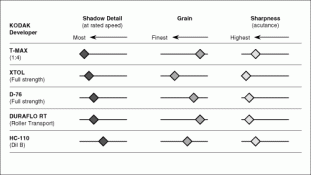
Why do you want to change developers. TMax developer gives the best speed. The difference over the others is small, however. (1/3 stop or thereabouts).
f002_0072hc.gif
 
I don't understand why you have t shot Tmax at 200 and pulled it, if that's what you want to do, you already have a good film and developer combo.

I disagree with the poster who said Tri-X had more latitude than HP5+ ... I would like to see anyone shoot Tri-X at 3200 and come out with as good results as I have with HP5+ shot at 3200 and souped in DD-X I also disagree that the grain is any better in 400TX than in HP5+ as they are about equal in that regard.

But you really shouldn't need to change anything, the film and developer combo is just fine for what you're talking about.

If you switch to any other film, and want 400 speed, you're really limited to 4 it 5 films.... 400Tmax, 400TX, HP5+, and Delta400.and Foma400 (ultra grainy when compared to the others, but still good and has a very classic film grain look which can be pleasing to some).

Of those Delta400 and TMY are similar in latitude and grain (similar not identical)

And 400TX and HP5+ are similar with greater total latitude than the T-Grain emulsions, and slightly grainier.

Using both Tmax and / or DD-X with any of those films will give you the versatility you probably need.

But again, have you tried pulling the film / dev combo you already have?
 
Why do you want to change developers. TMax developer gives the best speed. The difference over the others is small, however. (1/3 stop or thereabouts).
View attachment 85789

Where did you get this chart?

According to this, Tmax is the developer to give you the grainiest images... That can't be right...
 
That chart comes straight from Kodak - it is artfully hidden on their website.
 
My suggestion is to continue to shoot with the same film and developer and use neutral density filters. Change as little as possible.

TMax developer does give more grain than D76 and Xtol for sure, Stone. But that's not a bad thing. It's beautiful grain!
 
My suggestion is to continue to shoot with the same film and developer and use neutral density filters. Change as little as possible.

TMax developer does give more grain than D76 and Xtol for sure, Stone. But that's not a bad thing. It's beautiful grain!

Interesting, I was under the impression it was similar to DD-X which seems to give less grain than HC-110 (seems to my untrained eye).
 
@Stone grain on prints can be subjective some people don't see it at all...

@OP try 100 ISO film Kodak still do one Ilford still do two, Forma one,... etc. you might like the different signatures.

pull and push are just nonsense rewinding and reloading work

Tmax100 and Delta100 are different from Forma100 but Id try one of each.
 
Well, for post #13, Harman do at least four films around ISO100 - FP4+, Delta100, PAN100 and Kentmere 100. Plus possibly other materials made under contract for other brands.

The original question could be solved by using the same materials as are already being used. Could the OP explain why the results of extended and reduced development of TMY in TMax developer is inadequate? That might give more information to suggest alternatives.
 
Where did you get this chart?

According to this, Tmax is the developer to give you the grainiest images... That can't be right...

Kodak made it, poke around their site, it's there.
 
TMY has a lot of overexposure latitude so personally I'd just set the camera to 1/200 and set the aperture where you prefer and just shoot and develop normally.

Printing these negatives will take a bit learning.

This is very much how people who use Holgas and disposables and actually works quite well.
 
john/op

if you want to try something that is unconventional
as developers go
but will give you the ability to push and pull your film to your heart's content
do a split development with ansco 130 and caffenol c with 15cc of ansco 130 / 1L of caffenol.
use the ansco 130 as your first developer
dilute 1:7-8 process in small tanks or in a tray or whatever ..
agitate as you would any developer
( tanks 1 full min, 10 sec /min after that)
when you get to the 4 minute mark
pour out the ansco 130, and pour in the caffenol 130
and agitate it constantly again for 4 minutes.
it will work with prety much any film,
qnd i have used this technique for ilford + kodak's finest ...
expired as well as fresh

i used to stand develop for a similar effect and use, the caffenol c with
130 mixed in the same amount 15cc/1 L stand for 30 mins worked out fine ..
sometimes a bit uneven development and bromide streaking mainly in sheetfilms,
roll film looked line a dream, printed and scanned like a dream too.
and i've exposed tmy @ about iso 25 or lower and as high as 1600/3200 and gotten good results ..

i use sumatran robusta coffee beans roasted by me but have done this
development for nearly 8? years wih cheap rot gut too ...
check out caffenol-cookbook.com for more information
like an approximation of my recipe for caffenol c ( i dont measure )

like with everything YMMV

good luck
john
 
The differences between developers are not that huge in terms of grain. The greatest variation between them I have always thought was in the basic tonality they yield.

Just in support of your comments, Michael.

It can be right. It is a speed-enhancing PQ developer. All things being equal one would expect a little more graininess.

Note the following before reading too much into it:

1) There is no "scale" on that diagram so people may tend to exaggerate the indicated differences. It is just a guideline.

2) From the perspective of graininess, dilution can make a difference, so keep in mind D-76 and XTOL are at stock strength on the diagram.

3) Read about how these measurements are made and evaluated. Remember that given a specific film, developer and contrast index, exposure affects granularity also.

The diagram is under "choosing a film developer" on this page:

http://www.kodak.com/global/en/professional/products/chemistry/filmBWmain.jhtml?pq-path=14024
 
Use a filter. A yellow filter is good for a stop, an orange filter two stops. If you do not desire the effects those filters provide, get a ND filter. In medium format, tmy2 is a normal priced high quality film. (and a high quality film at varying price in the other formats)
 
Photrio.com contains affiliate links to products. We may receive a commission for purchases made through these links.
To read our full affiliate disclosure statement please click Here.

PHOTRIO PARTNERS EQUALLY FUNDING OUR COMMUNITY:


Ilford ADOX Freestyle Photographic Stearman Press Weldon Color Lab Blue Moon Camera & Machine
Top Bottom