
• Welcome to Photrio!
    Registration is fast and free. Join today to unlock search, see fewer ads, and access all forum features.
    Click here to sign up

Verichrome Pan Spectral Sensitivity Graph

Recent Classifieds

Forum statistics

Threads
202,825
Messages
2,846,026
Members
101,548
Latest member
Underexposed
Recent bookmarks
0

Andrew O'Neill

Moderator
Moderator
Joined
Jan 16, 2004
Messages
13,218
Location
Coquitlam,BC Canada
Format
Multi Format
Happy Sunday (or monday, depending where you are on the planet!)... Does anyone out there have this film's spectral sensitivity graph? I have it's characteristic curves, but seeing spectral graphs would be great. A very generous photographer down in Dallas, Texas, gifted me several 120 rolls. This is a film that I never tried when it was around. I know my Grand Father used Verichrome in his old Brownie Six-20, back in the 30's and 40's (he forgot an exposed roll in it which sat since about the mid to late '30's, which I processed a few years ago!) The "newer" stuff that this generous Texan gifted me has expiry dates in the mid 90's. I would love to see spectral curves. Thank you!
 
It is very similar to Plus X Pan in 120-size. The biggest difference is the support does have as good anti-halation protection.
 
It is very similar to Plus X Pan in 120-size. The biggest difference is the support does have as good anti-halation protection.

Are saying its anti-halation layer is inferior to plus-x's? I did hear that Verichrome Pan was geared more toward the general public, so that would make sense. It would keep the costs down... Similar with Kentmere films.
 
Are saying its anti-halation layer is inferior to plus-x's? I did hear that Verichrome Pan was geared more toward the general public, so that would make sense. It would keep the costs down... Similar with Kentmere films.

Yes that's the truth, well at least the one I have heard.

In the last years VP120 was manufactured (I have some that expired in 2002) only the anti halition layer and base on which the emulsion was coated, was different.
 
Yes that's the truth, well at least the one I have heard.

In the last years VP120 was manufactured (I have some that expired in 2002) only the anti halition layer and base on which the emulsion was coated, was different.

Thanks! Interesting that if they are the same film, then why are their characteristic curves different... VP has a much longer toe. Because of that, they cannot be the same...similar, but not the same.
 
Last edited:
Same emulsion, but different anti-halation, results in a very different characteristic curve.
The same applies to the same emulsion on different substrates - part of the reason that large format films have different characteristic curves than 35mm film of the same type.
To pick an illustrative analogue - think how much difference there is between the results when one changes the paper used when one is making kallitypes.
 
Same emulsion, but different anti-halation, results in a very different characteristic curve.
The same applies to the same emulsion on different substrates - part of the reason that large format films have different characteristic curves than 35mm film of the same type.
To pick an illustrative analogue - think how much difference there is between the results when one changes the paper used when one is making kallitypes.

Very interesting. I had no idea that substrate and anti-halation layers can affect the characteristic curve... but when I think about carbon transfer printing, and different paper sizing, it makes sense. Thank you. I need to do side by sides with VP and PX...
 
I skimmed some of my Kodak booklets and could not find any spectral response plots. Here are some curves from Kodak Professional Black-and-White Films book F-6 © 1984.

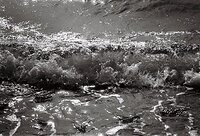
Like you, I did not use Verichrome Pan when it was in production. But now I wish I had. Here are some snow examples from a roll that a friend sent me:

https://worldofdecay.blogspot.com/2021/03/another-expired-film-treasure-kodak.html


Verichrome-Pan-Curves_resize.jpg
 
I skimmed some of my Kodak booklets and could not find any spectral response plots. Here are some curves from Kodak Professional Black-and-White Films book F-6 © 1984.

Like you, I did not use Verichrome Pan when it was in production. But now I wish I had. Here are some snow examples from a roll that a friend sent me:

https://worldofdecay.blogspot.com/2021/03/another-expired-film-treasure-kodak.html


View attachment 340050

Thank you for posting this and the link as well!
 
Verichrome Pan may have been the first film I used - my first cameras were handed down 620 and 127 cameras (a Kodak Duaflex and Brownie Starflash?), and Verichrome Pan was the black and white film easily available in those formats in the mid to late 1970s. Of course, I was maybe 8-10 years old and any technical details were beyond me, getting a roll of film back without missed or double exposures was enough cause for celebration. Verichrome Pan was a forgiving film for that sort of general purpose photography, like color negative film.

The predecessor Verichrome not-Pan, probably what your grandfather had pre-WWII, is a different film, orthochromatic. My Kodak Reference Handbook from 1945 only has data for Verichrome not-Pan, although other pan films such as Plus-X are listed.
 
Verichrome Pan may have been the first film I used - my first cameras were handed down 620 and 127 cameras (a Kodak Duaflex and Brownie Starflash?), and Verichrome Pan was the black and white film easily available in those formats in the mid to late 1970s. Of course, I was maybe 8-10 years old and any technical details were beyond me, getting a roll of film back without missed or double exposures was enough cause for celebration. Verichrome Pan was a forgiving film for that sort of general purpose photography, like color negative film.

The predecessor Verichrome not-Pan, probably what your grandfather had pre-WWII, is a different film, orthochromatic. My Kodak Reference Handbook from 1945 only has data for Verichrome not-Pan, although other pan films such as Plus-X are listed.

Thank you! Yes, the film that was in his Brownie was Verichrome...not Pan.
 
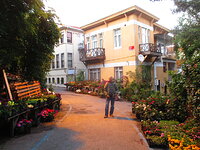
Turns out I did use Verichrome Pan in the 1980s (once that I have traced so far). I took some pictures of an abandoned cliff house in Encinitas (since removed). I used Verichrome Pan, and Hp5 in 120 (Mamiya C330f).

Verichrome Pan:


HP5:


Unfortunately not a lot of great direct comparisons. The apartments were just south of the abandoned cliff house.

In Kodak's "How to Make Good Pictures", 25th edition (late 30s/early 40s), they talk about Verichrome (non-Pan) as good enough for everyday, and panchromatic film as for more special purposes.
 
If VerichromePan were made today and Kodak didn't price it super high, I'd buy and use it. It was the very first B&W film I used in my Sputnik 127 camera. It was also the only film period that went through dads Kodak Target Six-16 box camera. I even used it when I got my first Hasselblad 500C. Very easy film to use, not the fastest at the time, but very good exposure latitude. I made some very nice photos with it developed in Edwals FG7 and Kodaks Microdol at 1+1.
 
I used it right to the end. 120 VP in PMK on a Jobo was as close to a perfect film/dev combo as I ever got. The lighter tones, clouds etc, seemed to almost be 3D.
 
Verichrome Pan was a very forgiving film that could handle a wide illumination range and provide usable photographs from simple box cameras. My first film and I used it for years.
 
Based on some posts here from @laser (Bib Shanebrook), it is my understanding that early Verichrome Pan was a different emulsion than Verichrome Pan in its later years - see his post above . So it might be necessary to discount the 1956 era information.
 
Are saying its anti-halation layer is inferior to plus-x's? I did hear that Verichrome Pan was geared more toward the general public, so that would make sense. It would keep the costs down... Similar with Kentmere films.

The antihalation of late VP was inferior to PXP . I made some picture tests to check it out. I photographed a light bulb. There was a difference but it was very subtle. It would only show in extreme cases. Toward the end of its product life it was a value brand sold primarily in emerging markets for very low prices. Eliminating the antihalation reduced the manufacturing cost a little.
 
The antihalation of late VP was inferior to PXP . I made some picture tests to check it out. I photographed a light bulb. There was a difference but it was very subtle. It would only show in extreme cases. Toward the end of its product life it was a value brand sold primarily in emerging markets for very low prices. Eliminating the antihalation reduced the manufacturing cost a little.

With its inferior antihalation, rolls that I have from the mid 90's should make for some interesting night shots...
 
Andy,
"nosmok" has some pictures up on the standard gallery that he shot with his homemade camera on 620 VerichromePan exp. 1973. Yes, if Kodak made this film today I would buy it. Great travel B&W film.
 
Andy,
"nosmok" has some pictures up on the standard gallery that he shot with his homemade camera on 620 VerichromePan exp. 1973. Yes, if Kodak made this film today I would buy it. Great travel B&W film.

Thank you, John. I'll go check them out now...
 
Photrio.com contains affiliate links to products. We may receive a commission for purchases made through these links.
To read our full affiliate disclosure statement please click Here.

PHOTRIO PARTNERS EQUALLY FUNDING OUR COMMUNITY:


Ilford ADOX Freestyle Photographic Stearman Press Weldon Color Lab Blue Moon Camera & Machine
Top Bottom
