• Welcome to Photrio!
    Registration is fast and free. Join today to unlock search, see fewer ads, and access all forum features.
    Click here to sign up

Using red led strips in the darkroom

spanish market

A
spanish market

  • 0
  • 0
  • 16
Paper Birch.jpg

H
Paper Birch.jpg

  • 1
  • 0
  • 28

Recent Classifieds

Forum statistics

Threads
203,059
Messages
2,849,297
Members
101,629
Latest member
Evgenymv
Recent bookmarks
0
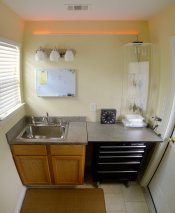
I bought a 3 color LED light strip to try out and experiment with. I don't care for the character of the "white" light it provides, but using it with just the red LEDs for safe lighting is working out very well. (I was hoping for lighting that could be white and safe in one).

I tested it up to 15 minutes with no fogging, it's very bright, and the remote allows you to dim it in any color.

The product I bought is this one, or similar to it;
http://www.homedepot.com/p/Commerci...ote-DC5237WH-A/204087512?N=5yc1vZc7phZ1z115g2
 
I'm using a long strip of red LEDs in mine. They point up and bounce off the ceiling for soft, even illumination. I added a LED dimmer so I could adjust the brightness as well. These red LEDs tested safe out to twenty minutes (I went out to thirty minutes) using the Kodak safelight testing methodology.
 

Attachments

  • Dark-2.jpg
    Dark-2.jpg
    114.7 KB · Views: 775
I cut a 20cm strip and make a crefully test it with some piece of papers, distance from 3m to 30cm, in 45 minutes. After develop and fix, they're still white, so it's absolutely safe! Not only cheap, easy to find, but also much brighter than traditional safelight.
 
Why suffer with red when you can use amber and yellow.

Well, "any" color will work if it tests "safe".


Easier to see ...

For some. Some prefer red. YMMV

I used to have red lights that were not safe in the darkroom for when I needed more light, but didn't want to use the white lights, so that I could retain my "night vision". I learned this from the astronomy folks. (Now with much brighter safelights, I don't do this anymore.)
 
Last edited by a moderator:
I bought a led strip and put it on the ceiling (4 meter high) bouncing back.

I preflashed the paper for getting a 18% gray. After that put it at the place where the develop tray is positioned. put some coins on the paper and leave it for 10 minutes.
after that develop normally.

I see that the paper is fogged. The place where the coins where are more white than the rest. This means the red strip is not darkroom save!

Now I wonder how you guys tested it?
Did you also preflash the paper? I would check this the next time you are in the darkroom!!!!!
 
I preflashed the paper, but did the test with it on the enlarger easel. The distance is about the same as my developer area though.

I bought the LED strip at a home center, no longer have the box it came in, but I'll look at the strip and see if there is a manufacturer name or some other indication of the LED source.
 
You will find all the information here.

(there was a url link here which no longer exists)

By the way, the first LEDs I used were centered on 620nm. The spectrum of LED is not a single wavelength like lasers have but a bell shape curve. The 620nm LED emitted enough energy under 600nm which fogged the paper. 600nm is the safe limit recommended by paper manufacturers in their datasheet.

Then I went with high power 700nm LEDs which were the first high power deep red LEDs available on the market. They were very safe indeed but I could hardly see anything in the darkroom (only 20% of the light was visible)!
One year after, high power 660nm LEDs were available and those are perfect for darkroom usage.

I have opted for a design you could adjust the intensity which is a very nice feature when you work long hours in the darkroom.
 
......By the way, the first LEDs I used were centered on 620nm. The spectrum of LED is not a single wavelength like lasers have but a bell shape curve. The 620nm LED emitted enough energy under 600nm which fogged the paper. 600nm is the safe limit recommended by paper manufacturers in their datasheet.

Then I went with high power 700nm LEDs which were the first high power deep red LEDs available on the market. They were very safe indeed but I could hardly see anything in the darkroom (only 20% of the light was visible)!
One year after, high power 660nm LEDs were available and those are perfect for darkroom usage.

I have opted for a design you could adjust the intensity which is a very nice feature when you work long hours in the darkroom.

I've had a similar experience. Note that the published spectrum graphs of LEDs have the vertical axis in arithmetic units, not exposure units that we are used to. This means that the spread is worse than it looks in the graph.

I also have variable intensity, very useful. Also, I have read (don't remember where) that the spectral spread of LEDs is smaller when they are working at lower currents.

Also, I made a hand held light with 4 yellow-orange LEDs that I use to check paper near the end of development. Those LEDs are not safe enough for normal darkroom illumination, but quite safe for a short look. It's a relief to see the image in yellow-orange light after being accustomed to 660nm red!
 
I've never read one of these LED red safelight threads that inspired confidence.
 
Believe it or not, Walmart sells bulbs called "party bulbs" which come in red, green, yellow etc. The red ones work spectacularly well. I have mine in 6" aluminum reflectors with spring clamps and plig them right into my timers..about a $10 or so imvestment.
 
Photrio.com contains affiliate links to products. We may receive a commission for purchases made through these links.
To read our full affiliate disclosure statement please click Here.

PHOTRIO PARTNERS EQUALLY FUNDING OUR COMMUNITY:


Ilford ADOX Freestyle Photographic Stearman Press Weldon Color Lab Blue Moon Camera & Machine
Top Bottom