
• Welcome to Photrio!
    Registration is fast and free. Join today to unlock search, see fewer ads, and access all forum features.
    Click here to sign up

Using MF lenses on a 35mm body???

Recent Classifieds

Forum statistics

Threads
202,980
Messages
2,848,369
Members
101,575
Latest member
JDuB
Recent bookmarks
0
One thing about some of the answers posted...I asked early on if there was a "conversion" between focal length of a MF lens and a 35mm. The answers were if the focal length is XXmm the it is the same in both formats?

Any specific focal length will be the same. For example, a 200mm f/4 lens will have the same angle of view and depth of field on a Pentax K1000, whether it is the 200 f/4 made for K-mount or the 200 f/4 made for the Pentax 67 attached to it with the adapter Pentax used to make.
 
Last edited by a moderator:
Any specific focal length will be the same. For example, a 200mm f/4 lens will have the same angle of view and depth of field on a Pentax K1000, whether it is the 200 f/4 made for K-mount or the 200 f/4 made for the Pentax 67 attached to it with the adapter Pentax used to make.

Yes, that is absolutely true. The real difference between a 200 mm lens made for 6x7 format as opposed to a 200 mm lens made for 35 mm format is size of the image circle cast by the lens. A lens made for the 6x7 format must cast an image circle with a diameter of about 90 mm. By contrast the image circle needed to cover the full frame 35 mm format has a diameter of about 43 mm.
 
Yes, that is absolutely true. The real difference between a 200 mm lens made for 6x7 format as opposed to a 200 mm lens made for 35 mm format is size of the image circle cast by the lens. A lens made for the 6x7 format must cast an image circle with a diameter of about 90 mm. By contrast the image circle needed to cover the full frame 35 mm format has a diameter of about 43 mm.

Which is why, typically, 135 format lenses resolve better than 120 format lenses. Image circle is smaller, lens elements can be smaller, easier to produce with higher resolving capability. This is how I understand it to be.
 
MF lens is more expensive because you can create far less lens per optical glass mass. Engineering harder , more time needed to carve it , bigger the lens , more problems rises etc.
CNC machines must waste more time to make the mechanics etc etc.
This does not make a Hasselblad lens better than small Rollei lens. And Screw Leica lenses are smaller than Nikon lenses but faraway better.
 
MF lenses are also made in much smaller quantities, raising the individual price of each. Just as with bodies, where a very complex 35mm body could cost less than a simpler MF body.
 
Which is why, typically, 135 format lenses resolve better than 120 format lenses. Image circle is smaller, lens elements can be smaller, easier to produce with higher resolving capability. This is how I understand it to be.

This is (still) not true. Often repeated. But entirely Myth (with a capital M).
Yes, smaller, cheaper. But by no means better.

But we have been over this already.
 
"We have been over this before."

Well, I have an opinion, and you have an opinion. Do you have any facts to support yours? If not, it's no better than mine.

What are some typical resolution numbers for a prime 80/85mm 135 format lens? (Or how about a 135 format normal lens?) For the Hasselblad 80f2.8, it's 68 line pairs/mm in the center. Let the numbers speak.
 
Last edited by a moderator:

"We have been over this before."

Well, I have an opinion, and you have an opinion. Do you have any facts to support yours? If not, it's no better than mine.

Well, there's opinion, and there's informed opinion.
First, it is clear when and how this Myth started life.
Second, there is no evidence at all supporting the Myth.
Third, yes, lens performance tests have shown that it's bogus.
(I know, i know: now you're going to ask to produce the evidence. It takes time and work to form an informed opinion. I don't really feel like doing the work to help you form your informed opinion.)
:tongue:

What are some typical resolution numbers for a prime 80/85mm 135 format lens? (Or how about a 135 format normal lens?) For the Hasselblad 80f2.8, it's 68 line pairs/mm in the center. Let the numbers speak.

Numbers mean nothing if you don't know how they were produced.

But seeing that you are looking for numbers to compare, i.e. don't have any, i think it would be a misnomer to call what cannot be more than your belief an "opinion".
:wink:
 
Well, there's opinion, and there's informed opinion.
First, it is clear when and how this Myth started life.
Second, there is no evidence at all supporting the Myth.
Third, yes, lens performance tests have shown that it's bogus.
(I know, i know: now you're going to ask to produce the evidence. It takes time and work to form an informed opinion. I don't really feel like doing the work to help you form your informed opinion.)
:tongue:


Numbers mean nothing if you don't know how they were produced.

But seeing that you are looking for numbers to compare, i.e. don't have any, i think it would be a misnomer to call what cannot be more than your belief an "opinion".
:wink:

Sorry, can't understand the last part of your post. I do pick up a condescending tone however.

Here is something I found on the net about some new Zeiss 135 format lenses here: http://www.photodo.com/topic_96.html

The new ZEISS ZF lenses went to test for resolving power recently. Attached to a Nikon F6, which was mounted on a Sachtler heavy duty tripod, we exposed our Eastman resolution test chart onto Kodak Imagelink HQ film. The best we had ever achieved before with any SLR lenses was 250 lp/mm.

The new Planar T* 1.4/85 ZF achieved that same resolution at f/5.6, and even down to f/2.

The new Planar T* 1,4/50 ZF went even further: It reached 320 lp/mm in the aperture range from f/5.6 to f/2.8, and 250 lp/mm at f/2.
 
Last edited by a moderator:
Sometimes the results are worth it...

I have used a Hasselblad adapter on my Nikons to evaluate how well they work compared to modern lenses.
While it's not to easy for fast action, it does work.

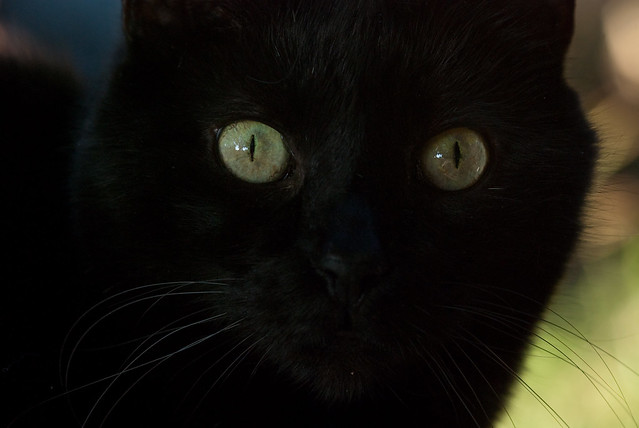
I took this photo of my cat with my 1969 model, non T*, Carl Zeiss 120mm S-Planar set at f5.6 and 400ISO on my Nikon D80.

3888289993_446c0fa0f0_z.jpg


If you have doubts about MF lens quality on smaller format, I suggest you look at the detail in the green part of the eyes on the image link below at 10 megapixels. This is a straight image from the camera, no photoshop sharpening or anything like that.

Click for the Full Resolution version
 
Frank,

And you're comparing that to... what exactly?


Here's a tidbit: Not long ago, on the same topic, i believe, i quoted Zeiss reporting that their MF 40 mm wide angle 'did' 200 lp/mm.
For a retrofocus lens (!), that's certainly beyond what most more symmetrical 35 mm format lenses are capable of.


Your 68 lp/mm for the Planar, by the way, is way off. Says a lot about the test, but not a lot about the thing being tested.
Could almost be a Photodo score.
 
Slrlensreview.com has tested some M645 lenses on 35mm body.
 
Sorry for slightly derailing the topic from all the number crunching...
Does anyone here have any experience with the ARAX Tilt-Adapter for P-Six lenses on various 35mm bodies? My Kiev-88 has passed away, but the 80mm/2,8 standard lens is still in great condition. I'd like to use it on various M42 and (via another adapter) Canon EOS bodies. I don't have the money for large format or a dedicated T/S-lens currently, so I want to know if it is any good. If the build quality is about as bad as my original Kiev camera, I might as well throw 125$ out the window...
 
Good morning, Moki;

Do not be too worried about the products you may buy from Gevorg at ARAX. He and his technicians have been making Kiev-88 cameras "right" for a long time, when there is enough left to work with from the guys who built them at Zavod Kiyiv (Kiev Arsenal). It is always true that there are some cases where the effort to make the thing "right" may not be worth the required effort and the resulting cost. That sample should be set aside to serve as a parts donor when repairing others, with the assumption that at least some of the parts are close to specification. Many users of Kiev cameras here in the USA do ship their cameras and magazines to ARAX for CLA and repairs. Yes, the cost of shipping does add to the expense, but finding qualified camera technicians here in the USA who can do the work is not an easy task either. We are working on identifying those people here and sharing among Kiev users that information as it becomes available.

And, yes, others have found that the ARAX Fixed Tilt Adapters that can go onto (choose one) Nikon, Canon, Pentax, Minolta, Sony, and other camera bodies, does indeed work. Lens Tilt is one useful function, but I have more use for Lens Shift, and that is not as easy. There is another company in Germany that is making a Variable Tilt/Shift Adapter for some camera bodies, but it is more expensive ($400 or $500 or so?), and it is not a high volume production number item. The information for this is on one of my other computers.
 
I have, on several occasions, used various MF lenses on a 35mm body. In particular, I use the mamiya m645 80/4 macro, because it is very convenient. The mamiya 200/2.8 apo is also very nice on 35mm (and I daresay far less expensive than the 35mm equivalent). I have also used the big mamiya 500/5.6 on a 35mm body as well- quite nice and a good deal less expensive than your typical 500mm lens.

Are 35mm lenses typically better, in term so resolution, across the 35mm frame? Yes, sure, but it's not usually a big issue. If you shoot res charts with high contrast film then you'll see the difference. But the 35mm camera will sample the best (central) portion of the image circle, where MTF values can be very good indeed. That said, I always cringe when people say this or that apo moneygon lens gets 100 or 200 lp /mm. Where? In the dead center of the frame?? And will I need to shoot high contrast film with crappy tonality to see the benefit?! And what about bokeh, colour rendition, etc....

For me it's all a matter of using whatever gets the shot you want, and sometimes it's simply convenient to use one lens or another. Just use whatever works for you. If that's the lens from the eyeball of a dead cow, go for it.
 
And what about bokeh, colour rendition, etc....

Exactly. It's funny how much time people spend arguing about sharpness and resolution (which nobody cares about when it comes to viewing your photo), and rarely the character which is far more important (to the photographer, not viewer). Besides, I've never heard anyone viewing a good photo wonder about line pairs/mm or sharpness, or even character. At the end of it all a good photo is what it's about, with any lens.
 
Photrio.com contains affiliate links to products. We may receive a commission for purchases made through these links.
To read our full affiliate disclosure statement please click Here.

PHOTRIO PARTNERS EQUALLY FUNDING OUR COMMUNITY:


Ilford ADOX Freestyle Photographic Stearman Press Weldon Color Lab Blue Moon Camera & Machine
Top Bottom