

• Welcome to Photrio!
    Registration is fast and free. Join today to unlock search, see fewer ads, and access all forum features.
    Click here to sign up

Using FUJIFILM Maxima RA4 paper

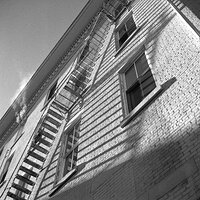
Fire escape.

H
Fire escape.

  • 2
  • 1
  • 10
22886.jpg

A
22886.jpg

  • 2
  • 0
  • 23

Recent Classifieds

Forum statistics

Threads
204,343
Messages
2,867,389
Members
102,231
Latest member
kimlee2027
Recent bookmarks
0
I hit my stride today. Two quite different images. The first is from a recent series of floral and architectural street shots handheld on rainy days with my Nikon and an old single-coated lens having a color rendering I like. Moderate contrast lighting ratios shot with Ektar film. 8X enlargement, which is about as big as I like to go with 35mm. Maxima proved to be a very good fit for that level of magnification with punchy Ektar.

The second image was a sheet of 8x10 Ektar which I presumed was outdated, and gambled with for a very difficult shot. It was inside a giant burnt out redwood tree stump, almost dark in there. I'm really surprised I even got the composition right along with acute focus. The long exposure was a complete guesstimate with respect to reciprocity failure correction. I opted for a KR3 warming filter due to the intense blue of the shadows under an open blue sky. The charred wood had iridescent blue and violet shades, offset by patches of blue-green fluorescent algae (really difficult to capture on color film), plus a little bit of green moss, with a range of other color accents (and plenty of near blackness).

I'm sure any other photographer who sees the 20X24 Maxima print will accuse me of some kind of Photoshop hanky-panky. But it truly was an otherworldly looking little scene in a burnt out nook in what was once a giant tree. There is a slight exaggeration of the cyan elements - but that's characteristic of Ektar film itself. I don't think any other color paper could have pulled off the full gamma of those hues, except for related Fujiflex Supergloss. Now I'm tempted to make a 24X30 print of it too.
 
We'd have to see your 20x24 Maxima print first; wouldn't we?
 
Well, my response is predictable. Anything posted on the web would be a pretty awful representation of the real deal. The web has a color gamut worse than any kind of color paper. If I did need to use the copystand, 20X24 is easier to copy than even bigger prints. The larger the size and higher the sheen, then I'd have to resort to cross-polarized hot lights like I used for copying Ciba prints. The sheer depth of range of blacks in the Maxima print would all come out generic blaah over the web
anyway.

But some day, perhaps in a different life, I'll get around to digitally cataloging my collection. The thought of that chore is just about as appealing to me as filling out income tax forms again.

I'm not in a rush to make 30X40 prints again yet. Even with a 240 lens in relation to 8x10 film, the baseboard for my Durst 10X10 L138 enlarger would be almost to the floor. Meanwhile, my 14 ft tall custom additive enlarger, Ideal for printing that size, needs its complex control module electronics repaired, something I'm just too lazy to do anytime soon, if ever.
 
Last edited:
I hit my stride today.
That's nice to hear; good to hear in any case that the color project you have been anticipating for several years is finally happening now (I remember several "gearing up" posts over the past 2-3 years). It's rewarding when images start to appear on paper. Also nice that the Maxima paper is to your liking. Going by your remarks, you're starting to see now why so many of us have embraced papers like Maxima and DPII.

(and plenty of near blackness)
That's the kind of print that places higher demands on the paper and where the entry-level CA tends to break down and crumble. Again, as many of us have observed before. This is where Maxima and DPII come into their right.

It's a pity that the matte surface isn't anywhere close to Endura's.

my 14 ft tall custom additive enlarger, Ideal for printing that size, needs its complex control module electronics repaired
The line between a magnificent, unique tool and an awkward pile of old rust is sometimes eerily thin. Ask the many (ex-)owners of Durst Pictographs etc.
What broke on yours?
 
Oh, nothing really broke. All the machinery is built like a tank. Just a bunch of triacs and resistors, capacitors, etc that all need to be all checked out and rebalanced. The color system is six-channel 1500W pulsed RGB, divided into a V-head for sake of more efficient cooling, with the two hemispheres meeting in the mixing chamber. This kind of technology is quite susceptible to EMI (electromagnetic interference) if more than three channels are involved. I built it slightly before computerized sine-wave controls were first made available for multiple pulsing circuit rock concert light shows, but which would have been even more problematic due to the software and computer platforms repeatedly needing replacement (real expensive too).

I still have the option of using the Durst L184 for 30X40 prints from 8x10 film. It's just that with aging finger and knee joints, working so close to the floor is getting to be literally a pain. Printing 24X30 prints from 8X10 film, or even 30X40 ones from 4X5 negs, is at a comfortable easel height, however. Early on, I made 30X40 prints with a horizontal enlarger instead; but that too up too much room.

I was leafing through a variety of C prints the other day. There are a number of images from 8x10 originals where the comparatively inexpensive Fuji CA cut sheet product was ideal, which benefitted from the more limited range of that particular paper. Then others fit into the shoes of Super C much better. Then there was Fujiflex, which better fit my craving for that Cibachrome look which comprises so much of my color printing background. And I anticipate that Maxima too will prove excellent for some images, but not for others. I have plenty of negs to choose from; so I'm not worried about that. I'm just glad Maxima finally became available in this country.
 
Just a bunch of triacs and resistors, capacitors, etc that all need to be all checked out and rebalanced.
Out of curiosity, what kind of rebalancing is typically needed on triacs, resistors and capacitors?

This kind of technology is quite susceptible to EMI (electromagnetic interference) if more than three channels are involved.
Oh, that's interesting. So how does the number of channels relate to EMI? And how come your RGB enlarger uses more than three channels; i.e. what's a 'channel' in your setup? And are we talking about susceptibility to EMI as in the enlarger controller or lamp drivers being affected by EMI of other equipment, EMI of one part of the system affecting other parts of it, or the system creating EMI problems for other equipment nearby?
 
Let's imagine you're throwing rocks into a pond. The more rocks you throw in, the higher the probability that their waves will produce "interference" with one another.
In pulsed lighting technology, this tended to happen with over three circuits. Then sine-wave controls were invented, pulsing the different waves just micro-seconds apart, allow for over 20 channels to be used. This has gone well beyond stage production lighting, and into high-rise architectural e-window control involving multiple circuits.

Balancing. Because I have a unique V-head design, with each hemisphere separately controlled, they have to somehow be precisely matched in both color output and feedback circuitry. The device I use for that was designed by ZBE and involves a lot of statistical juggling due to its extreme sensitivity. But once the two factors are figured out, there's no more need for it ... UNTIL something in the main electronics goes bad or weak, and potentially needs replacement.

The full colorhead itself is so heavy that I have to use a block and tackle to remove it. But all the control devices are remote and easy to get to. But they still have be isolated from any-cross talk between them, which can go right through the air. Can't have anything static-generating or anything like electronic fluorescent light ballasts in the same building either. Can't operate it during a thunderstorm.
 
Yes, I know what interference in general is, and also what EMI is. I also understand that you might want to space switching patterns for high-power circuits apart so as to limit transients. But this is a design property and not something that would shift over time (unless the system is very poorly engineered) and hence it doesn't require adjustment. The remaining question still is: do certain subsystems of the machine suffer from EMI resulting from switching transients in the power section; i.e. does the machine effectively sabotage itself? Or is the main concern other EMI-sensitive equipment nearby? Also, given that this is (again) ultimately a set of design choices, I don't see how it would now be an issue if it wasn't right form the start.

As to balancing: I get that. Two remarks:
1: Either the light sources are closed-loop (e.g. servo) controlled, or not. If they are, they're inherently stable, although in a dynamic way. No adjustment needed; after all, they 'self-adjust' constantly.
2: If something in the power section burns out or goes bad (let's say a triac or part of its pulse train driver), the failure is generally total. It's not a matter of adjustment. It's a matter of fixing the broken section and looking for any downstream damage it may have caused (very little in a well-engineered system).

So the adjustment story just doesn't really add up. But I think, like always, we're going to keep guessing after details, and I have other things to do.
Good luck sorting your enlarger head. BTW, in your place, I'd junk it and just get one of those Heiland LED lights instead. Or, if that's too salty price-wise, build one yourself. You built this one, allegedly, so you can do the LED variant as well. It'll save you time in the long run and it'll run a lot cooler as well, which would be nice in those hot Californian summers.
 
You are correct about spacing. But I cannibalized components from all kinds of things building this device. Some of them might need to be reengineered. But then someone could come along, if they were interested in this rig after my days are over, and simply slap a big LED pancake head atop it, IF that kind of technology pans out for realistic large color printing. At my age, its unlikely I'll ever gamble my remaining energy and money going down that path. And I do have the Durst 10X10 L as a very reliable "backup" enlarger, plus a 5X7 additive colorhead enlarger.

Or else I could simply slap my big 12X12 high output cold light atop the beast chassis for making 30X40 black and white prints (if I could ever afford the paper, which going wildly crazy in price already). Its currently atop an 8X10 modified L138 chassis, suitable for up to 20X24 b&w prints.

But I probably should have spoken of "coordinating" the two hemispheres instead of "balancing" them. The light is double-diffused. Each hemisphere has its own diffusion system with its own filtered feedback sensor. Then the light from both of those goes to a lower reflective box where both mix. It occurs there quite well due to a linear (not concentric) fresnel array, which evens out the lateral spread from both sides. But the fine tuning is done by means of a separate RGB monitoring sensor which does not involve feedback, but just a slight manual tweak to the control box setting of each respective hemisphere, which are programmed in CMY.
For example, the L side hemisphere might consistently produce 2 cc more blue light than the R side, so I simply add 2 cc Y to the L setting. Pretty simple until something in the electronics overheats or gets cross-talk.

The head itself cools far more efficiently than commercial high-wattage units; that's why I designed it in the first place. But budget-wise, the prototype had to be the final version. No second-guessing. And it has certainly been far less expensive to run and maintain than my old Durst 2000W color mural head, which I used in horizontal mode - way better color too. But like I already stated, that was relative to the Ciba media of those days. With current Fuji papers, RGB and CMY performance are quite similar.
 
Last edited:
But just to clarify, we do not have hot summers here, but cold summers up until around mid-August. I'm in the coastal fog belt. But just a 15 or 20 minute drive inland, past our coastal hills where the fog banks up, it can be 50 degrees hotter than here, more typical of central California summer temperatures. Everything is about microclimates. Then we have high mountains too, across the State, where my second property was. On the same day, one might die of the summer heat over-exerting themselves at lower elevations, but die of hypothermia in a snowstorm higher up if not equipped with winter-style gear.

I'd get up at 4:00 in the morning and do a few hours of property work. By 10:00 AM it would be around 90 degrees or higher. So I'd jump in the truck, drive uphill to 10,000 feet or so, scale a mountain and do some photography, then drive back down at dark when things started to cool lower down.
 
My previous print involved an almost slot-canyonesque extreme psychedelic palette, but inside a giant burnt-out stump. Today I wanted to experiment with the opposite extreme - an exceptional high key image with a wide range of quite subtle hues. This involved a secret shoreline cove once accessible by a tricky cliff descent, but now totally off-limits legally due to hazardous cliff erosion, plus a lot of elephant seal presence over the last decade. I shot it on 8x10 Ektachrome S 100 about 25 years ago. It was in dense fog, with a rich 5% foreground, but under "natural softbox lighting", while the 95% rest of the image gradual melts away fog softness, yet with lovely complex high key hues throughout, and discernable extreme detail along the shoreline itself up to middle distance. The water itself was gentle and an exquisite blend of turquoise, blue, and subtle green.

This called for skating right to the edges of the ice rink. The shot itself had to be precisely exposed, and came out lovely atop a lightbox. It proved impossible to faithfully print on Cibachrome. So about a decade ago I made a precise contact internegative of it on 8X10 Ektar color neg film. Ordinarily Ektar would be a horrible choice for interneg purposes; but because the contrast was so low in this case, it was realistic to fit onto the midsection of the relatively contrasty Ektar curve itself, and at the same time, boosted the contrast and saturation of the original just a little. Around 10 yrs ago I tested the result on CAii RA4 cut sheet paper, and the result came out surprisingly well.

So now it was time to try it on Maxima, and the extra gamut of that sure made the most out of it! In this case, I wanted a very realistic outcome matching the original scene as faithfully as possible. Inkjet would have made an atrocity out of it, and I never printed it on Fuji Supergloss because any reflections on that very high sheen would have spoiled the extremely gentle nature and esthetic feel of the background hues. I pretty much got a-hole-in one 20X24 from Maxima this afternoon (after a couple of test strips, of course). And only a color transparency film would have cleanly bagged those particular color relationships in the first place.

This gives me confidence to try Maxima for some other subtle high key images which I've successfully printed on Super C, but which came out somewhat disappointing on cut sheet CA, and some which I've never even attempted to print yet. I'm anticipating results even superior to Super C.
 
Last edited:
Well, one of us would have to cross the border! or an Ocean. I'd love to actually see (in person) some of BC or Tasmania too.
 
Photrio.com contains affiliate links to products. We may receive a commission for purchases made through these links.
To read our full affiliate disclosure statement please click Here.

PHOTRIO PARTNERS EQUALLY FUNDING OUR COMMUNITY:


Ilford ADOX Freestyle Photographic Stearman Press Weldon Color Lab Blue Moon Camera & Machine
Top Bottom
