• Welcome to Photrio!
    Registration is fast and free. Join today to unlock search, see fewer ads, and access all forum features.
    Click here to sign up

Understanding zones/gray card usage.

A long time ago...

A
A long time ago...

  • 0
  • 0
  • 26
Boy and teddy, 1920's.jpg

A
Boy and teddy, 1920's.jpg

  • 2
  • 2
  • 44

Recent Classifieds

Forum statistics

Threads
201,202
Messages
2,820,399
Members
100,582
Latest member
v1photos
Recent bookmarks
1

Corey Fehr

Member
Allowing Ads
Joined
Mar 15, 2017
Messages
108
Location
Wisconsin
Format
35mm
I'm currently plugging through Ansel Adam's book, and plan on doing an experiment tomorrow to potentially answer this question. In the meantime, I'd like to understand this concept a bit better.

1. I understand the concept of over exposing/under exposing for the zone system due to the camera's automatic middle gray (18%). Got it.

2. In the very little experience ( a month or so) of being taught the zone system in a course, we were taught to expose for the "darkest subject you want with detail". Ok. Simple enough. Expose for the shadows/develop for the highlights.

3. Then I see a lot of suggestions for gray cards/palms/etc. I understand this is a reliable source to find the proper exposure for middle gray. My confusion lies in this: Why don't we always just use a gray card then? Why bother with finding the darkest thing with detail, shadow, etc? Or, are you sacrificing some of these zones by using a gray card in situations where it's just too difficult to get a proper exposure/reading? Aren't we trying to "get away" from the middle gray that the camera auto-corrected to exposure wise?

Please keep in mind I am an extreme novice to the zone system, I am being taught it in class so I must learn it as it will be tested, and I have not done anything with the zone system beyond camera exposure. (i.e. no development times, printing, etc.)

Thank you all in advance!
 

Old-N-Feeble

Member
Allowing Ads
Joined
Feb 22, 2012
Messages
6,805
Location
South Texas
Format
Multi Format
IMO, a calibrated spot meter is the way to go... no gray card or palm needed. Of course, you'll have a dozen replies with a dozen opinions, some of which will suggest not using the zone system and others suggesting using an incident meter. I learned with the zone system and will still use it and a spot meter if I ever get around to shooting again.
 
OP
OP
Corey Fehr

Corey Fehr

Member
Allowing Ads
Joined
Mar 15, 2017
Messages
108
Location
Wisconsin
Format
35mm
IMO, a calibrated spot meter is the way to go... no gray card or palm needed. Of course, you'll have a dozen replies with a dozen opinions, some of which will suggest not using the zone system and others suggesting using an incident meter. I learned with the zone system and will still use it and a spot meter if I ever get around to shooting again.

Thanks for your reply. What's the technical explanation for this?

Why would someone use a gray card over a spot metering on the subject, and how does it affect the final image?

Thanks!
 

MattKing

Moderator
Moderator
Joined
Apr 24, 2005
Messages
54,714
Location
Delta, BC Canada
Format
Medium Format
I'm going to suggest a small change in word usage.
"over expose" tends to imply too much exposure.
"under expose" tends to imply too little exposure.
Both tend to imply a mistake.
For clarity, it is really helpful in these sorts of discussions to instead discuss actions - we decide to "increase exposure" or to "decrease exposure" and we usually speak in terms of numbers of stops.
And, when we compare the light reflecting off of various parts of a scene, we talk in terms of stops as well.
The reason to use a grey card is that it supplies a repeatable reference. The reflectivity of an 18% card is approximately the middle of what we encounter in real life. So if everything is calibrated correctly, if we meter off of a grey card (using the proper technique) then the image of any 18% tone in a scene will be recorded on the negative to a density that should print as a middle grey tone in a print, and the darker and lighter tones in the scene should print appropriately as well.
The reason we use a meter to gather information from the shadows, is twofold:
1) negative film has less room for error on the shadow side, and more room for flexibility on the highlight side. Accordingly, we meter the shadows to be sure we capture the important information there; and
2) not all scenes have a 18% reflectance in the middle. Some scenes are such that you want the middle to be darker. Other scenes are such that you want the middle to be lighter.
It is important to understand that with respect to the zone system, you don't meter to find the "darkest thing with detail". You meter the darkest thing that you want to have detail in your final output (usually a print).
Let me give you an example. I take lots of photographs in forested areas. There are lots of scenes there where there are dark shadows that I'm quite happy to render dark and free of detail in my prints.
If I am using zone system principles when metering, I'm visualizing the result I want in the print and then measuring the light reflecting back from the various parts of the scene. Those measurements tell me that if I adjust the camera exposure to place a certain part of the scene (the part where detailed shadows matter to me) at one level, the other parts will fall at other levels. My experience then tells me how the resulting negative will print in a straight print, and will give me a good idea how it may print if I also apply the printing controls available to me.
The zone system is a way of systemizing the following:
1) visualizing first, and then
2) accomplishing the vision.
It all comes back to the final output - the print.
 

Bill Burk

Subscriber
Allowing Ads
Joined
Feb 9, 2010
Messages
9,455
Format
4x5 Format
As you experiment with a gray card, get a black card and a white card too.

It doesn't have to be a special calibrated percentage, just find something black and something white.

Find out what they meter in the daylight, you might see that the difference between black and white is 5 f/stops.

Now take them under the shade (side of building or under a tree) and do the same, you'll still find them 5 f/stops from black to white, but maybe 2 or 3 f/stops darker than when they were out in the broad daylight.

Instead of talking about f/stops, it is easier to talk about it using Zone System terms (once you get used to it).

Meter the black card in the shade and place the reading on Zone II

Meter the white card in the sun and place the reading on Zone IX

You will probably come up with about the same settings recommendation for f/stop and shutter speed.

Now try gray card in the sun and you will probably get a different reading. If my guess is right, the simple gray card reading will recommend less exposure.

While the gray card reading in the sun will be a "correct" exposure, it is a different exposure than you would be making if you metered in terms of what the Zone System would tell you to do.

And your negative, exposed as the Zone System recommended, would give you more shadow detail in your negative because you gave it more exposure when you took the picture.
 

Bill Burk

Subscriber
Allowing Ads
Joined
Feb 9, 2010
Messages
9,455
Format
4x5 Format
Matt makes a good point, some things should be blackest black.

So in real life, when you are metering a scene, you wouldn't normally meter a black card in the shade and place it on Zone II.

You would find something in the shade that's a little darker than the gray card, meter that and place on Zone II

For example I often meter the bark of a tree in the shade and place it on Zone II.

(If your teacher says to place it on Zone III, don't worry about the point it's a trifling difference in practice).
 

RSalles

Member
Allowing Ads
Joined
Aug 29, 2013
Messages
142
Location
RS - Brazil
Format
4x5 Format
In your first example above - expose for the shadows you want to have plain of details - let's take this situation for instance: proper exposure of shadow details fall on Zone IV - generally speaking. You're reading of 18% Gray Card, it's giving you 1/125 S at f8, obviously for Z V. If you "read" in your shadows area an exposure 1EV less than this - 1/60 at f8 OR 1/125 f5.6, you're done: the shadows will fall where you've intended. If not, and your shadows are falling differently (Zone III or Zone II) you have to place your scene exposure properly. How will you do that?
Easy:
- If you shadows falls on Zone III, place it on Zone IV by opening 1 f-stop OR halving the exposure speed to 1/60 s.
- If your shadows falls on Zone II, giving you 3 EV or f-stops less than the light reflected by the 18% card - or Zone V - rise this shadows exposure to Zone IV opening/+ 2 f-stops.
You'll have to observe where the highlights falls in these scenarios - this is the other half of the Zone System - and proceed accordingly to extract highlights details where you want details in the highlights adjusting your film development. If you haven't calibrated your development for the film you're shooting with, by extracting the correct ISO, and development times for N, N+X, and N-X, I would suggest you to do this step first.

HTH,

Renato
 

dasBlute

Member
Allowing Ads
Joined
Apr 12, 2008
Messages
421
Location
San Jose, CA
Format
Multi Format
... Why don't we always just use a gray card then? ...

Point a light meter at the grey card, then change the orientation of the grey card. Tilt it, rotate it slightly,
it varies a bit, easily more than a stop. Hard to use as a "standard", at least in my experience.

For most things, important shadow detail is what I focus on. Sometimes, the clouds are too bright,
and I can't fit both the shadows and the highlights on [at most] a 9 stop range, then I either let the
clouds be hot, or use a filter to calm them, or with extreme ranges, rethink the shot, knowing that
I'd have plenty trouble printing the image without adjusting development or other such measures...
the shot may justify it though, your call :smile:

At the end of the day, you need a negative that gives you options. It does not have to be perfect,
they rarely are :smile:
 

MattKing

Moderator
Moderator
Joined
Apr 24, 2005
Messages
54,714
Location
Delta, BC Canada
Format
Medium Format
You would find something in the shade that's a little darker than the gray card, meter that and place on Zone II

For example I often meter the bark of a tree in the shade and place it on Zone II.
Bill is correct, but what Bill is saying depends on an unstated assumption.
He is assuming that you want to record the scene in a way that will cause it to be reproduced fairly naturally in the print.
While that is most often what you want, it may not always be what you want.
As an example, in some cases, you may wish that bark to be lighter in the print, and to have the brighter areas in the scene render much brighter still.
What the Zone System teaches is that it is important to view the scene and then visualize the result you want. If you want the print to look lighter than usual - maybe high key and somewhat washed out - you can decide to place the bark on Zone IV or Zone V instead. This will result in the measurements from the lighter parts of the scene falling in higher than typical zones. This will lead normally to the bark being fairly light in the print, and the lighter parts of the scene being even lighter - possibly even blown out. If that is in accord with your vision, than you will have successfully used the Zone System.
 
OP
OP
Corey Fehr

Corey Fehr

Member
Allowing Ads
Joined
Mar 15, 2017
Messages
108
Location
Wisconsin
Format
35mm
Thanks all your responses. I feel our professor may have not thought this out when he taught us one extremely basic concept without explanation of how we got there.

1. If you have a scene. A forest. Let's say we meter the dark bark. Then I take a gray card and get a reading on that in the same area. Are the photos going to be different? (Let's say the readings, for this example, are perfect with no outside infractions.)

2. In more advanced stages of the zone system, are you guys taking exposure readings for every area in the picture plane wherein the shading is different?

3. How often is it that you find a perfectly gradient scene? Or is that simply the ultimate goal of the photography (camera to print) process?
 

MattKing

Moderator
Moderator
Joined
Apr 24, 2005
Messages
54,714
Location
Delta, BC Canada
Format
Medium Format
If you take a reading from a grey card, and do it correctly, and set the exposure on your camera accordingly, you will get a negative that will print that card out as a mid grey (Zone V).
If you take a reading instead from an area of dark bark, and set the exposure on your camera accordingly, you will get a negative that will print that bark out as exactly the same mid grey (Zone V).
You need to adjust the settings on the camera in order to have the dark bark render as dark. To do that, you place the reading for the bark on a lower zone - say Zone II. That means reduce the exposure from the exposure recommended by the meter for the bark by three zones (= three stops).
The other parts of the scene that are brighter than the bark will fall on higher zones, and will therefore print lighter.
Usually you check those other parts out. If they are going to fall too many zones higher, they won't record properly, so you may have to compromise and let some of the dark bark go even darker, or adjust the development to bring the contrast down and the highlights under control. Or, if everything is really close in tone, you may end up with a really bland result. That is when you try to increase the contrast by adjusting the development .
You also take readings from those other parts to see if the result you visualize is likely to be accomplish-able in the print.
You regularly find scenes that, with some work at the printing stage, can be rendered very well. Less frequently, you end up with a negative that will essentially print itself - a fully satisfying range of tones without any darkroom printing manipulations.
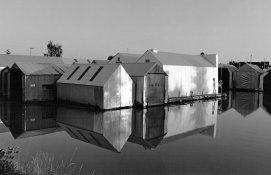
Here is a shot that was metered fairly simply and accomplishes what I wanted, but required some work at the printing stage. I didn't have or use a spot meter, but the subject certainly lends itself to using one:
Reflections.jpg
 
OP
OP
Corey Fehr

Corey Fehr

Member
Allowing Ads
Joined
Mar 15, 2017
Messages
108
Location
Wisconsin
Format
35mm
Great photo! Thanks for sharing this.

I have a better grasp-not complete-but good enough.

So is it safe to say that spot-metering will render you a more accurate depiction of what you envisioned?

Is that the advantage of metering the subject over a gray card?

And one more question for the evening: when you say "you will get a negative that will print the card out as middle gray", does that mean simply that anything with that tone of gray in the scene to begin with, will simply be placed on middle gray?
 

Bill Burk

Subscriber
Allowing Ads
Joined
Feb 9, 2010
Messages
9,455
Format
4x5 Format
Whether you meter bark or a gray card, so long as you are "placing" that exposure on an appropriate low zone, like Zone II as Matt said by reducing the exposure... You'll get the same result.

I'll often look at a scene and meter one thing, and tentatively place it on the Zone which I think I would be happy with. Sometimes that's all the time I have and I'll take the shot and move on. Sometimes I am just exploring, then as I wander around with the meter, I'll keep asking myself if I'd be happy if those different things were to be that shade of gray the meter says they will be. If I wish they were lighter or darker, I'll change the meter dial to "place" my new found important subject where I think it needs to be. Sometimes I can spend all day and not have to change the camera setting much at all.

I consider more advanced Zone System to be when you depart from reality. Say you revisit your mannequin heads and meter tells you there is only 3 f/stops of light difference from the head in shade to the head in light. Then you might develop the film longer... maybe 15-20 minutes (maybe that's N+3 in Zone System terms) .. then when you print those three dummy heads your print might naturally make them go from black to gray to white.

It's fairly common for a scene to just work out where everything I meter "falls" on a Zone that will make me happy. When that happens, I call that "Normal". Then I would develop the film for the time that's printed on that chart by the sink.
 

jimjm

Subscriber
Allowing Ads
Joined
May 2, 2007
Messages
1,239
Location
San Diego CA
Format
Multi Format
As you probably already know, AA first co-developed the zone system in the 30's - 40's as a way to evaluate a scene and plan his exposure and development so that he would obtain optimal results for the final print that he visualized. That's it in a nutshell. What I got most out of his books was how to look at the different shadows, midtones and highlight areas of a scene, determine the relationships and then plan my exposure (and sometimes development) based on that. Your instructor is probably trying to get you to grasp the concepts and reasons behind the zone system, and it can be a useful thing to understand moving forward. I normally only intentionally use it when I'm shooting large format and have the time up use a spot meter and get readings from all areas of the scene.

This is a huge subject, the relevance of which is still passionately argued about among internet forum posters to this day, so you will get lots of advice and lots of opinions. Some folks never use it and think it's BS, others consider it scripture. Many use an incident meter only, which measures the light that illuminates the subject and then they base their exposure off of that.

Using a gray card would be great if your photos were all Zone V, 18% gray with no shadow or highlight areas to consider. The real world is not 18% gray, you can have dark shadows and bright highlights in the same photo, so you need to look at your scene, figure what's important and set your exposure to let the optimal amount of light hit the film so that you get the best final image possible. B/W film is very forgiving of overexposure, so it's better to ensure you get sufficient exposure for the shadow areas and you can often pull detail out of the highlights that you thought may have been overexposed. If you have a scene that's primarily dark tones and you use an 18% gray card as your metering reference, your resulting negative will be underexposed, to the point where any shadow areas will look muddy and lack detail. It may take awhile to fully grasp the concepts, but once you do the important parts will stick with you.

Here's one example where I had to consider my exposure carefully and selectively meter the scene to get what I wanted. Interior scene, dark shadow areas under the stairs with a very bright window in my frame. Using a 35mm camera with a standard center-weighted meter. The important part for me was the lit highlights in the stair railing as I didn't want to lose detail in the wood. I also didn't want the area under the stairs to be totally underexposed because there was some interesting details there. I knew the window was going to be almost blank white as it was a sunlight desert sky outside. I metered the area below the stairs at the bottom right and figured I would set it at Zone IV (underexpose 1 stop) and also Zone III (underexpose 2 stops) and took 2 shots. Developed the film normally and decided that the Zone III shot worked best for the final print. I kept all of the detail in the sunlight railings, and was able to burn-in below the stairs enough to get inky blacks and the dark mood I was looking for. The final print took months to get right, but most importantly all the information was in the negative that allowed me to get the final print I envisoned.

Desert Tower Staircase_sm.jpg
 

Bill Burk

Subscriber
Allowing Ads
Joined
Feb 9, 2010
Messages
9,455
Format
4x5 Format
"you will get a negative that will print the card out as middle gray", does that mean simply that anything with that tone of gray in the scene to begin with, will simply be placed on middle gray?

I think you know that when you take any close-up meter reading of something that is a particular shade and use that reading as-is, it will make that thing middle gray. Decrease the exposure by three stops to "place" the reading on Zone II and it will make that thing black, increase the exposure two stops to "place" it on Zone VII and it will be a light gray.

The print's an optical illusion with some "compression". When you print a picture that has a gray card in it, the gray card might "look" to your eye like it's the exact same gray as the original card... but in reality the gray card in your print could be a lighter shade of gray than the real card. It's a trivial difference in shade. But just remember your goal is to make a satisfying picture, not to make a gray card match a gray card.
 

Old-N-Feeble

Member
Allowing Ads
Joined
Feb 22, 2012
Messages
6,805
Location
South Texas
Format
Multi Format
A spot meter allows you to stand at the camera position and meter small areas accurately. Sometimes you simply can't access the scene to take direct readings either because it's too far away (a mountain) or is across a river, etc. Evaluate the scene and decide how you want the final print to look. Then select a shadow area which you want to look nearly black... or very dark... or just a little darker than the mid tones. Adjust exposure accordingly (-3, -2, or -1 respectively). Select an area in the scene that you want to retain highlight detail and take note of where the meter reading falls. Then decide if you want to adjust development to compensate (if needed) or simply burn or dodge during printing. You'll have different looking prints depending on every step you take in the process. It's a bit more in-depth than this but that's basically it.
 

_T_

Member
Joined
Feb 21, 2017
Messages
425
Location
EP
Format
4x5 Format
You have to understand that sometimes when you are taking a photo you don't want that grey card under incident lighting to be recorded on your film as 18% grey. Sometimes you want your photo to be very bright, sometimes you want your photo to be very dark. It all depends on what you're shooting and how you want it to look. You need to learn to be able to choose at what point information is no longer being recorded in the shadows because they're too dark, and at what point information is no longer being recorded in the highlights because they're too bright. Using the zone system allows you to reliably produce negatives that will record the scene the way that you want it to look.
 

Lachlan Young

Member
Allowing Ads
Joined
Dec 2, 2005
Messages
5,057
Location
Glasgow
Format
Multi Format
Mostly it's about knowing enough to have an idea of what exposure will give you adequate shadow detail & what processing will hold the highlights within the range of multigrade paper without needlessly forcing overly awkward dodge & burn or advanced masking techniques. Masking techniques can be incredibly useful, but are really outside the scope of this discussion.

The Zone System tends to rather ignore the interactions between film and paper curves - a rather critical relationship that defines a lot of the final aesthetic of the image!

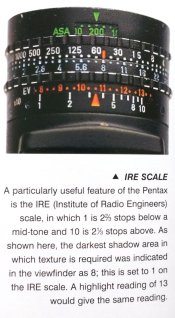
A spotmeter can be useful, if it has the Institute of Radio Engineers scale - it allows you to key to highlights or shadows (see the thumbnail at the end of this post for a brief description from Hicks & Schultz 'Medium and Large Format Photography) - ironically, the 'calibrated' spotmeters talked of upthread (if it's the Zone VI modification that's being referred to) essentially put a sticker over the IRE scale...

My own preference is to use an incident meter reading from a shadow value bastardised from Phil Davis' BTZS methods. Essentially, I am keying to the shadows in the same way as the IRE scale does & aiming my processing for a contrast index in the low mid 0.5s - others go higher, some lower.

I should add that Davis' 'Beyond The Zone System' and other writings are worth a read - far better than Adams for getting an understanding of sensitometry, curve shape etc and their relationships to the final image - yes they can get deep into the weeds of sensitometry and densitometers, but you begin to realise that making a good negative that'll land between Grades 0-5 without awkward dodges and burns is pretty easy.

Not that any of this guarantees a negative that does what you want it to do - it's like learning music theory - ie it gives you the tools to help you communicate what you want to say & it is important to bear in mid that it is not a set of rigid unbending rules - sometimes Richard Avedon's methodology of TXP rated at 200, processed in replenished D-76 for 15 minutes is what is necessary...

hicks schultz spotmeter.jpg
 

tedr1

Member
Allowing Ads
Joined
Feb 3, 2016
Messages
940
Location
50 miles from NYC USA
Format
Multi Format
Why bother with finding the darkest thing with detail, shadow, etc? Or, are you sacrificing some of these zones by using a gray card in situations where it's just too difficult to get a proper exposure/reading? Aren't we trying to "get away" from the middle gray that the camera auto-corrected to exposure wise?

The problem: photographic printing paper has a brightness range of about 100, the brightest white is about 100 times brighter than the deepest black, (this is roughly 6 to 7 stops of exposure). Some subjects (grey cards) have no brightness range. Some subjects (high mountains with the sun above them and snow in the foreground) have a brightness range of hundreds, perhaps even thousands. That is an extreme chosen as an example. Most subjects are somewhere in between the two, no contrast and extreme contrast. Conclusion: depending on the subject, the type of light and the camera location relative to the light we don't know what the brightness range of the subject we are trying to capture is. It may be easily printable (range 100 or less) or, it may be difficult to print (range more than 100) but we don't know till we measure the brightness range.

Once we pass 100:1 something has to "give". There are choices. We can accept the need to dodge and burn our print. We can chose to modify the contrast of the film by varying the development conditions. We can accept that some areas of the print will be empty of detail (empty blacks, empty whites) because they do not contribute to the aesthetics of the image we want. Each of these choices has a plus and a minus side to it, there is no free lunch. These choices and their pluses and minuses are present in the mind of the photographer before the camera exposure is made and they influence the choice of the type of exposure meter to use, how to use it and which of the possible exposure values to chose.

Progress is made by understanding the pluses and minuses of the choices available: dodging and burning; contrast reduction; empty tonal areas.
 
Last edited:

Skiver101

Member
Allowing Ads
Joined
Jan 4, 2017
Messages
122
Location
Scotland
Format
4x5 Format
Hey Corey,
I see 4x5 film photography as a relaxing pastime. I learned the Zoning technique through the same book.
Most of what you ask is addressed by old Ansell in the book -and also by the guys here.
I simply spot-meter a shadow Zone roughly according to the guide Ansell gives on page 60, and then apply development (+ or -) to best suit my highlight requirements - according to the scope of the film. When I properly apply these elements, things work out fine. I have never used a gray-card.
I tend to get lost and somewhat dis-heartened; when I over-analyse.
Simplifying the process in order to dedicate more concentration to the vision is my aim, but I understand that in order to pass a technical test you may have to study a bit harder.
Stick with it until you get some kind of grasp on the technicalities and things will soon become instinctual - and more fun :smile:

Like Ansell said - (paraphrase) 'the ultimate goal is the vision manifest, not the perfection of method' - I'm a photographer, not a scientist.

JP
 

BrianShaw

Member
Allowing Ads
Joined
Nov 30, 2005
Messages
16,947
Location
La-la-land
Format
Multi Format
What media are you putting this image on... color neg, black and white, color positive (slide) or digital sensor?

As Jim Jim and tedr1 point out... each has its characteristics that affect your decisions on placing/falling using spot metering and zone system. Easpecially in a situation that isn't average. Sometimes you can only get so much onto the film/paper and the biggest decision is what to let go.

Divulging this might help the conversation.
 

Bill Burk

Subscriber
Allowing Ads
Joined
Feb 9, 2010
Messages
9,455
Format
4x5 Format
Ah, I think I can clarify something about the gray card, sure it's a reference but... it's not a "key"

It stands in for an average middle gray, can be used to set exposure, gets exposed on film somewhere in the gray region and gets printed somewhere in the middle grays... but it's not where you lock down your tone (except when you do flat graphic art copy work).

A better "key" for deciding your exposure is the deepest shadow where you want detail, or the brightest highlight you want detail, or a person's face...

Then when you choose your print values for those keys, it will be obvious to you where your key value needs to be printed. Low key, high key or when a person's face looks right, it will be obvious. The gray on the other hand, will move around from it's subject 18% value to some other gray value on the print which (due to illusion) will kind of seem like 18% gray even though it isn't.

For you see, the gray card value floats on the print, it's not the key.
 

Peter Schrager

Subscriber
Allowing Ads
Joined
Jul 19, 2004
Messages
4,294
Location
fairfield co
Format
Large Format
Great photo! Thanks for sharing this.

I have a better grasp-not complete-but good enough.

So is it safe to say that spot-metering will render you a more accurate depiction of what you envisioned?

Is that the advantage of metering the subject over a gray card?

And one more question for the evening: when you say "you will get a negative that will print the card out as middle gray", does that mean simply that anything with that tone of gray in the scene to begin with, will simply be placed on middle gray?
Are you photographing cards??...if so then use it!... get a spot meter and a zone dial off tge internet. No thinking needed
 

Peter Schrager

Subscriber
Allowing Ads
Joined
Jul 19, 2004
Messages
4,294
Location
fairfield co
Format
Large Format
Get the Fred picker zone vi handbook
If you do the exercises you will know more than 99% of ALL PHOTOGRAPHERS IN THE WORLD
 
Photrio.com contains affiliate links to products. We may receive a commission for purchases made through these links.
To read our full affiliate disclosure statement please click Here.

PHOTRIO PARTNERS EQUALLY FUNDING OUR COMMUNITY:


Ilford ADOX Freestyle Photographic Stearman Press Weldon Color Lab Blue Moon Camera & Machine
Top Bottom