• Welcome to Photrio!
    Registration is fast and free. Join today to unlock search, see fewer ads, and access all forum features.
    Click here to sign up

Understanding the characteristic print curve

Forum statistics

Threads
201,215
Messages
2,820,583
Members
100,589
Latest member
rando
Recent bookmarks
0

Photo Engineer

Subscriber
Allowing Ads
Joined
Apr 19, 2005
Messages
29,018
Location
Rochester, NY
Format
Multi Format
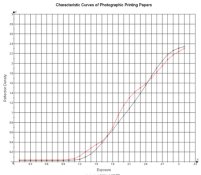
The horizontal (x axis) is only relative LogE and has nothing to do with energy or exposure. This is due to the fact that the light may vary in any way including spectral distribution. A different scale is used for release of curves, as a more absolute horizontal value is used as is a defined light source.

This is especially true with papers and specifically with VC papers where the light can be almost anything.

PE
 

Bill Burk

Subscriber
Allowing Ads
Joined
Feb 9, 2010
Messages
9,455
Format
4x5 Format
Characteristics in this context means the whole number part of the exponent of a logarithm.
...
I don't feel very comfy with logarithms so you do the math and tell me whether this is a reasonable explanation of the way the originally posted graph is constructed.

Yeah the bar over the characteristic means it is negative... and the mantissa is the other part of the number and remains positive... That old notation was useful in the days of slide rules and logarithm charts. But it will make you mad. Today I only use that when I have to, like when looking at historic charts where they were used. Working with those numbers is difficult and confusing.

I recommend using the calculator to convert arithmetic numbers that represent exposure to base 10 Logarithms. After calculating the total you are looking for you can use the antilog function to get the arithmetic number back to double check. That's fun for finding out how many foot candles were figured for sunny 16.

A calculator makes quick work. You can take an arithmetic number and convert to logarithm easily and if you push the wrong buttons on the calculator you will get an error or a number that doesn't make any sense with what you are trying to do.

The density of a photographic material is usually given in logarithmic terms (the definition is certainly round-about but gives us numbers such as 0.0 is clear film, 1.0 lets 10% of the light through 2.0 lets 1% through and 3.0 lets a tenth of a percent of the light through.) Transparency isn't a bad way to think about it, but the measure is how transparent it is not.

When you have a handful of logarithmic values you can add or subtract them. That's how you can easily take two 0.3 ND filters on top of each other, get 0.60 and know that the exposure compensation is two stops.

Again, I assert everyone is right here. Although the original chart is not a "tone reproduction" chart... it is a paper characteristic curve... the x-axis is exposure.

The x-axis is indicated with positive logarithmic numbers. I assert that this indicates the numbers of the densities of the step wedge placed on top of the film when making the test exposure. The base exposure is 1 mathematic, 0.0 logarithmic. Starting on the right and working backwards by 0.1 marks you get a step labeled 0.3 and I assert that is the base exposure reduced by being covered with a piece of film with an 0.3 density.

The negative sign could just as well have been put in front of each of these numbers on that original chart, for example -0.3 would clarify that the exposure is a base exposure minus 0.3 density. The paper received -0.3 exposure.

While exposures can't be "negative", the logarithm of an exposure, which reflects an exponent, can be negative. -2.0 is not a negative exposure, it is ten to the minus two, or one-one-hundredth of the base exposure.
 

Bill Burk

Subscriber
Allowing Ads
Joined
Feb 9, 2010
Messages
9,455
Format
4x5 Format
for those still struggling with it I have converted the values to film transmission %age in RED. Now see they are nicely ascending values but I expect they are even lesss meaningful to you all since they are not log values, but they are what is really happening.

That is good RobC, well done.
 

RobC

Member
Allowing Ads
Joined
Nov 5, 2007
Messages
3,880
Location
UK
Format
Multi Format
Yeah the bar over the characteristic means it is negative... and the mantissa is the other part of the number and remains positive... That old notation was useful in the days of slide rules and logarithm charts. But it will make you mad. Today I only use that when I have to, like when looking at historic charts where they were used. Working with those numbers is difficult and confusing.

I recommend using the calculator to convert arithmetic numbers that represent exposure to base 10 Logarithms. After calculating the total you are looking for you can use the antilog function to get the arithmetic number back to double check. That's fun for finding out how many foot candles were figured for sunny 16.

A calculator makes quick work. You can take an arithmetic number and convert to logarithm easily and if you push the wrong buttons on the calculator you will get an error or a number that doesn't make any sense with what you are trying to do.

The density of a photographic material is usually given in logarithmic terms (the definition is certainly round-about but gives us numbers such as 0.0 is clear film, 1.0 lets 10% of the light through 2.0 lets 1% through and 3.0 lets a tenth of a percent of the light through.) Transparency isn't a bad way to think about it, but the measure is how transparent it is not.

When you have a handful of logarithmic values you can add or subtract them. That's how you can easily take two 0.3 ND filters on top of each other, get 0.60 and know that the exposure compensation is two stops.

Again, I assert everyone is right here. Although the original chart is not a "tone reproduction" chart... it is a paper characteristic curve... the x-axis is exposure.

The x-axis is indicated with positive logarithmic numbers. I assert that this indicates the numbers of the densities of the step wedge placed on top of the film when making the test exposure. The base exposure is 1 mathematic, 0.0 logarithmic. Starting on the right and working backwards by 0.1 marks you get a step labeled 0.3 and I assert that is the base exposure reduced by being covered with a piece of film with an 0.3 density.

The negative sign could just as well have been put in front of each of these numbers on that original chart, for example -0.3 would clarify that the exposure is a base exposure minus 0.3 density. The paper received -0.3 exposure.

While exposures can't be "negative", the logarithm of an exposure, which reflects an exponent, can be negative. -2.0 is not a negative exposure, it is ten to the minus two, or one-one-hundredth of the base exposure.

Yes, If you want to convert the log of film opacity to the log of film transmission percentage, you just negate the log value. Then to convert the log back to decimal you raise 10^negated log which gives the percentage as a decimal fraction of 1. But I assert that the graph is most meaningful as it was published in the book because most people will be familair with negative densities and NOT negative transmission percentages and would therefore not know what they are looking at (not that they did anyway). But essentailly I think we more or less agree.
 

Diapositivo

Subscriber
Allowing Ads
Joined
Nov 1, 2009
Messages
3,257
Location
Rome, Italy
Format
35mm
the chart is not showing exposure time to produce negative density and exposure times vary so stop quoting what you find relating to negative development.
The chart is showing negative density producing print density for a single exposure time. i.e. completely different so you should not keep quoting what you find about negative development.

(bold mine)

OK I think I finally got it but then, again, if the numbers on the X axis are what you say (and I believe they are) then they are not "negative", are they? They show the density of the negative in that point of the print. From left to right the densities are decreasing up to (almost) full transparency of the negative.

"Exposure scale" is simply "density of negative in that point" measured the usual way, only in decreasing density left-to right.

Anon Ymous stated this in #4 but this "negative density" stuff mislead my understanding.

I still cannot rule out I did not understand it at all, though (never printed a thing in my life, but waiting to, one day).

Oh my God now I get it: NEGATIVE density as in "density of negative" not as in "negative as opposed to positive (sign -, sign +)". Geeeee
 
Last edited:

RobC

Member
Allowing Ads
Joined
Nov 5, 2007
Messages
3,880
Location
UK
Format
Multi Format
you got it. Negative density doesn't tell you relative exposure unless you understand logs and that its density in the chart and not transmission percentage. You need to convert using the adjustment from 0 (or 100% tansmission) on the right using the usual each 0.3 log units equals one stop of exposure so that 1.5 on the x axis means 5 stops less exposure than 100% (or 5 stops difference from 0). If you just remember that each 0.3 log units of density equals 1 stop and each 0.1 units of log density equals 1/3 of a stop you don't need to think about logarithms apart from that very simple shortcut.

Negative as in film negative NOT as in less than zero.

I kind of thought you may have misinterpreted that.
 
Last edited:

Diapositivo

Subscriber
Allowing Ads
Joined
Nov 1, 2009
Messages
3,257
Location
Rome, Italy
Format
35mm
I did misinterpreted your words. Very funny thread. Every time I read "negative density" I though "how can a density have a negative value?". I was totally confused. Then I found that old method of referring to negative density with a logarithmic measure based on lux instead of millilux, which gave less than one values (negative exponent of a logarithm). I don't think I was the only one to misinterpret your affirmation about negative density, if you read the thread again is, I think, very funny :smile:
 

Bill Burk

Subscriber
Allowing Ads
Joined
Feb 9, 2010
Messages
9,455
Format
4x5 Format
...You need to convert using the adjustment from 0 (or 100% tansmission) on the right using the usual each 0.3 log units equals one stop of exposure so that 1.5 on the x axis means 5 stops less exposure than 100% (or 5 stops difference from 0). If you just remember that each 0.3 log units of density equals 1 stop and each 0.1 units of log density equals 1/3 of a stop you don't need to think about logarithms apart from that very simple shortcut...

That 0.1 is a third of a stop is very practical for photography, not very mnemonic but it's what you need every day.

Another mental shortcut that often helps me is thinking in the whole powers of 10. It does give negative numbers, but don't let it get you down. Ten to the minus 1 is 10% and ten to the minus 2 is 1% (one hundredth). If you can point to those on the graph, you will know where you are.

And if a number between two points you know is not between those two points... You are probably looking at a chart done up with traditional bar characteristic dot mantissa notation.
 

Gerald C Koch

Member
Allowing Ads
Joined
Jul 12, 2010
Messages
8,131
Location
Southern USA
Format
Multi Format
What is important is the general shape of the curve (which is the same I might add for both film and paper). That is why it is called the Characteristic Curve. So unless one is speaking about a particular film or paper the actual numbers are meaningless.

What is of interest is that the curve eventually turns downward. You can just see this by looking closely. This is what permits "development to completion" to work. But that is another story which I mention only because there are good illustrations for this thread.
 
Last edited:

ic-racer

Member
Allowing Ads
Joined
Feb 25, 2007
Messages
16,694
Location
USA
Format
Multi Format
The graph published is not meaningless if on understands log values, and exposure. There is no universal 'conversion factor' to go from exposure to transmission. Read up on logs. Values less than unity are negative.
 

Gerald C Koch

Member
Allowing Ads
Joined
Jul 12, 2010
Messages
8,131
Location
Southern USA
Format
Multi Format
The graph published is not meaningless if on understands log values, and exposure. There is no universal 'conversion factor' to go from exposure to transmission. Read up on logs. Values less than unity are negative.

You misunderstand my point. It is not that the graph is meaningless but that the specific numeric values are meaningless. They do nothing to explain the graph and only confuse the reader. It would be better to just use relative adjectives such as greater or lesser. This what most texts on photography do.
 

markbarendt

Member
Allowing Ads
Joined
May 18, 2008
Messages
9,422
Location
Beaverton, OR
Format
Multi Format
You misunderstand my point. It is not that the graph is meaningless but that the specific numeric values are meaningless. They do nothing to explain the graph and only confuse the reader. It would be better to just use relative adjectives such as greater or lesser. This what most texts on photography do.
I agree.
 

RobC

Member
Allowing Ads
Joined
Nov 5, 2007
Messages
3,880
Location
UK
Format
Multi Format
What is important is the general shape of the curve (which is the same I might add for both film and paper). That is why it is called the Characteristic Curve. So unless one is speaking about a particular film or paper the actual numbers are meaningless.

What is of interest is that the curve eventually turns downward. You can just see this by looking closely. This is what permits "development to completion" to work. But that is another story which I mention only because there are good illustrations for this thread.

When you consider that the photographic (light sensitivity) scale is exponential and that the only reason logs are used is to contain and straighten the curve then its hardly surprising all characteristic curves look similar so I fail to see whats important about them looking that way.

De log your curves and you would get a far better impression of variances betwen curves.
 

Sirius Glass

Subscriber
Joined
Jan 18, 2007
Messages
50,717
Location
Southern California
Format
Multi Format
The graph published is not meaningless if on understands log values, and exposure. There is no universal 'conversion factor' to go from exposure to transmission. Read up on logs. Values less than unity are negative.

You misunderstand my point. It is not that the graph is meaningless but that the specific numeric values are meaningless. They do nothing to explain the graph and only confuse the reader. It would be better to just use relative adjectives such as greater or lesser. This what most texts on photography do.


+! The graph is conceptual [or notional]. The exact scales and plots depend on the actual paper and developer used for a standard negative.
 

ic-racer

Member
Allowing Ads
Joined
Feb 25, 2007
Messages
16,694
Location
USA
Format
Multi Format
Since the scales are log, one only needs to ADD or SUBTRACT a constant to establish exact values in one's favorite units for the Y-axis in the sample graph shown in the original post. This is the beauty of log representation of information. Multiplication and division are effected via addition and subtraction.
 

Photo Engineer

Subscriber
Allowing Ads
Joined
Apr 19, 2005
Messages
29,018
Location
Rochester, NY
Format
Multi Format
The graph means nothing in real terms. It is, as said above, notional. It is an idea that varies with film, paper, contrast filter (if VC) and light source (temperature).

Attached is a notional aim curve for a VC paper and superimposed is an actual curve from a well known product filtered to give the same general contrast.

PE
 

Attachments

  • bumpy curve.jpg
    bumpy curve.jpg
    87.9 KB · Views: 141

RalphLambrecht

Subscriber
Allowing Ads
Joined
Sep 19, 2003
Messages
14,859
Location
K,Germany
Format
Medium Format
Actually the x-axis of a characteristic curve plot can easily end up with negative numbers growing in magnitude from right to left, depending on the units used for exposure. Remember that the x-axis is the log of exposure, not exposure. Numbers less than 1 will take on negative values of increasing magnitude when converted to logs.

Below is a link to a characteristic curve I plotted. It's for a film, but the principle is identical for paper. On the x-axis, exposure is increasing to the right and the log values of exposure (H) are becoming less negative.

(there was a url link here which no longer exists)

I believe this is what we're essentially looking at on the diagram you posted (with the negative signs omitted). That's the only possibility if the x-axis truly represents exposure as labeled on the diagram. And again, all that's important are the intervals/ranges (ie the exposure range of the paper): characteristic curves for photographic materials are typically constructed such that each log exposure interval of 0.3 on the x-axis represents a doubling or halving of exposure - ie one stop.

If on the other hand the x-axis on the diagram you posted is really supposed to show step wedge densities, then the axis is mis-labeled and should be called something like "step wedge D", not exposure.

A sensitometry primer including characteristic curves for film, paper etc.:

http://motion.kodak.com/KodakGCG/up...en_motion_education_sensitometry_workbook.pdf
actually ,step wedge densities can be seen as exposure for the print.
 
Photrio.com contains affiliate links to products. We may receive a commission for purchases made through these links.
To read our full affiliate disclosure statement please click Here.

PHOTRIO PARTNERS EQUALLY FUNDING OUR COMMUNITY:



Ilford ADOX Freestyle Photographic Stearman Press Weldon Color Lab Blue Moon Camera & Machine
Top Bottom