• Welcome to Photrio!
    Registration is fast and free. Join today to unlock search, see fewer ads, and access all forum features.
    Click here to sign up

Understanding parallax

Grass

A
Grass

  • 3
  • 0
  • 21
Texas

A
Texas

  • 9
  • 1
  • 94

Forum statistics

Threads
203,435
Messages
2,854,650
Members
101,841
Latest member
Jannis
Recent bookmarks
0

SalveSlog

Subscriber
Allowing Ads
Joined
Sep 29, 2013
Messages
270
Location
Southern Norway
Format
Medium Format
I try to understand parallax in depth. Not just like: "For close subjects use the markings in the viewfinder"..

I would think that with my Vito CLR where the viewfinder has 1/1 magnification, things are simple:
moving the object in the finder the same distance and direction as the distance and direction between the lens and the finder, should correct for parallax(?) But in a normal viewfinder, if a camera like Altissa Altix or Ikonta 35 may be considered normal, the magnification may be only 1/2, and parallax is probably not that simple?

I used to be quite adept with geometry, but need help to understand this to my satisfaction.
 
I try to understand parallax in depth. Not just like: "For close subjects use the markings in the viewfinder"..

I would think that with my Vito CLR where the viewfinder has 1/1 magnification, things are simple:
moving the object in the finder the same distance and direction as the distance and direction between the lens and the finder, should correct for parallax(?) But in a normal viewfinder, if a camera like Altissa Altix or Ikonta 35 may be considered normal, the magnification may be only 1/2, and parallax is probably not that simple?

I used to be quite adept with geometry, but need help to understand this to my satisfaction.

But then you would know there is no way to completely compensate for parallax.
 
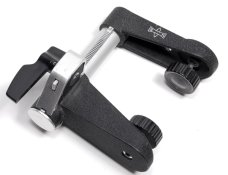
Solution:
Paramender02.jpg
 
That thingy is mounted on a tripod and then the camera on top if it. You screw it down, frame via the finder and then crank up the camera for the height distance between taking lens and finder.


Though, I see such for the first time too and am puzzled by it having two mounting screws instead of one. (The other one would be at the tripod.)
 
What is that gizzmo?

A Paraminder. It is for Mamiya Cx TLR cameras. Compose the photograph in the upper lens, then with the camera and the Paraminder on a tripod raise the camera via the Paraminder to place the lower lens in the place the upper lens was thus correcting for parallax.
 
I like to point this out as something extra to think of when using a rangefinder.

Even viewfinders corrected for parallax will not precisely compose the relationships of near and far elements in the picture.

For example, the parallax reminder lines are there to help you know to recompose for near subjects...

The mountains are still accurately framed by the main lines.
 
A Paraminder. It is for Mamiya Cx TLR cameras. Compose the photograph in the upper lens, then with the camera and the Paraminder on a tripod raise the camera via the Paraminder to place the lower lens in the place the upper lens was thus correcting for parallax.


Which works if Subject Distance (x) = Rangefinder-to-Lens offset (y). If it deviates then you have (pictorially) a changing situation like this...
rangefinder%20offset_zpsfki6i7py.jpg


And in a table, the values are like this...
rangefinder%20correction_zpsifjgeq3n.jpg

.
OP only needs to adjust the values for his actual Rangefinder-to-Lens offset (y). OP, Geometry is no help, Trigonometry is.
 
Paramender works perfectly for all distances; no 'if.'
 
NSFW due to language...

[video=youtube;ck2LMiosXXk]https://www.youtube.com/watch?v=ck2LMiosXXk[/video]
 
That video reminds me of a show on TV about snipers, and in one segment they have a hostage situation and a police sniper on the other side of a wall... the situation got to the point where the sniper had to take out the hostage holder. He fired a shot...nothing. He fired a second shot...nothing again. It was not until before the third shot that the police sniper figured out his rifle sight was seeing above the top of the wall, but the rifle barrel was BELOW the top of the wall. Two rounds of .308 embedded in the wall confirmed his elightened assessment. That settled, the third shot took out the hostage holder!
 
NSFW due to language...

[video=youtube;ck2LMiosXXk]https://www.youtube.com/watch?v=ck2LMiosXXk[/video]

So funny that my sides still hurt! I almost pissed my pants! :w00t::w00t::w00t:
 
I like to point this out as something extra to think of when using a rangefinder.

Even viewfinders corrected for parallax will not precisely compose the relationships of near and far elements in the picture.

For example, the parallax reminder lines are there to help you know to recompose for near subjects...

The mountains are still accurately framed by the main lines.

But that is part of the Zen practice in using a rangefinder.
 
A note on the Paramender: the parallax correction will only be 100% accurate when used with a C series Mamiya. It raises the camera by the exact distance between the centre of the viewing lens and the centre of the taking lens. On most 35mm rangefinder cameras the viewfinder/rangefinder is not located directly above the taking lens but off to one side. Also, the vertical distance between the centre of the viewfinder/rangefinder and the centre of the lens will in most cases be less than the distance covered by the Paramender.
The Mamiya C series focuses extremely close by means of bellows, making the Paramender indispensable when used at distances closer than 3 feet or so. No rangefinder camera I've used focuses closer than about 3 feet.
My practice when using a rangefinder camera is to frame loosely!
 
It is really important to remember that parallax error (to express the problem more accurately) is usually only significant if the subject to camera distance is fairly small - less than about 10 times the focal length of the lens or so.

If you want to compensate for the parallax, and thus avoid the error, it is really quite simple. Just move the camera so the centre of the lens moves to where the centre of the viewfinder was. Without moving the camera back and forth, and keeping the film plane in the same place, of course.
 
Last edited by a moderator:
A Paraminder. It is for Mamiya Cx TLR cameras. Compose the photograph in the upper lens, then with the camera and the Paraminder on a tripod raise the camera via the Paraminder to place the lower lens in the place the upper lens was thus correcting for parallax.

A note on the Paramender: the parallax correction will only be 100% accurate when used with a C series Mamiya. It raises the camera by the exact distance between the centre of the viewing lens and the centre of the taking lens. On most 35mm rangefinder cameras the viewfinder/rangefinder is not located directly above the taking lens but off to one side. Also, the vertical distance between the centre of the viewfinder/rangefinder and the centre of the lens will in most cases be less than the distance covered by the Paramender.
The Mamiya C series focuses extremely close by means of bellows, making the Paramender indispensable when used at distances closer than 3 feet or so. No rangefinder camera I've used focuses closer than about 3 feet.
My practice when using a rangefinder camera is to frame loosely!

That is why I specified Mamiya Cx only and made no reference to any other camera nor any other format.
 
It is really important to remember that parallax error (to express the problem more accurately) is usually only significant if the subject to camera distance is fairly large.

The other way round.
 
But that is part of the Zen practice in using a rangefinder.

Yes, I think I have gotten to the point where it is almost instinctive to me that the sliver of sky above the mountains will be where the framelines were before I focused, and the framelines are there for the focused subject.

I took a silly demonstration shot once where the SLR was superior because it does not exhibit parallax. Big wup the cross in the background lines up with a gap in the churchyard fence. Like I say, it was a silly demonstration that only left me thinking it proved nothing.
 
Assuming that the viewfinder is directly above the lens, couldn't the tripod be raised by the correct amount?
 
Photrio.com contains affiliate links to products. We may receive a commission for purchases made through these links.
To read our full affiliate disclosure statement please click Here.

PHOTRIO PARTNERS EQUALLY FUNDING OUR COMMUNITY:


Ilford ADOX Freestyle Photographic Stearman Press Weldon Color Lab Blue Moon Camera & Machine
Top Bottom