


Jarin Blaschke
Member
Hi all:
Sorry, this is a long one.
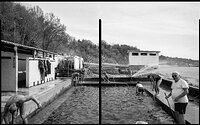
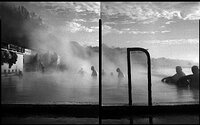
I’ve been exploring staining developers for use in a motion picture machine to increase local contrast. The film is double X 5222. My latest test was pyrocat MC 1:1:100 developed at home vs. D96 processed properly in a large volume motion picture machine. When enlarging only 4-perforations of 35mm film, I prefer the grain structure of MC to Phenidone-based HD. The footage was a subject in a moody low-key lit environment, outside in high contrast light and outside in soft shade. I saw the results projected in a 4k Digital intermediate suite tonight.
To me, compared to a typical solvent developer like D96, pyrocat is an excellent landscape developer- local mid tone separation and texture is excellent. However, seeing it now used with a human subject, and with moody lighting, the tonality is too severe and not quite “pictorial” enough. Additionally, i’m seeing at least a 2/3 stop speed decrease with the pyrocat. I’m now interested in basically splitting the difference between these types of developers. I want very textured skin tones ; this film is not about flattery, but as is, pyrocat MC almost looks like graphic arts when scanned in a motion picture suite.
I’m considering increasing the metol, which is only a trace in pyrocat MC working solution, perhaps from .025 g/L to .1g/L at first. According to Sandy King, increasing metol will reduce the stain, but some loss of stain is ok to me, as it improves the sharpness and texture of the grain itself. I may also put a little sulfite in there to ensure it’s possible to use with replenishment, but not enough to kill too much stain or lose acutance.
So, a couple questions:
1. Increasing the metol by this much, would I likely see an improvement in film speed?
2. How much sulfite should introduce to preserve this developer for use with some degree of replenishment, without losing sharpness or noticeably killing image stain? It needs to work for 4 hours.
3. Should I use sodium sulfite, or the acidic sodium metabisulfite? Does the latter have the same solvent properties as the former?
4. Anything else I should try?
Thanks in advance!
Jarin
Sorry, this is a long one.
I’ve been exploring staining developers for use in a motion picture machine to increase local contrast. The film is double X 5222. My latest test was pyrocat MC 1:1:100 developed at home vs. D96 processed properly in a large volume motion picture machine. When enlarging only 4-perforations of 35mm film, I prefer the grain structure of MC to Phenidone-based HD. The footage was a subject in a moody low-key lit environment, outside in high contrast light and outside in soft shade. I saw the results projected in a 4k Digital intermediate suite tonight.
To me, compared to a typical solvent developer like D96, pyrocat is an excellent landscape developer- local mid tone separation and texture is excellent. However, seeing it now used with a human subject, and with moody lighting, the tonality is too severe and not quite “pictorial” enough. Additionally, i’m seeing at least a 2/3 stop speed decrease with the pyrocat. I’m now interested in basically splitting the difference between these types of developers. I want very textured skin tones ; this film is not about flattery, but as is, pyrocat MC almost looks like graphic arts when scanned in a motion picture suite.
I’m considering increasing the metol, which is only a trace in pyrocat MC working solution, perhaps from .025 g/L to .1g/L at first. According to Sandy King, increasing metol will reduce the stain, but some loss of stain is ok to me, as it improves the sharpness and texture of the grain itself. I may also put a little sulfite in there to ensure it’s possible to use with replenishment, but not enough to kill too much stain or lose acutance.
So, a couple questions:
1. Increasing the metol by this much, would I likely see an improvement in film speed?
2. How much sulfite should introduce to preserve this developer for use with some degree of replenishment, without losing sharpness or noticeably killing image stain? It needs to work for 4 hours.
3. Should I use sodium sulfite, or the acidic sodium metabisulfite? Does the latter have the same solvent properties as the former?
4. Anything else I should try?
Thanks in advance!
Jarin
