

I've done Tmax3200 in Dektol, 1:3 for 3 1/2 minutes at 75F. Sharp, but grain the size of baseballs. Try that as a starting point for your project.
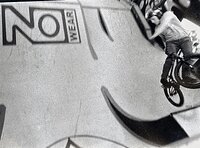
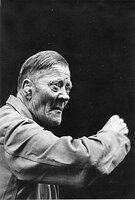
I know this is a physical method, as opposed to chemical, but have you thought about using a grain screen in contact with the neg or print?


awww comm'on clive !
that is too easy
i was going to suggest he shoot a roll of film of grainy texture,
and sandwich it with his negative when he printed it,
or making an enlargement onto lith film and printing through it as you suggested ( like a combination print )
but it is more fun to try to destroy film
john


tkamiya,
I was looking through LP Clerk's Photography Theory and Practice, and think I have some validation of two ideas...
1. Dektol's the right developer to use:
In section 325 Silver Halide Grains... about the filimentary structure of developed silver grains, "they are roughly similar in shape to the original emulsion grains"... "These filiments grow from the sensitivity specks ... leads to some enlargement of the shape"... and "This enlargement is ... greater the more energetic the developer used"...
2. Expose normally or just slightly overexpose (about 2/3 stop over)... and Underdevelop! Try to get the main subject to fall on or around 0.3 density...
In section 345 Graininess... "On a negative the graininess reaches a maximum for a density of 0.3"
You will need to print on Grade 4 or 5 ... but I am sure that you will get the grain you want!
If you want large grain, isnt under developing a bit counter intuitive?
Maybe. Intuitively, I think I've seen grainy prints from underexposed shots.
Fortunately, this could be easily tested. Sensitometric strips would reveal graininess. So step wedge exposures will "cover" all the exposures needed. Then develop a few strips, each to a different Contrast Index. Make a few prints.
Once the exposure and development is worked out, then it's just a matter of selecting "that" Exposure Index and Negative Density Range which meets tkamiya's new definition of quality.
Bill, my point was not about underexposed shots, but under development.
Just did a snip test with the leader of a roll to see how fast and how black Dektol 1:4 works. It's too fast, looked like 2 minutes would be a normal time.
So I did a series with Dektol 1:9 and it's hanging up to dry. We'll see soon enough how this turns out.
My first impression is that this isn't going to be grainy enough.
john
i guess one person's not grainy enough is another person's " holy crap " ..
i have a feeling there is a whole concert in play here,
lighting, film, chemistry + print ... its beautiful when everything works together
i guess clerc or henry didn't know what 2013 grainy meant !

Geoffrey Crawley's FX-16 was designed specifically to enhance the grain effect in fast (ISO 400 and above) films while retaining image sharpness.
| Photrio.com contains affiliate links to products. We may receive a commission for purchases made through these links. To read our full affiliate disclosure statement please click Here. |
PHOTRIO PARTNERS EQUALLY FUNDING OUR COMMUNITY:  |