
Hello -
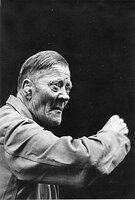
I am referring to the grain in the first attached photograph. The photograph has its problems, it is a bit out of focus, and the car was moving so there is that. But the grain, is something that I care for very much and I want to replicate. Both photographs were developed with Rodinal 1:50, first minute agitation, and four agitations every minute afterward for a total of 13 minutes, as per massive chart. The film was exposed at 400 iso.
This is the catch, while developing, I moved the developing tank from the basement where I had a controlled temperature of 20C (room temp ~17C) up to my studio, where is typically warmer by ~4-5 oC (~22C).
I understand that it is difficult to compare both photographs as they are very different subjects: "indoor" vs "outdoor" for which TriX exhibits very different behavior.
My theory is that temperature played a major role in the 'look' of the first photograph, with grainy shadows, high contrast (t-shirt), with an overall look as if it were a lith print -not saying that it is.
To verify this theory I want to run a test by exposing an 'indoor' subject with controlled lighting and developing the film with 4 different approaches:
1- T=20C, agitation 1st minute, 4 times every minute for 13 minutes
2- T=22C, agitation 1st minute, 4 times every minute minutes for 13 minutes.
3- T=22C, agitation 1st minute, 4 times every three minutes for 13 minutes.
4- T=22C, agitation 1st minute, 3 times every 30 seconds for 13 minutes.
I wanted to run this by you so that I can get any comments on whether or not my reasoning is ok or if I am missing something to replicate the results of that first picture.
thanks for comments,
I am referring to the grain in the first attached photograph. The photograph has its problems, it is a bit out of focus, and the car was moving so there is that. But the grain, is something that I care for very much and I want to replicate. Both photographs were developed with Rodinal 1:50, first minute agitation, and four agitations every minute afterward for a total of 13 minutes, as per massive chart. The film was exposed at 400 iso.
This is the catch, while developing, I moved the developing tank from the basement where I had a controlled temperature of 20C (room temp ~17C) up to my studio, where is typically warmer by ~4-5 oC (~22C).
I understand that it is difficult to compare both photographs as they are very different subjects: "indoor" vs "outdoor" for which TriX exhibits very different behavior.
My theory is that temperature played a major role in the 'look' of the first photograph, with grainy shadows, high contrast (t-shirt), with an overall look as if it were a lith print -not saying that it is.
To verify this theory I want to run a test by exposing an 'indoor' subject with controlled lighting and developing the film with 4 different approaches:
1- T=20C, agitation 1st minute, 4 times every minute for 13 minutes
2- T=22C, agitation 1st minute, 4 times every minute minutes for 13 minutes.
3- T=22C, agitation 1st minute, 4 times every three minutes for 13 minutes.
4- T=22C, agitation 1st minute, 3 times every 30 seconds for 13 minutes.
I wanted to run this by you so that I can get any comments on whether or not my reasoning is ok or if I am missing something to replicate the results of that first picture.
thanks for comments,