• Welcome to Photrio!
    Registration is fast and free. Join today to unlock search, see fewer ads, and access all forum features.
    Click here to sign up

Tripod socket for DIY Large format camera

Recent Classifieds

Forum statistics

Threads
202,986
Messages
2,848,449
Members
101,582
Latest member
LtDave
Recent bookmarks
1

reefman77

Member
Allowing Ads
Joined
Jan 25, 2010
Messages
6
Format
Large Format
I am in the process of building a 8x10 field camera and i am wondering what the best way to make a tripod socket is. are there parts you can buy some where? i have a 1/4-20 thread tap so i could tap the threads myself but im just not sure of the materials to use, how to mount it on the base, etc.
 
What you need is a T-nut. I bought one at my local hardware store for $1.

T-NUT-EVOr.jpg
 
An ultra simple way is to go to a hardware store, get a 1/4-20 nut, chisel a recess for it, and install in into the bottom of the camera (or a piece of wood, and then attach the piece of wood to the camera.

This is how I did it with my 12x20 pinhole. I carefully chiseled out a six-sided hole for a hex nut, from the back side, leaving about 3 or 4 mm of thickness in the bottom plate underneath the nut. I then glued a plug over the nut to retain it (though I did not glue the nut itself).

I suppose you could do just as well by drilling a simple circular hole that is a bit undersized, and then bashing a hex nut in with a hammer, and aligning it with a nail punch. Obviously, this should be done in a piece of wood separate from the camera, and then the wood should be attached to the camera.

There are other sorts of nuts aside from hex nuts too. I just got lazy.

 
Thanks for the fast responses!
i think the T-nut is what i need. i tried using a regular nut but it just didnt seem sturdy enough to me.

Thanks for the tips!
 
Barry Young here on APUG made a couple of nice brass tripod sockets for me at a very reasonable price.
 
If you can't find a T-nut at your hardware store, try a model store. 1/4-20 T-nuts are frequently used, in addition to nylon bolts, to hold the wings on model aircraft.

Roger.
 
You can get 1/4-20 threaded inserts at most hardware stores, you drill a larger hole and this screws right in, and has a 1/4-20 threading on the inside. This is probably the easiest way to do this.
 
You can get 1/4-20 threaded inserts at most hardware stores, you drill a larger hole and this screws right in, and has a 1/4-20 threading on the inside. This is probably the easiest way to do this.

I agree with 3e8 on this point. I tried t-nuts on 16x20 and 20x24 inch cameras. They were not strong enough for that size, but may work for 8x10. The problem with t-nuts is that the load is placed on the base of the nut, with little of it spread into the supporting wood. Over time, the shaft will become loose in the wood and the camera becomes wobbly. With the treaded insert, the load is moved up into the wood. Because the edges of the insert are curved, attaching the screw actually forces the sides of the insert into the wood, creating a more solid bond. I now use the inserts on all my big cameras. But again, the t-nut may work fine for 8x10 as they are not as heavy.
 
The T-nuts should be installed from the top so when tightened down on the tripod it clamps the wood rather than being pulled away from it.
 
With a T-nut or the kinds of sockets that Barry made for me (with 1" flanges, which are wider than most T-nut flanges and wider than the flanges on the original tripod sockets used on both cameras), the flange should be on the inside of the baseboard, so that when the camera is screwed into the tripod or QR plate, the flange presses down on the wood and makes the camera more stable.

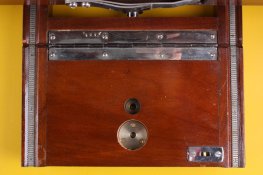
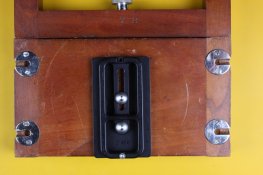
I use Arca-Swiss-style QR plates, so I got these sockets to add a second tripod hole to my 7x17" Korona and 11x14" American Optical cameras, enabling me to attach a QR plate with two screws for additional strength, and so the camera doesn't twist on the tripod.

The attached images show the flanges of the two sockets on the Korona looking down from the top. The one with the larger flange is Barry's and the smaller one is original. The bottom view shows the RRS B35 QR plate attached to the bottom of the baseboard.
 

Attachments

  • 717Sockets.JPG
    717Sockets.JPG
    516.2 KB · Views: 363
  • 717QRPlate.JPG
    717QRPlate.JPG
    351.9 KB · Views: 358
Another option is to use an existing part from a defunct camera. I used the threaded insert from an old Mamiya C33. Behind the vinyl trim are three fixing screws.

image313.jpg


Steve.
 
I just used ordinary wood screws. One advantage of having Barry make them is that I could specify a flange size that corresponds to a flat drill bit that I already own (1") for the countersink.
 
I would recommend the B or C type shown instead of the barbed types. Secure them with screws. You can also use glue under the flange for added stability.
If the wood is robust enough, I like the idea of the threaded insert. That's very stable, even more if it is installed with glue. Also, those are usually brass instead of thin walled aluminum.
Whatever you use, if you use glue as part of the installation, insert a screw with a film of oil on its threads into the threads of the insert. Remove it after the glue dries.
 
Note that the Kirby site show the fittings inserted from the top also.
When installed like this, the woodscrews aren't really a working part of the tripod socket. They just keep it from rotating or becoming loose.
 
I had noticed that on the kirby site and that seems like it might be the strongest option but im not exactly sure how to do it. all that i got out of his write up was that he uses a brass bush? does anyone know more specificly how to make a tripod socket like that? im realy concerned about stability. it would be very disapointing to have all my hard work destroyed after the camera comes crashing down because of a faulty tripod socket.
 
Either the Barry Young route or T-nut.
With a standard 1/4 or 3/8 t-nut the flat section will be about 3/4" diameter. That seems to be about the norm.
The advantage to Barry's is it's a much larger flange & will spread the load better. If it's brass, it will be prettier too.
 
Something worth considering if it's a very heavy camera is that the tripod thread isn't actually 1/4 20 UNC. It is 1/4" British Standard Whitworth which is also a 20 threads per inch thread but is cut at an angle of 55 degrees instead of 60 degrees for the American UNC thread.

For all practical purposes they are interchangeable but if you are having a brass insert made specifically for this purpose it would be a good idea to have it tapped with the Whitworth thread.


Steve.
 
The Skink tripod socket is what I used on a 4x5 pinhole camera I made. They are obviously very heavy as they are made of stainless and quite large diameter. That said, it is the way to go for holding anything large.

i just found this on Ebay.
http://cgi.ebay.com/Skink-tripod-so...emQQptZLH_DefaultDomain_0?hash=item439d00d483
i also think i will contact Barry and see if he can make me one. im also wondering how to go about attatching it. can i just use basic wood screws to screw it into the base? or should i have something on top like shown in the picture here http://www.raymentkirbycameras.co.uk/build-your-own-camera/finishing-the-job.html
 
I think that if your camera is large and heavy, that a 3/8" t-nut or insert would be the size of choice, as opposed to 1/4". Looks like the Skink is well made and should fit the bill nicely.

Rick
 
Photrio.com contains affiliate links to products. We may receive a commission for purchases made through these links.
To read our full affiliate disclosure statement please click Here.

PHOTRIO PARTNERS EQUALLY FUNDING OUR COMMUNITY:


Ilford ADOX Freestyle Photographic Stearman Press Weldon Color Lab Blue Moon Camera & Machine
Top Bottom