• Welcome to Photrio!
    Registration is fast and free. Join today to unlock search, see fewer ads, and access all forum features.
    Click here to sign up

Tri-X looks too grainy to me

Lowlight freestyle

A
Lowlight freestyle

  • 0
  • 0
  • 39
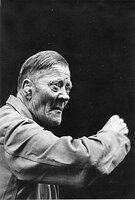
man arguing 1972

A
man arguing 1972

  • 7
  • 3
  • 84

Recent Classifieds

Forum statistics

Threads
203,022
Messages
2,848,736
Members
101,602
Latest member
chasmccl
Recent bookmarks
0
One last thought Adrian, is this print a full frame print (looks like a 6x6) or is this cropped/enlarged than the full frame of the negative? When you enlarge more than the full frame neg, your grain will become more pronounced too...
 
Tri-X is grainy in comparison to many films and HP5 400 is probably the closest replacement in terms of 400 speed films, but it also has a pronounced grain. I find TMax 400 less grainy but to have more contrast, and not in a good way. TMax 100, Delta 100, and Acros are favourites of mine.

It's a great shot and can probably be printed beautifully at a decent size (maybe not up to 8x10). Looks a little flat, so I too would guess underexposure is the culprit. Tri-X and HP5 can be wonderful, but as we each have our own tastes when it comes to what is the perfect amount of grain, you may need to play with it a little before you're satisfied. Good luck! :smile:
 
A few points:

1. Increased exposure increases granularity
2. The subjective sense of graininess depends not only on the objective granularity of the negative, but also contrast and subject matter, among other variables
3. If HC-110B is found to be too grainy with Tri-X, it may be worth trying XTOL (stock strength) which, all things being equal, will tend to produce slightly finer grain. Stock D-76 would be somewhere in between, but the differences are small
4. For significantly finer grain in a 400 ISO film, TMY-2 is the way to go

That is true about exposure once one has ENOUGH exposure - additional, while it may do no harm in terms of tonality with modern films that have little shoulder, increases grain. But significant underexposure also produces grainy looking results. The grain isn't actually larger, but fewer grains are exposed leading to more transparent film areas between grains. The result is grain that LOOKS grainier.
 
2. The subjective sense of graininess depends not only on the objective granularity of the negative, but also contrast and subject matter, among other variables

This is probably the most significant point as to whether grain is objectionable or beautiful.
 
When Kodak T-Max film was first available decades ago I switched from Tri-X to T-Max 400 (and sometimes T-Max P3200) and haven't used Tri-X since then.

Kodak no longer makes Tri-X or Tri-X Professional. They made extensive changes in their films a few years ago when they move their coating facility to a new machine. There was a press release at the time. This was also evidenced by Kodak changing the names of their films with the convention of the speed being given first in the name. Tri-X 400 became 400TX, Tri-X Professional became 320TXP. There were also changes to each film's box. The RMS granularity for 400TX changed significantly from that of Tri-X. Come on people you're not paying attention. I would encourage you and others to revisit this film. You may be pleasantly surprised. As I mentioned previously 400TX is the finest grained film in its speed class.
 
Last edited by a moderator:
Gerald - Do you belive the "Kodak misprinted the HC-110 400TX time to be 3:45, when it should've been X" theory?
 
Kodak no longer makes Tri-X or Tri-X Professional. They made extensive changes in their films a few years ago when they move their coating facility to a new machine. There was a press release at the time. This was also evidenced by Kodak changing the names of their films with the convention of the speed being given first in the name. Tri-X 400 became 400TX, Tri-X Professional became 320TXP. There were also changes to each film's box. The RMS granularity for 400TX changed significantly from that of Tri-X. Come on people you're not paying attention. I would encourage you and others to revisit this film. You may be pleasantly surprised. As I mentioned previously 400TX is the finest grained film in its speed class.

Gerald, that's a good way to get a rumor started. I know what you're saying, but it could be easily misunderstood. About gave me a heart attack.

KODAK IS STILL MAKING TRI-X FILM. They are TRI-X 400 and TRI-X 320, AKA 400TX and 320TXP.


www.kodak.com/global/en/professional/support/techPubs/f4017/f4017.pdf
 
Sorry, but if I had said that Tri-X is now 400TX most people would not notice. Far too many don't read posts but only give them a quick scan and forget what they say. As I said Kodak no longer makes these two films and the new versions are very different from the old ones. Everyone needs to realize that data applying to the old films is no longer valid. This is the very reason that Kodak changed the names.

If someone fails to READ my entire post then the fault lies on their shoulder's not mine.
 
Again from the tech pub

My emphasis added

—NOTICE—
To reflect our enduring commitment to black-and-white photography, black-and-white film production will take place in an even more advanced film-coating facility. New technology applied to these superior, time-tested emulsions will result in slightly different processing times for the film family. But the same great films—those you've known and trusted for years—will still deliver the same breathtaking results.
 
Sorry, but if I had said that Tri-X is now 400TX most people would not notice.

That is what you said.

If you had said that TRI-X is now TRI-X 400 and TRI-X Professional is now TRI-X 320 you would have been clear and accurate. Old name, new name.
Old designation TX 400 became new designation 400TX; TXP 320 became 320TXP.

Then you could have made your valid and correct point that more than the names changed, and old data sheets no longer apply.

This thread will likely be turned up by Google, Bing, etc. searches, which is why I pointed out how your post could mislead and wanted to make sure it got clarified.
 
Last edited by a moderator:
Thanks for all the feedback :smile:
This frame was taken with 35mm (Nikon F80 + Nikon 85mm 1.4D). After scanning I cropped to 1:1 factor (most of the time, I prefer square format).


I will try other rolls improving the exposure.


Thanks again for the feedback and help.
Adrian
 
Thanks for all the feedback :smile:
This frame was taken with 35mm (Nikon F80 + Nikon 85mm 1.4D). After scanning I cropped to 1:1 factor (most of the time, I prefer square format).


I will try other rolls improving the exposure.


Thanks again for the feedback and help.
Adrian

Adrian you may also have scanning/digital processing issues along with exposure & development issues.

I say this because film is a very forgiving medium. Tri-X specifically is a very forgiving film of both under and over exposure and is forgiving in development.

Shoot at an EI of 800, 400, or 200, or even 100, you'll get something workable. Develop that roll at 3-1/2 minutes or 6 with HC-110 at dilution B and you will get you something workable. I'm not suggesting that Tri-X will be at its best or that it is good practice to work sloppily, just that you'll get something workable that prints somewhere in the ballpark of Tri-X's normal look.

I absolutely encourage you to play with Tri-X some more and refine your exposure and developing methods. Having a well controlled and well tested work process (clear to print) can minimize Tri-X's grain but the grain never going away; it is simply part of Tri-X's "DNA". You should also refine the digital side too, maybe over at DPUG.org you can get some pointers.

I'd also suggest that you play with some TMY or FP-4 to see if they might fit your sensibility better. In a sense when choosing a film you are choosing a pallette to work in, much like choosing oils or pens or watercolors to draw with. That's part of the joy of film, picking the general look you want before you go shooting.

Grain is just a characteristic, not a flaw.
 
All I can add to this is the grain of Tri X is super and what workers like I try to see when we make prints.

btw HP5 is no slouch either for having nice grain..

as Flotsam says, Its suppose to be there....:munch:
 
...and I think everyone agrees that 3.5 minutes [HC-110 Dil B @20c] was a misprint that Kodak for some reason never fixed...

Can you or somone explain this "mis-print" that has gone on uncorrected for what now, 10 years?

I don't buy it. Gerald brings up a good point that "Tri-X" has changed over the years.

Is it not true that almost all the dev times changed when Tri-X evolved to be 400TX? (Let's just talk 35mm film so as not to bring is more varriables bc that is what the OP is using).

For eg, when I compare the times pre-change (aka Tri-X Pan - TX) to post change, I see lots of times change:
Small tank - Tmax Dev 6 min vs 5 3/4 when at 20c
Small tank - D76 Dev 7 1/2 min vs 6 1/4 when at 20c
Small tank - HC-110 6 1/2 min vs 3 1/2 when at 20c

Current guide (2007):
http://www.kodak.com/global/en/professional/support/techPubs/f4017/f4017.pdf

Prior guide (2003):
http://www.kodak.com/global/en/professional/support/techPubs/f9/f9.pdf

Ron / Pixel-Prof - or any Kodak'r care to put this to bed?
 
Though I am a Kodak'r, I'm in a different role, so any discussions I join at APUG I speak for myself as a photo-enthusiast (my opinions and positions are not necessarily those of EKC).

Today, in the wash, is a roll of fresh 35mm 400TX which I developed deliberately to MAXIMIZE grain - Dektol 1:9 for 5 minutes. EI 200 shot in a half-frame camera and anticipating to require Grade 4 printing.

I'll show a print / crop when done and you can see what I believe is a maximum grain, this may give an edge to compare against.
 
The "old" time for Tri-X in HC110 dilution A was 3.75 minutes.

I believe the mis-print is that 3.5 minutes is supposed to refer to dilution A.
 
Still hanging up to dry, but through a loupe, there is something "very interesting" going on in my Dektol-developed negatives.

The grain itself is not "bigger" but the images are "wild". For lack of a better word, it looks a little like reticulation. Perhaps the "infectious" nature of Dektol caused some clumping.
 
Can you or somone explain this "mis-print" that has gone on uncorrected for what now, 10 years?

I don't buy it. Gerald brings up a good point that "Tri-X" has changed over the years.

Is it not true that almost all the dev times changed when Tri-X evolved to be 400TX? (Let's just talk 35mm film so as not to bring is more varriables bc that is what the OP is using).

For eg, when I compare the times pre-change (aka Tri-X Pan - TX) to post change, I see lots of times change:
Small tank - Tmax Dev 6 min vs 5 3/4 when at 20c
Small tank - D76 Dev 7 1/2 min vs 6 1/4 when at 20c
Small tank - HC-110 6 1/2 min vs 3 1/2 when at 20c

And nothing strikes you as odd about that pattern? All the dev times got shorter; by only a few percent in Tmax, by about 15% in D-76...and by almost 50% in HC-110?? To me that stretches believability.

It's also, as far as I know, unprecedented for Kodak to recommend a development time that short---most people would say it's too short for good reproducible results, because the effect of any small variation is magnified as a fraction of the short base time and because it's too close to the induction time. Finally, everyone I've seen write from experience on the subject has converged on ignoring the published time and using something more in line with the pattern you'd expect above: typically 6 minutes or so.

I dunno---does anyone find, in practice, that the "official" times *do* work? I usually use other developers with TX anyway, so for me it's a theoretical discussion.

-NT
 
And nothing strikes you as odd about that pattern? All the dev times got shorter; by only a few percent in Tmax, by about 15% in D-76...and by almost 50% in HC-110?? To me that stretches believability........

-NT

I always wondered about that too. Surely someone has done some basic tests with a densitometer? Maybe I should try, given that Neopan400 is finished (my only film for years).
 
Hey Nathan, yes the varriance from pre/post change for HC-110 dil B is a bit outside of the norm, seems most devs had 5%-20% decrease, whereas HC-110 dil B had a 100% decrease.

So I am now becoming a bit of a "HC-110 Dil B conspiracy theorist" with you all now, two reasons, 1) Arista Premium 400 doesn't list a HC-110 dil B time, and 2) the HC-110 dev time in the HC-110 psf is different from the Tri-X (or shd I say 400TX) time of 3.75 mins vs 3.5 mins respectively.

Odd huh? It's like Freestyle threw out the HC-110 dil B time altogether???
(there was a url link here which no longer exists)

Think I gotta email em to get to the bottom'a this....

I drives me batty seeing the Tri-X 400tx pub say 3.5, HC-110 pub 3.75, Freestyle saying "no comment", Massive Dev saying 400TX 4.5 with a footnote "Kodak time of 3.75 mins is considered to be short"......I find this quite bothersome for a manufacture to give times 1) that are different 3.5 vs 3.75 and then in the same breath say "Note: Tank development times shorter than 5 minutes may produce unsatisfactory uniformity." Why even get in the "business" of giving a HC-110 dil B time and then say it will be likely unsatisfactory. Why not give a dil D or something that won't make us all scratch out heads and debate it online?!

Adrian - you confused? Cus I am.

Btw I have dev a roll of 400TX at 3.75 min (20c) dil B and it looked good....

But something smells odd here, this has been brewing for 10 years now?!

Ohhhh Ron/Pix-prof or some other Kodak crew care to set this straight?
 
Last edited by a moderator:
Whatever Michael,experience has taught me that badly underexposed negatives produce prints that at least look grainy and, in fact, look a lot like what the OP posted including lack of shadow detail and contrast.
 
Well, one thing is clear to me: Tri-x are NOT for kids!:sideways:
 
Photrio.com contains affiliate links to products. We may receive a commission for purchases made through these links.
To read our full affiliate disclosure statement please click Here.

PHOTRIO PARTNERS EQUALLY FUNDING OUR COMMUNITY:



Ilford ADOX Freestyle Photographic Stearman Press Weldon Color Lab Blue Moon Camera & Machine
Top Bottom