• Welcome to Photrio!
    Registration is fast and free. Join today to unlock search, see fewer ads, and access all forum features.
    Click here to sign up

Tri-X in Rodinal. Part II

Sacred

A
Sacred

  • 0
  • 0
  • 11
San Miguel Arcangel

H
San Miguel Arcangel

  • 0
  • 0
  • 25

Recent Classifieds

Forum statistics

Threads
201,958
Messages
2,832,692
Members
101,031
Latest member
charotarguy
Recent bookmarks
0

gone

Member
Allowing Ads
Joined
Jun 14, 2009
Messages
5,504
Location
gone
Format
Medium Format
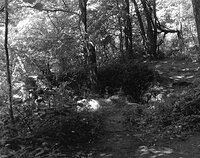
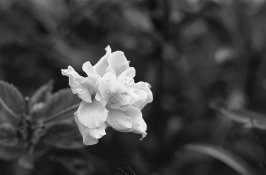
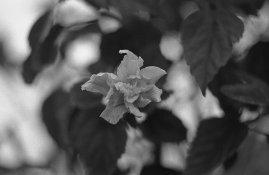
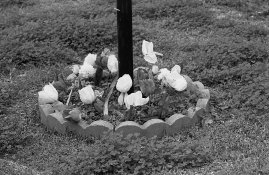
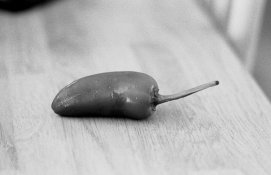
I'm beginning to get the hang of this Rodinal (Fomadon R09). These came out w/ a lot less grain than my first attempts. I mixed it 1:25, and developed it for 7 minutes at 68 degrees. The convenience of a one shot developer cannot be understated. It makes things so much easier. I set the camera to 200 ISO and used a yellow filter.

It's from my usual N8008s w/ a Leica R 90 Elmarit, and I think that's part of why things look better. The Nikon has a very consistent shutter and a great meter. Only the last shot shows the typical Rodinal grain because of the big expanse of light areas. Wonderful developer.

apug nr8.jpg

apug nr9.jpg

apug nr 6.jpg

apug nr4.jpg
 
Last edited by a moderator:

Richard S. (rich815)

Member
Allowing Ads
Joined
Jan 14, 2003
Messages
4,924
Location
San Francisco
Format
Multi Format
Quite nice. I've always used Rodinal at 1:50. Thought I read that at 1:25 it was more grainy. My sense is that 1:50 is by far the most common way Rodinal is used....but I could be wrong.
 

BetterSense

Member
Allowing Ads
Joined
Aug 16, 2008
Messages
3,151
Location
North Caroli
Format
35mm
So, what do you think you are doing to minimize grain?

I'm apartment living right now and decided I would use Rodinal for convenience. I immediately noticed the grain with 35mm trix. Does lower temperature help minimize it?
 

dorff

Member
Allowing Ads
Joined
May 31, 2011
Messages
443
Location
South Africa
Format
Multi Format
Quite nice. I've always used Rodinal at 1:50. Thought I read that at 1:25 it was more grainy. My sense is that 1:50 is by far the most common way Rodinal is used....but I could be wrong.

I had it the other way round: Due to the acutance effect, it also very slightly accentuates the grain at 1:50. It is better from acutance perspective to use it at 1:50, and to agitate not more than 2 or three gentle inversions once a minute (or less often). By using less agitation, one can pull up the mid-curve, but one must remember to increase the total developing time in that case. At 1:25, Rodinal is somewhat less special in terms of acutance, and grain is not much different between the two dilutions. So unless you need shorter dev times, it is better to use 1:50. Some films have really long dev times at 1:50, but they are the exception. FP4+ is one of the culprits, as is Kentmere 400.

So, what do you think you are doing to minimize grain? I'm apartment living right now and decided I would use Rodinal for convenience. I immediately noticed the grain with 35mm trix. Does lower temperature help minimize it?

Yes, developing at 16 degC will reduce the grainy appearance, but it cannot be eliminated for a film such as Tri-X, HP5+ or similar. You either like the grain or not, and if you hate it, then Rodinal is probably not your developer and Tri-X is probably not your film. It is worth saying that the higher the temperature, the worse the grain issue becomes. So if you like the Tri-X in Rodinal look, but are slightly grain averse, keep the temperature down as much as you can. If you want less grain, then seriously consider TMax 400 and develop it in D76 or Xtol. That will give better results from a grain perspective.

The number of grains and their physical size of course do not necessarily change, but their appearance and the way they develop into one another do change. So one can get fine, sharp grain or blotchy or lumpy grain. The fine sharp type is preferrable to me, and is what you will get if you use Rodinal and tame the temperature (20C/68F and below). I always think of Rodinal as an honest developer - it shows the film as it is. No solvent shenanigans or anything like that. However, there is the trick of diluting the Rodinal 1:50 or 1:25 into a 100g/L sodium sulphite solution. That will give a solvent effect which will reduce the grain appearance similar to D76 at stock strength. It is a much more expensive way to use Rodinal, so is not often done.

EDIT: One more thing - if you don't like grain then don't overdevelop the film. You will have the best grain result with a negative that is as thin as you can afford to have it while still getting the full scale that you want to print. If you must, then increase the EI and trim back the developing time. As with most things, you'll have to do your own testing here and not solely rely on what others tell you. This is one of the reasons why 35 mm is developed thinner than 4x5, as on the latter the grain is hardly ever an issue and as a denser negative can accommodate a wider tonal scale it is preferable to err on that side.

 
Last edited by a moderator:
OP
OP

gone

Member
Allowing Ads
Joined
Jun 14, 2009
Messages
5,504
Location
gone
Format
Medium Format
I think the key, in my negs anyway, is to have correct exposure in the first place. That's why my Nikon camera is better for this developer. Rodinal seems a lot less flexible in this regard compared to my usual developer, D76. Ditto on the developing. I'm learning to keep my times, agitation and temps exact, vs "pretty close", which again works fine for the D76. On the 1:25 vs 1:50, aspect, I'm 62 years old. I don't have time to wait around on long development times. I got stuff to do! 7 minutes is plenty long enough to spend on developing a roll of film, and in my mind, longer times just mean more chances to miss an agitation cycle and screw up the consistency. I give it 15-20 seconds of gentle agitation initially, one inversion every 30 seconds thereafter, and none the last minute. Fixing is w/ Kodak Rapid fixer, and it's 30 seconds of gentle agitation, followed by 2 inversions every 30 seconds, and fixed for 5 minutes. Your water/thermometer may call for slightly different times.

I also use my D76 straight up, not 1:1, and find that it is "better" this way. A lot of people have differing ideas on this, but I think that weaker dilutions do not necessarily lead to sharper and "better" negs, at least on the developers I use. It just means longer development times. Just get the thing developed and move on so you can print it. I don't have any theories or formulas to back me up on this, just what I see in front of me, and since this is a visual thing I'll go w/ that.

This has been said by a lot of people and it's true. Rodinal is a developer that you can tailor make the results you're after if you're willing to experiment with it. It doesn't have just one look, which is more of a D76 characteristic. Others have also said that it isn't good for 400 speed film, a point I cannot agree on. These Nikon negs are nearly as smooth as my D76 developed negs on the grain thing. True, something like T-Max would have given less grain, but I don't care for that look. The Tri-X grain is definitely different w/ Rodinal. It's an individual taste whether the D76 or the Rodinal grain is for someone. It WILL appear to some degree or other w/ the Rodinal in large areas of flat tones w/ Tri-X, while it may not be that noticeable in D76 if everything is nailed. But hey, it's Tri-X. I love the grain to this film.
 
Last edited by a moderator:

baachitraka

Member
Joined
Apr 6, 2011
Messages
3,649
Location
Bremen, Germany.
Format
Multi Format
You may find sweet spot around 3+100 thats, 9ml of Rodinal in 300ml of water.

@1+50, I got slightly muddy hightlights.
 

dorff

Member
Allowing Ads
Joined
May 31, 2011
Messages
443
Location
South Africa
Format
Multi Format
Momus,

Whatever workflow and method works for you, use it. If you manage to find the right balance for yourself then you can focus on the photography, which is as important (if not more) as the technique.

I should also add another thing: I find it very difficult to form an opinion based on film scans. And I am including my own scans here, too. There is something about the way the scanner converts reality into virtual reality that affects the appearance of grain, to the extent that a print from the same neg looks wonderful with fine sharp grain while a scan looks horrible with mushy grain. I have seen it countless times with my own work, and I therefore do not even try to judge a grainy film based on a scan. Acros is the only b/w film that I have no reservations at all about scanning. The others all need to be "managed", to a lesser or greater degree. Tri-X is one of the trickier ones. So if you haven't printed these, try to do so, and you might get a very pleasant surprise from the worst (ito grain) of them.
 
Photrio.com contains affiliate links to products. We may receive a commission for purchases made through these links.
To read our full affiliate disclosure statement please click Here.

PHOTRIO PARTNERS EQUALLY FUNDING OUR COMMUNITY:


Ilford ADOX Freestyle Photographic Stearman Press Weldon Color Lab Blue Moon Camera & Machine
Top Bottom