
• Welcome to Photrio!
    Registration is fast and free. Join today to unlock search, see fewer ads, and access all forum features.
    Click here to sign up

Tri-X, HC 110, and me...

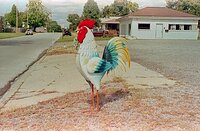
The Chicken

A
The Chicken

  • 1
  • 2
  • 17
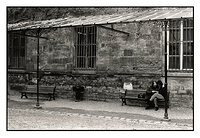
Amour - Paris

A
Amour - Paris

  • 0
  • 0
  • 53

Recent Classifieds

Forum statistics

Threads
203,235
Messages
2,851,866
Members
101,740
Latest member
Andrewford
Recent bookmarks
3

Steve Mack

Member
Allowing Ads
Joined
Nov 4, 2006
Messages
142
Location
Dillwyn, Vir
Format
35mm
I decided to give Tri-X a try (pun intended!:tongue:), since I can get it for a reasonable price, and I bought some HC 110 to go along with it. I bought the HC 110 because I can mix up a batch as I need it; I'm a slow worker, and sometimes a pre-mixed batch of other developer doesn't get used up before it rots (have had it do that in a jug, or at least it SMELLED rotten.)

Anyhow, I get it home and find out that the development time for Tri-X with HC 110 is 4 and 3/4 minutes, max. However, the disclaimer on the Tri-X deveopment sheets states that good results can't be always expected if the development time is less than 5 minutes. How badly have I messed up? Should I have gotten D-76 instead?:confused: Or can I just go ahead and round out the development time to 5 minutes?

Thanks to all who reply.

I've been using Ilford and Ilford developer before.

With best regards.

Steve
 
no, the hc110 will be fine, just use the older times. in our lab we use solution b at 68 for 6 minutes even tho the old times where about 7 minutes.

this is a long time problem that has never been corrected from Kodak, when they changed plants and the formula about 5 years ago those times appeared which drove a lot of folks to "drink", So , we just continued to use the times as in the past with no regrets.
 
HC 110 can be used at several different dilutions, Kodak's time for Tri-X using dilution B is 7 1/2 minutes and more, depending on your exact methods.
If you don't have it yet, here's a link to the Kodak datasheet; http://www.kodak.com:80/global/en/professional/support/techPubs/j24/j24.pdf

Also Jason Brunner, who is one of the moderators has a simplified method for dealing with dilutions of HC-110 and some recommended timings; http://www.jasonbrunner.com/hc110.html
His method gives you an 8 minute starting time.
 
No, you haven't messed up too badly. One of the very neat things about HC-110 is that you can use it at other than the recommended dilutions. When you dilute the developer more, the development times will grow longer. One of the contributors here, one Mr. Jason Brunner, has an excellent web site with some guidelines for using HC-110 at the 1+49 dilution. You can find that here. Though I do not personally know him, his advice is sage.
 
@ ashokgoyal42 - Ilfotec HC is very similar to HC-110.

@ OP - The advice to look at Jason Brunner's web site for some good recommendations on using HC-110 is good.
For what it's worth, I have always used the 'unofficial' Dilution H, which is twice the dilution of Dilution B, 1:63. That gives nice long development times in the 10m region, and it's very economical to process film that way. I've tried that with Plus-X, TMax 100 and Fuji Acros, and it works a charm. HC-110 is a good all-round developer, and you definitely don't have to look at D76 or any other developer - just learn some more tricks with HC-110.

- Thomas
 
Good advice Thomas

HC110 is an excellent developer, just find the mix that works well for you.

Mike
 
I vote for HC110...and Rodinal. This is always polarizing but, in my opinion, with these two developers you would have all bases well covered. Easy to use, longevity and economical. Can't really beat that. I like to have some fun with Rollei RLS for low speed film and that works very well but for everything else I always go back to these guys. Tri-X in HC110 is wonderful and I use either dilution H or G (B sometimes for street-shots). Just developed two rolls of Tri-X with these two dilutions and posted a few images here..http://www.flickr.com/photos/leicaman/

The set at dilution H was developed @ 75 degrees for 8 1/2 minutes, with two gentle inversions at the beginning and two at the 4 min mark..that's it. Shot @ 400, 11:00 am, full sun. The dilution G set (1:119, 6ml syrup+720ml water) was also shot @ 400 but later in the afternoon, with milder lighting and little haze. 16 minutes @ 75 degrees with gentle inversions for the first minute and two every two minutes thereafter.
 
I can't import Rodinal so I've decided to brew it myself, based on the formula in Darkroom Cookbook. I've heard so much about it - and it excites me because it will allow me to stand develop as well as slow develop - which I believe will be better for my room temp.

Looking forward to experimenting with HC110 as well. Thanks for lead in.
 
I did alot of testing with DDX at 1+9 instead of 1+4 with Delta 100, but in 35mm I did not like the results. Too grainy for me. I was experimenting with severe minus development/compensation. From that perspective, it worked very well, allowing for alot of contrast reduction while still maintaining pretty good film speed, which suggested to me DDX is more similar to T-Max than HC-110.

I looked up the MSDS of HC110, LC29 and DDX all three are hydroquinone based with different strengths. But LC29 and DDX have another chem I'm not familiar with so can't really say that these three are of the same family.

I want to dilute and elongate my development time for normal developmet. I will come back with details after I'm done...
 
Tri-X in HC110 is what I use for all my
medium format work. I use a recipe that
another photographer passed on to me.
I shoot the film at EI 200, then process
for six minutes in a dilution of 5/8 ounce
HC110 to 900ml water @ 68F, agitating
every 30 seconds. I've relied on this
recipe for years and it's never failed me.
 
Sanders

My math isn't to good, do you know what 5/8 ounce equals in ML? Just curious how much different the dilution I use is from yours.

Thanks

Mike
 
1 US fluid oz. = 29.57 ml. So (29.57 / 8) * 5 will give you the answer. Approximately 18.5 ml. An English fluid ounce is slightly smaller than a US fluid at 28.41 ml. to the ounce. Take that into consideration when making the calculations.
 
Makes sense, then Sanders is using a touch more than double the syrup and just under half the time I use.

Mike
 
Thank you to all who replied to my original post.:D I'll be trying some of the recommendations out, just as soon as I finish up a roll.

With best regards.

Steve
 
Tri-X in HC110 is what I use for all my
medium format work. I use a recipe that
another photographer passed on to me.
I shoot the film at EI 200, then process
for six minutes in a dilution of 5/8 ounce
HC110 to 900ml water @ 68F, agitating
every 30 seconds. I've relied on this
recipe for years and it's never failed me.

Hi Sanders,

Fantastic images!!

Question..One inversion every 30 seconds?

Thanks,

Max
 
It appears that my recipe is based
on Kodak Dilution E, FWIW.

Which for all intents and purposes is so close to Jason Brunner's 1 + 49 dilution recommendation as to be functionally identical.

Isn't it wonderful how small this world can be :smile:?
 
Be careful! Kodak's recommended times for Tri-X and Plus-X in dilution B are dead wrong. These crazy three-minute times are for dilution A, not B. It is either a misprint or a mistake in testing, but whatever the reason, it has not been fixed for years, TMK.

Check out Ilford's recommended times for Tri-X 400 and Plus-X in their Ilfotec HC developer at 1:31 (the same as Kodak's dilution B), and that should give you a starting point, since Ilfotec HC and HC-110 are effectively the same developer. There is no way in hell that the time difference for a film in Ilfotec HC versus the same film in HC-110 could be as great as the published differences are (around three minutes difference). Also, note the similarity of the recommended times for Tri-X and Plus-X in Ilfotec HC 1:15 (the same as Kodak's dilution A) to Kodak's recommended times for Tri-X and Plus-X in HC-110 dilution A. They are near identical.

All these comments apply to Tri-X 400 only, not Tri-X 320.
 
Last edited by a moderator:
I've been using HC-110 with Tri-X pretty seriously for the last six months or so and I highly recommend the following two sites:

http://www.covingtoninnovations.com/hc110/
http://www.jasonbrunner.com/hc110.html

I follow Michael Covington's recommendations about decanting the syrup into 125ml glass bottles and using a baby syringe for vending it out. Jason Brunner's recommendations of using the 1+49 dilution makes diluting the syrup much easier. At that dilution at 20C agitating every minute, my own testing ends up around 9 to 9.5 minutes for Tri-X at 320. Jason's site lists around 8 minutes, but he agitates every 30 seconds, so my times are a bit longer.

It works for me, it's really a great soup to use once you get used to working with it.

-jbl
 
I love HC-110 dil B for Tri-X. 7 min in the Jobo or 7.5 min in the small tank does me just fine.

Tough to go wrong with HC-110. It lasts for ages, gives very consistent results, and does just peachy in a rotary processor.
 
This is the way I am working with TX400 and HC110:
Film: TX400, 35 mm.
EI 200
Pre-washed: Water, during 1 minute of constant agitation.
Developer: HC110 (E- 1:47), (bought in Europe)
Developed two rolls of film, continuous agitation during the first 30 seconds, and then 3 times each 30 seconds.
Time of developing: 6 minutes.
Temperature: 20ªC.
Stop bath: Kodak Max Stop, 1:15, and 1 minute with constant agitation.
Fixer bath: Tetenal, 1:9, 5 minutes. The first minute with continue agitation, and then 5 times each 30 seconds.
Results:
After having taken pictures of a Kodak grey card, I have found the following relative densities:
Zone 8: 1,25
Zone 5: 0,68
Zone 1: 0,10
These densities have been measured with my RH Designs Analyzer Pro.
Theoretically, if you work with a condenser enlarger, like my case, a good exposed and developed film should has the following relative densities: ZI: 0.08 - 0.11 / ZV: 0.60 - 0.70 / ZVIII: 1.15 - 1.25.
I think TX400, EI200, HC110, 1:47 (E), 6 minutes, 20ºC is OK.
Henry.
 
I looked up the MSDS of HC110, LC29 and DDX all three are hydroquinone based with different strengths.

In addition they all contain a derivative of phenidone. Because the amount required is small it does not have to be listed on the MSDS. They may also contain other chemicals such as an antifoggant which will not be listed for the same reason.

Since the formulas are propriatary manufactures will try to omit as much useful information as possible.
 
I looked up the MSDS of HC110, LC29 and DDX all three are hydroquinone based with different strengths. But LC29 and DDX have another chem I'm not familiar with so can't really say that these three are of the same family.

I want to dilute and elongate my development time for normal developmet. I will come back with details after I'm done...

They are Phenidone-hydroquinone developers, not just hydroquinone based.

DD-X is definitely a little different than the other two you named. It seems more like Kodak's T-Max Developer to me. It has a lot of punch (is "hot," you might say), and brings out the "best" in Delta films in the same way that T-Max Developer brings out the "best" in T-Max films. ("Best" meaning these films' unique characteristics.)

Ilfotec LC-29 and Ilfotec HC (and thus Kodak HC-110) are effectively (if not actually) the same thing, but in different concentrations.
 
Photrio.com contains affiliate links to products. We may receive a commission for purchases made through these links.
To read our full affiliate disclosure statement please click Here.

PHOTRIO PARTNERS EQUALLY FUNDING OUR COMMUNITY:


Ilford ADOX Freestyle Photographic Stearman Press Weldon Color Lab Blue Moon Camera & Machine
Top Bottom
