• Welcome to Photrio!
    Registration is fast and free. Join today to unlock search, see fewer ads, and access all forum features.
    Click here to sign up

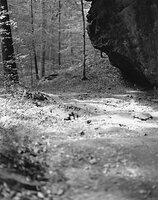
Tri-X 320 shot at 100

Recent Classifieds

Forum statistics

Threads
203,113
Messages
2,849,944
Members
101,673
Latest member
mkamera
Recent bookmarks
3

Ektagraphic

Member
Allowing Ads
Joined
Feb 3, 2009
Messages
2,928
Location
Massachusetts
Format
Medium Format
Hi Guys- I just got back from my first 4X5 shoot and I realized that my meter was left at ISO 100. Do I need to pull this film? I have never worked with it before so I am not familiar with it's exposure latitude. If so, how should I change the developing time? I am using D-76. Thanks so much. Patrick
 
Hey,

The question depends on your metering technique - if you just use an incident or you place your shadows low I wouldn't worry too too much about pulling the film If you tend to place your shadow values high (like zone IV) and you have some screaming highlights that are important you may want to give it about 20-25% less. Unfortunately you do not have a normal time yet if it is your first film.

So.....

Any advice given here is completely random and anecdotal. I can give you some facts:

TXP is hard to expand - in other words you have to develop it for a significantly longer time than normal to get the contrast to change drastically. It will - just slowly.

Under exposed or under developed TXP looks like absolute crap. IMO AND it is much easier to under develop than it is overdevelop. Hence my first recommendation.

If you can give me an idea of what you shot and how you metered it it I might be able to give you some more helpful advice so that you can decide how you want to go.

RB
 
It will be ok even if developed as normal. This film does not block up in the high tones easily. A 1-2/3 stop error with this film can be printed down to look "normal" with no alterations in processing. Even though this is the case, I would generally pull the film a stop in processing if I had made this error in a contrasty lighting situation. It is easier to increase the contrast of a negative that is a grade too flat than it is to reduce the contrast of one that is a grade too contrasty, so if in doubt, I aim for the flatter negative.
 
Expose two full film loaders and experiment with processing. Don't touch the original film until you get what you want. You can simply go into your studio or living room and expose like you did on the field.

Alternatively, if you have the time and the patience, order a Stouffer step tablet, insert unexposed film into your loader and tape a step tablet to the loaded film, then point at something uniformly white on the groundglass, expose for Zone X,—five more stops than you get on the meter— develop, and compare to a tablet exposed in the same way as when you made the mistake, repeat until you get it right.

 
You must pull it. That film is OK at 100. 6 1/2 minutes in D76 is the time I used when I used to shoot it at 100.
 
You must pull it. That film is OK at 100. 6 1/2 minutes in D76 is the time I used when I used to shoot it at 100.

This is IMPOSSIBLE to say without knowing what the scene was and what the heck he metered and where he placed those values, etc. Heck we all have no idea what kind of reading it even was, incident, spot, whatever.

RB
 
Photrio.com contains affiliate links to products. We may receive a commission for purchases made through these links.
To read our full affiliate disclosure statement please click Here.

PHOTRIO PARTNERS EQUALLY FUNDING OUR COMMUNITY:


Ilford ADOX Freestyle Photographic Stearman Press Weldon Color Lab Blue Moon Camera & Machine
Top Bottom