
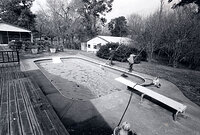
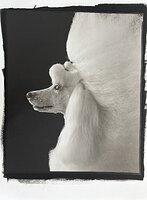
I was out shooting with my Speed Graphic on Sunday, mostly snapshots from a walk in the woods, but also at my wife's request a semi-formal portrait of our son wearing a silly hat. (Some subjects simply can't be resisted, you know?) So I had a stack of four holders waiting for development, along with a fifth that had the single exposure of the boy; all TXP. (There were exactly 9 sheets left in the box, is why I didn't use both sides; but never mind that.)
Well, I realized after the fact that I'd botched the shutter speed on the portrait and underexposed by about two stops; so everything else was at box speed, but that one sheet needed a push to about 1250. Fortunately the light had been pretty soft and the film behaves well under pushing, so I wasn't too bothered about it.
HC-110, water stop, TF-5, if you're keeping track.
It's a pain to tray-develop sheets with different times, but it works as long as you're organized. The plan was to unload all the holders while keeping the "push" sheet separate, put that one in the developer for the first 10 1/2 minutes, then add the others for 5 1/2 minutes. You have to make some allowances for time to load in the remaining sheets---if you just slap them in one after another they stick together, so they have to go in one by one, with a few seconds in between for the developer to penetrate. I figured I'd start at 9:30 and spend about a minute getting all the sheets in. (As a result, the one "push" sheet would get some extra agitation, but late in the cycle for a large push that shouldn't be a big deal. In general, this whole plan is imprecise, but precision is overrated and the whole gestalt of the Speed Graphic is about Making It Work Somehow.)
Straightforward, right? So I turn out the lights, unload the holders, keep the push sheet separate, put on my gloves, and pop the push sheet in the dev tray. Nine and a half minutes later, I grab the other stack and start shuffling them in, one at a time, careful not to let them stick. I finish a little early and shuffle through the stack a couple of times: eighteen meticulously counted motions from bottom to top. Now I'm at about the 11:00 mark, so I wait till 11:45 and go in to do the next agitation. And I feel ONE sheet in the dev tray.
Now, you know right away, as I did, what happened: The other eight sheets are sitting in the stop tray, and they are now presoaked like nobody's business!
Well, about all I can do is shift them into the developer now and go on. It's the 12:00 mark, so by the time they're done it'll be around 18:00, an extra 15% on top of the dev time for the push sheet. So I guess I'm developing for 1600 instead of 1250; I obviously can't cut down the time for the eight box-speed sheets, so the ninth will just have to take its chances on ending up oversouped. And yes, I really did think through all that in real time, standing in the dark muttering Anglo-Saxon words of one syllable.
The good news is, it all seems to have worked out. All I have so far is eyeball judgement of the negatives, but they aren't obvious trainwrecks, which is better than I do sometimes when everything goes according to plan.
All that is no big deal, right?---what it comes down to is, I had an unexpected presoak and overdeveloped an already heavily-pushed negative by an extra 15%. You'd expect it to work. But you know, don't you, that gut feeling of panic when you're standing in the dark and realize SOMETHING IS WRONG!?
I'll tell ya this, I'm glad I keep the fixer tray spaced well off to one side! I'd have a hard time getting to that one first without a conscious effort.
-NT
Well, I realized after the fact that I'd botched the shutter speed on the portrait and underexposed by about two stops; so everything else was at box speed, but that one sheet needed a push to about 1250. Fortunately the light had been pretty soft and the film behaves well under pushing, so I wasn't too bothered about it.
HC-110, water stop, TF-5, if you're keeping track.
It's a pain to tray-develop sheets with different times, but it works as long as you're organized. The plan was to unload all the holders while keeping the "push" sheet separate, put that one in the developer for the first 10 1/2 minutes, then add the others for 5 1/2 minutes. You have to make some allowances for time to load in the remaining sheets---if you just slap them in one after another they stick together, so they have to go in one by one, with a few seconds in between for the developer to penetrate. I figured I'd start at 9:30 and spend about a minute getting all the sheets in. (As a result, the one "push" sheet would get some extra agitation, but late in the cycle for a large push that shouldn't be a big deal. In general, this whole plan is imprecise, but precision is overrated and the whole gestalt of the Speed Graphic is about Making It Work Somehow.)
Straightforward, right? So I turn out the lights, unload the holders, keep the push sheet separate, put on my gloves, and pop the push sheet in the dev tray. Nine and a half minutes later, I grab the other stack and start shuffling them in, one at a time, careful not to let them stick. I finish a little early and shuffle through the stack a couple of times: eighteen meticulously counted motions from bottom to top. Now I'm at about the 11:00 mark, so I wait till 11:45 and go in to do the next agitation. And I feel ONE sheet in the dev tray.
Now, you know right away, as I did, what happened: The other eight sheets are sitting in the stop tray, and they are now presoaked like nobody's business!
Well, about all I can do is shift them into the developer now and go on. It's the 12:00 mark, so by the time they're done it'll be around 18:00, an extra 15% on top of the dev time for the push sheet. So I guess I'm developing for 1600 instead of 1250; I obviously can't cut down the time for the eight box-speed sheets, so the ninth will just have to take its chances on ending up oversouped. And yes, I really did think through all that in real time, standing in the dark muttering Anglo-Saxon words of one syllable.
The good news is, it all seems to have worked out. All I have so far is eyeball judgement of the negatives, but they aren't obvious trainwrecks, which is better than I do sometimes when everything goes according to plan.
All that is no big deal, right?---what it comes down to is, I had an unexpected presoak and overdeveloped an already heavily-pushed negative by an extra 15%. You'd expect it to work. But you know, don't you, that gut feeling of panic when you're standing in the dark and realize SOMETHING IS WRONG!?
I'll tell ya this, I'm glad I keep the fixer tray spaced well off to one side! I'd have a hard time getting to that one first without a conscious effort.
-NT


