• Welcome to Photrio!
    Registration is fast and free. Join today to unlock search, see fewer ads, and access all forum features.
    Click here to sign up

Traditional theory of exposure and development and variable contrast paper

Puddle

Puddle

  • 2
  • 2
  • 54

Recent Classifieds

Forum statistics

Threads
202,721
Messages
2,844,670
Members
101,487
Latest member
Bmattei
Recent bookmarks
0
John, I was kind of in the same pool with you.. Oh, well, I guess I´m still there and will always be, as I don´t think anyone will never come to the "perfect point"..
It might help you to read this article (and the others as well from Kachel)

http://davidkachel.com/historical/prilclct.htm

It made me think that all this striving towards the perfect tonal range maybe wasn´t exactly the right target..
Hope it helps somehow.

M
 
Marco,

This is the information I was looking for. Thanks so much. Great article.
 
John, I was kind of in the same pool with you.. Oh, well, I guess I´m still there and will always be, as I don´t think anyone will never come to the "perfect point"..
It might help you to read this article (and the others as well from Kachel)

http://davidkachel.com/historical/prilclct.htm

It made me think that all this striving towards the perfect tonal range maybe wasn´t exactly the right target..
Hope it helps somehow.

M

There is nothing wrong with this article, except that the author's approach does not offer an alternative to the Zone System; it is the Zone System.

Nowhere in Ansel's books is it ever stated that the entire subject brightness range has to be squeezed into the negative density range. He never says to fit everything on grade-2 paper and to avoid dodging and burning. The opposite is the case. Look at AA's printing maps in his books. They show extensive dodging and burning to improve local contrast. AA rarely made a straight print, and it was not his goal to do so.

As the author says, local contrast is very important. That's why the Zone System is not replaced by VC papers. VC papers unlock even more creative possibilities in combination with the Zone System. With the Zone System, I can make a perfect negative. With VC papers, I can make an even more perfect print than with graded papers.

The author is absolutely right, but he misquotes the Zone System. He uses the Zone System exactly as intended, because his experience allowed him to overcome his initial mistake of thinking the Zone System is a capture mechanism of the entire subject brightness range. It isn't.
 
Proper exposure and development of film still matters when using VC paper. Tones are better rendered on the "average" contrast grade such as say, grade 2 on graded paper. The same thing goes for VC paper. Find the curve that gives you a grade 2, then taylor your negative to it. That's if you want the best from your paper.
 
Even Less Attractive

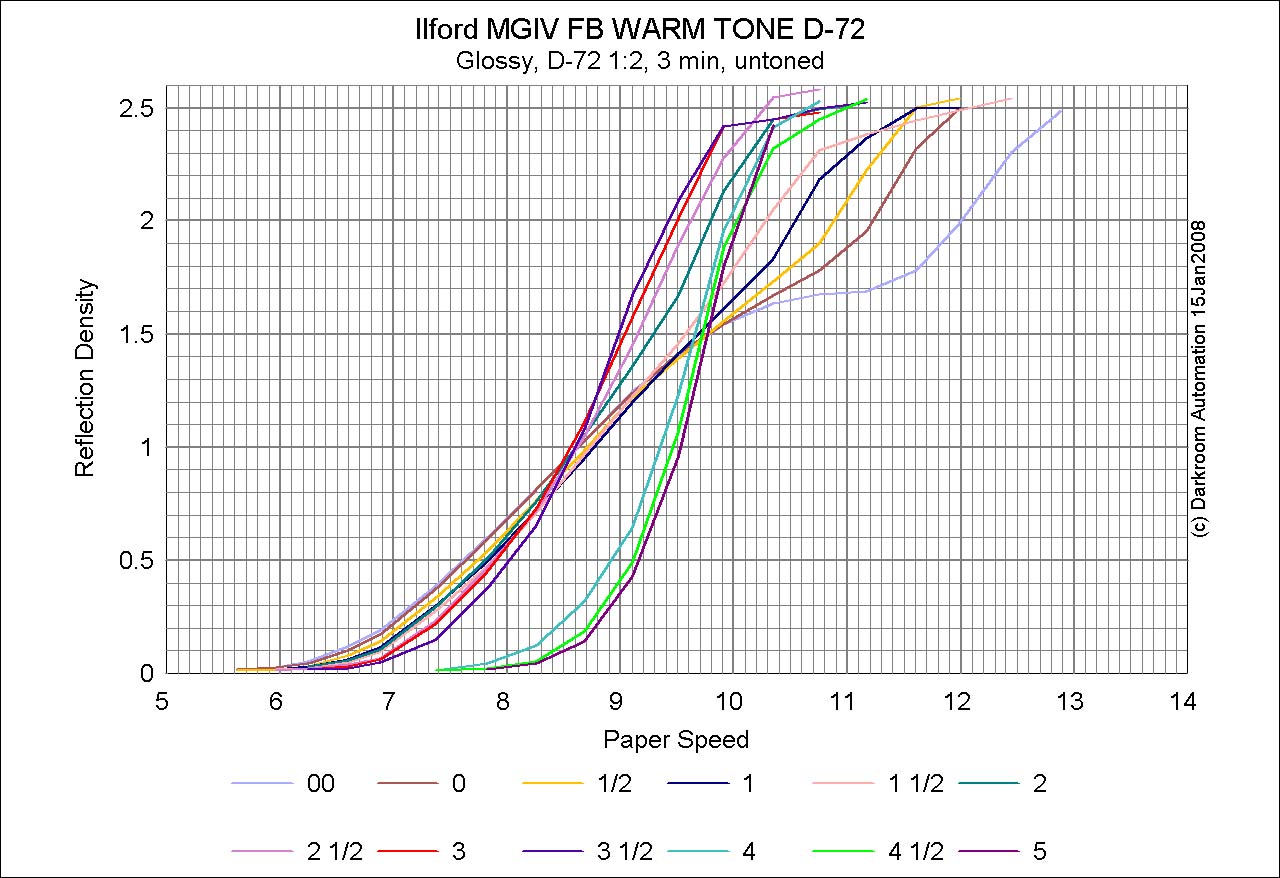
The curves for a few paper/developer combinations are also
on the Darkroom Automation web site:

http://www.darkroomautomation.com/support/index.htm

Some are not pretty to look at, example:
mgivfbwtd72hd.jpg

Phil Davis in a D-Max article written for Volume 7 Issue 4 graphically
exposes the same weakness in VC papers. Quote He: "... within this
filter range the only real difference in image contrast and gradation
occurs in the dark tones ..." The filter range will vary from paper
to paper. Quote again: " This is characteristic that's visible to
some extent in most, if not all, variable contrast curve
families ..."

The problem lies with the lower contrasts, eg. -1 through
2 or 3, where grade differentiation does not exist in the
high light areas. That is to say, those contrasts
simply do not exist. Dan
 
So Dan,

Perhaps those who use VC paper should be tailoring their negatives for, say, grade 3 or higher and then using grade 2 as the "low-contrast" and grade 5 as high contrast. That would avoid dealing with "misshapen" curves at lower than grade 2 for the most part. Plus, it would shorten development times, reduce grain a bit and yield faster printing times... ;-)

I keep some VC around for the rare times I need to print very contrasty, since grade 4 and above graded papers are practically nonexistent these days. However, 99.9% of my work gets printed on graded paper grades 2 and 3.

Best,

Doremus Scudder
www.DoremusScudder.com
 
I must admit to taking a similar approach Doremus. I will often use the VC to make a quick proof in order to see some of the "possibilities" open to me at several grades.

As Ralph and others have noted, whatever works!

Ed
 
Is there anything lost by less development that cannot be made up for by increased paper grade or higher grade filtration- sharpness, edge effects for example?
 
Is there anything lost by less development that cannot be made up for by increased paper grade or higher grade filtration- sharpness, edge effects for example?

Yes, extending development will increase the formation of metallic silver in all areas of the negative, including shadows (but to a much lesser degree). That's something you just cannot do with paper contrast.
 
It seems that most of the problems with lower filter grades are in the highlights. I imagine that development that compresses highlights would exacerbate those problems.
 
Photrio.com contains affiliate links to products. We may receive a commission for purchases made through these links.
To read our full affiliate disclosure statement please click Here.

PHOTRIO PARTNERS EQUALLY FUNDING OUR COMMUNITY:


Ilford ADOX Freestyle Photographic Stearman Press Weldon Color Lab Blue Moon Camera & Machine
Top Bottom