• Welcome to Photrio!
    Registration is fast and free. Join today to unlock search, see fewer ads, and access all forum features.
    Click here to sign up

Tnax3200 exposed at iso 100

Two Horses

A
Two Horses

  • 7
  • 2
  • 41
Billboard, Cork city 1977

H
Billboard, Cork city 1977

  • Tel
  • Mar 17, 2026
  • 1
  • 0
  • 33

Recent Classifieds

Forum statistics

Threads
202,802
Messages
2,845,710
Members
101,541
Latest member
ΦÆdon
Recent bookmarks
0
I think trendland meant that as a compliment of the highest order...
Yeah - better we will see this from that point.....:wink:
with regards
PS : If I read the word "troll" I allways think about aristokrats during the middle age
(courtly hunting).....and that they might have had rights to shot even trolls in the forest.So trolls are asocialted as a middle creature between man and animals.
Somethink in the near of that. But last month I googled it because I heard about "Computer trolls" = machines.
So they survived from the middle age?
:cry:
 
Exposure doesn’t affect contrast..

Oh, but it does, Bill, up to a point. A marginally exposed negative will attain more contrast (with the same development time/temp) for about two more stops of exposure. Then, only then, will the contrast begin to decline with even more exposure. - David Lyga
 
True, far underexposed and far overexposed.

NB23 hit the film with about 100 times the right amount of light. I figure film like this doesn’t shoulder until a thousand times the light or more.

This roll will have exposures on the straight line with maybe 0.4 more density overall above a correctly exposed roll.

I still say develop normally. If a typical negative usually prints at 15 seconds, expect 40 seconds. This is trivial.
 
Oh, but it does, Bill, up to a point. A marginally exposed negative will attain more contrast (with the same development time/temp) for about two more stops of exposure. Then, only then, will the contrast begin to decline with even more exposure. - David Lyga
Hi David - I suppose we BOTH would not spent such money to that expensive film and overexpose it in this exessive way ? with regards
 
True, far underexposed and far overexposed.

NB23 hit the film with about 100 times the right amount of light. I figure film like this doesn’t shoulder until a thousand times the light or more.

This roll will have exposures on the straight line with maybe 0.4 more density overall above a correctly exposed roll.

I still say develop normally. If a typical negative usually prints at 15 seconds, expect 40 seconds. This is trivial.

he could have hit it with 200x the right amount of light and still xtol might give him OK flat enough, enough detail &c negatives
sumatranol130 stand develop for 30-35 mins will also work.

YMMV
 
Hi David - I suppose we BOTH would not spent such money to that expensive film and overexpose it in this exessive way ? with regards
Actually, sometimes the 'over' exposure is necessary to lock in important shadow detail. That, trendland,, would possibly not be a waste of money. - David Lyga
 
Actually, sometimes the 'over' exposure is necessary to lock in important shadow detail. That, trendland,, would possibly not be a waste of money. - David Lyga
Sure ! (with negative film)....
:smile:

with regards
 
Update:

I decided to go with Ilfosol-3 @ 1+14 for 7 minutes at 68f.
The negs look great. A bit on the overexposed side and the contrast is totally manageable if I judge by quick eye-inspection. I have definitely seen worse from negatives that were correctly shot and processed fron start to finish.

I used a Meterless Leica and as these things go, I sometimes was over exposing and other times, underexposing, depending on the action and my own judgement of how to handle a scene. The shots that were exposed at 100/200 iso look great. The others shot at iso 50-ish are manageable.

As I’ve made ilfosol-3 one of my favorite developers besides xtol and hc-110, for its super sharp grain and high potency, I didn’t hesitate to go 1+14 and expect good results.
 
Correction: what I wanted to say by having seen worse from Correctly shot and processed films is that I’ve often developped films impeccably only to find out that they were underexposed by a stop.

Or developed a full batch of 10 films with an insatisfactory general look/density (notoriously iso overrated foma 200 comes to mind)...
 
Correction: what I wanted to say by having seen worse from Correctly shot and processed films is that I’ve often developped films impeccably only to find out that they were underexposed by a stop.

Or developed a full batch of 10 films with an insatisfactory general look/density (notoriously iso overrated foma 200 comes to mind)...
Glad it worked out for you! I once overexposed some sheet TriX by nearly the same amount, then botched the processing and got a printable but very suboptimal negative. Fortunately it was a landscape, no big deal to redo. Cause was a sticking prewar (WWI) Compound shutter.
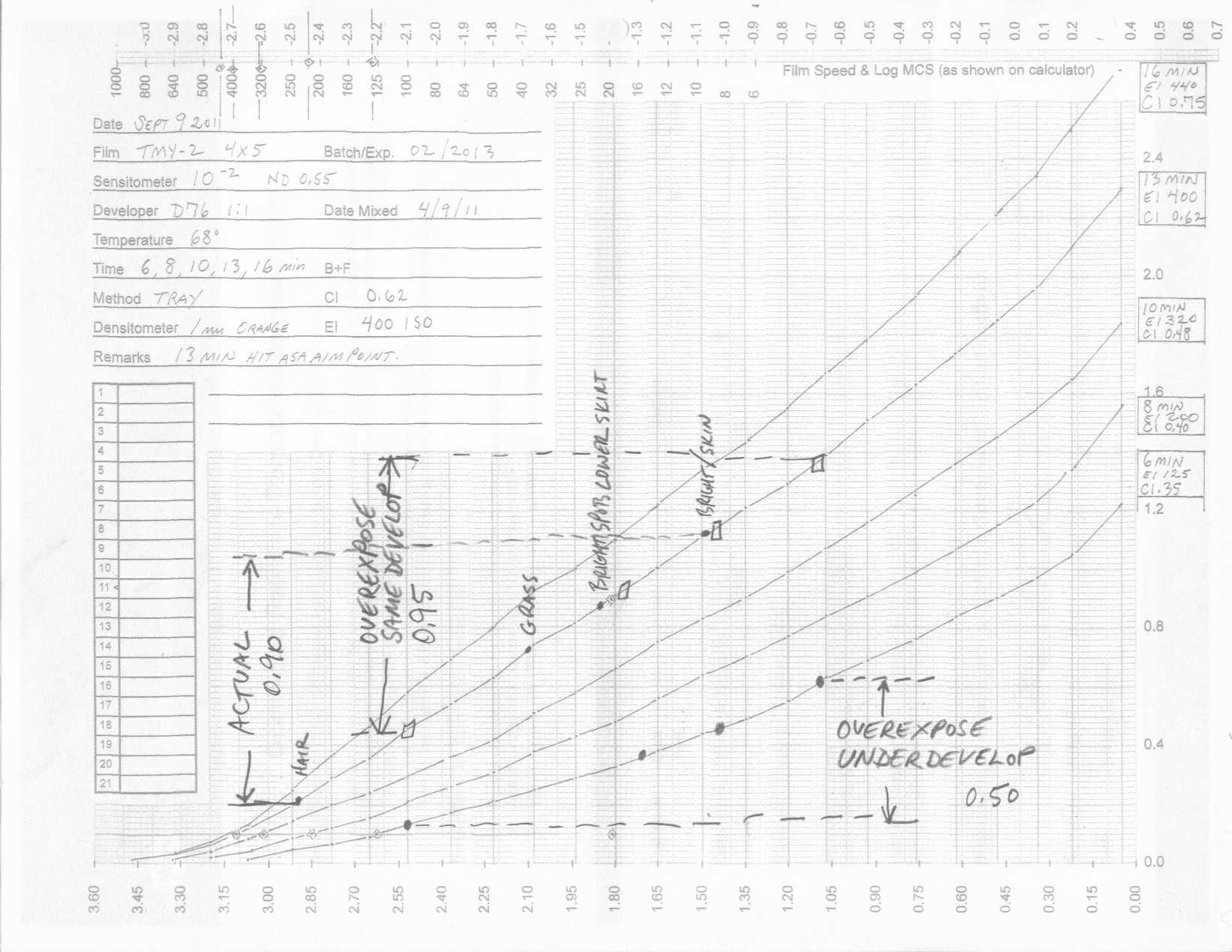
 
I will update with more infos at the printing stage, where the whole truth will be revealed.

Glad it worked out for you! I once overexposed some sheet TriX by nearly the same amount, then botched the processing and got a printable but very suboptimal negative. Fortunately it was a landscape, no big deal to redo. Cause was a sticking prewar (WWI) Compound shutter.
 
tmygraph.jpg

I know you already developed the film so this illustration is a bit late to help. But it shows why I insist on developing the same when you overexposed, because the negative would print the same. If you develop less, you make a lower contrast negative.
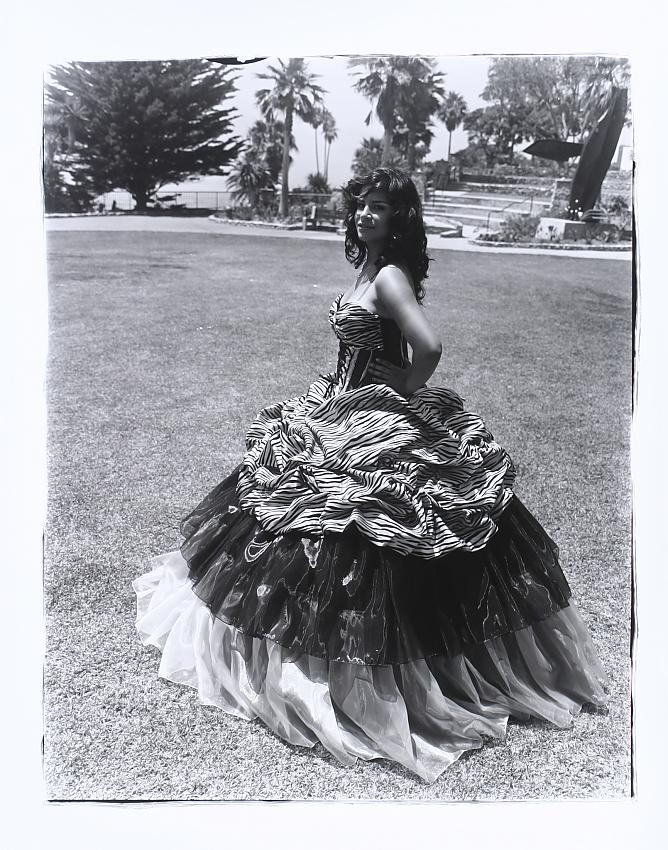
 
tmygraph.jpg

I know you already developed the film so this illustration is a bit late to help. But it shows why I insist on developing the same when you overexposed, because the negative would print the same. If you develop less, you make a lower contrast negative.

Am I reading your chart properly, Bill, that it shows that what you’d lose by overexposing/same develop is densities greater than 2.5 and/or any shadow details that would have been visible in your “actual 0.90” between the dot marked “hair” at 2.9 and the square mark at 2.5?
 

This is the picture in question. On the horizontal scale at the bottom is the "density" of the step wedge... so it is a measure of light being held back... more light on the right - less light on the left... until the light is so dim at the far left that the film doesn't respond at all...

The "hair" has density of 0.22 on the film... "bright skin" has density 1.12 for a density range of 0.90... Those are the dots. I drew boxes where I imagine overexposure about a stop and a half would be on the film.

Really, overexpose/same develop loses "nothing" 0.05 more density range is practically negligible. That's what I was trying to show.

The dots on the lower 6 minutes curve show what many people think they have to do when they overexpose film, to develop less.

I wanted to show that it is not necessary to develop less when you overexpose, you only end up with a flatter negative that is harder to print.
 
Actually, and to my surprise, the negative I have developed (tmax 3200 exposed at 100 and underdeveloped with ilfosol-3 1:14 for 7 minutes @ 20c, shows very good contrast, no loss, after a solid inspection.

I will post results as soon as I can.
I also have to praise ilfosol-3. A sid devleiped that I’ve been using for years now, and that never ceases to amaze me, each time I pull out the negatives from the reels. Highly potent, gives sharp grain (sharper than Rodinal), excellent contrast. Simply solid all around.
 

This is the picture in question. On the horizontal scale at the bottom is the "density" of the step wedge... so it is a measure of light being held back... more light on the right - less light on the left... until the light is so dim at the far left that the film doesn't respond at all...

The "hair" has density of 0.22 on the film... "bright skin" has density 1.12 for a density range of 0.90... Those are the dots. I drew boxes where I imagine overexposure about a stop and a half would be on the film.

Really, overexpose/same develop loses "nothing" 0.05 more density range is practically negligible. That's what I was trying to show.

The dots on the lower 6 minutes curve show what many people think they have to do when they overexpose film, to develop less.

I wanted to show that it is not necessary to develop less when you overexpose, you only end up with a flatter negative that is harder to print.

Thanks, I appreciate your sharing the photo and providing explanations — so very interesting. I recently did a test on Tri-X shot at 100, then underdeveloped; as your graphs anticipate, the images were very flat. I guess the old adage “over-expose, under-develop” was to ensure that the photographer got at least something of an image, even if it’s not optimal. I’ve also recently been testing different films in a couple of developers, shooting a static subject at nominal ISO, one EV over, one EV under, and sometimes 2 EV over. There have been occasions where the 2 EV over image is as good as the nominal ISO photo, and even has a certain look that’s preferable.
 
What about using a speed reducing developer? I understand that HC-110 has a slight tendency toward speed reduction. Rodinal might be even a little more so (but watch out for grain.) I understand that most fine-grain developers are somewhat speed-reducing, so how about something like perceptol?

Obviously, I'm talking about tinkering around the edges here.
 
Photrio.com contains affiliate links to products. We may receive a commission for purchases made through these links.
To read our full affiliate disclosure statement please click Here.

PHOTRIO PARTNERS EQUALLY FUNDING OUR COMMUNITY:



Ilford ADOX Freestyle Photographic Stearman Press Weldon Color Lab Blue Moon Camera & Machine
Top Bottom