• Welcome to Photrio!
    Registration is fast and free. Join today to unlock search, see fewer ads, and access all forum features.
    Click here to sign up

TMY-2 and 400TX

Forum statistics

Threads
203,265
Messages
2,852,090
Members
101,752
Latest member
Frederic CHICHE
Recent bookmarks
0

Tim Gray

Member
Allowing Ads
Joined
Sep 2, 2006
Messages
1,882
Location
OH
Format
35mm
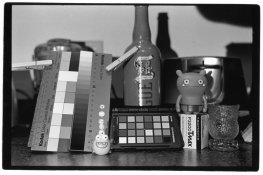
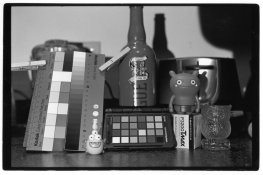
I finally got around to comparing T-MAX 400 with Tri-X. I shot some color charts, a gray scale chart, and some other trinkets. I developed in XTOL 1:1.

TMY was noticeably sharper on the finer details and a bit less grainy. I think Tri-X's large details look a bit sharper - the black print on the Kodak chart for example. A bit more contrast in the midtones? However, with a modest enlargement, it becomes clear that they aren't as sharp.

While TMY did have a bit finer grain, it doesn't make Tri-X look like a grain fest or anything. In the 8x10 print, Tri-X looked grainier mostly in the solid tone of the background wall.

The tonality of both were fine. The TMY looked slightly underdeveloped (my first time), but it printed just fine - shorter printing time than the TX, but the print exposures look pretty much the same. Oh yeah, and TX looks to be more sensitive to red compared to TMY. At least in this test.

TMZ shot in this same situation at 800 was significantly grainier. The difference between TMZ and the other two was far larger than the difference between TX and TMY. It was also interesting to see that TMZ was more or less as sharp as the TX when it came to small details.

I will say my prints aren't *exactly* matched, and that surely influences the outcome. For example, the last couple dark tones in the Tri-X picture look more compressed than in the TMY picture. I guess this is partially due to the toe in Tri-X, though could be influenced by my printing. And if I need to tweak my dev time of TMY up a little bit, that would give a bit more contrast in the midtones.

I'm kind of confused why people make such a big deal out of the differences of these two films. I didn't find TMY particularly hard to shoot or process. And if no one had told me, I'd probably have a very difficult time looking at either print (without looking at the fine detail up close) and saying which one was TMY or TX.

Last interesting tidbit (and out of the scope of this site) - the grain differences between the two were really downplayed when scanned at 4000 dpi on a Coolscan.
 

Attachments

  • 400-2tmy-print-med.jpg
    400-2tmy-print-med.jpg
    231.7 KB · Views: 426
  • 400tx-print-med.jpg
    400tx-print-med.jpg
    253 KB · Views: 386
Whoops, yeah the files were originally labelled. TMY on the left, Tri-X on the right. Though that does kind of prove a point. :D
 
The headline is TMY-2...
 
The glass cup on the right is sharper and more realistic looking in the TX image. Same for the Kodak color palette on the left.

The "xrite" text on the lower-center color palette is sharper in the TMY2 image. That said, looking at the text on the bottle in the background, does the TMY2 image have a deeper depth of field than the TX image?
 
I noticed while adjusting the negative scans of these images, playing around with the shadow contrast changed the impression of sharpness on the glass owl. For whatever reason (printing, developing, toe of the TX), the TX shot has steeper contrast in the shadows.

I have it written down that both shots were at f/4. It's possible that the shots are focused at slightly different points. That being said, when I look at the 4000 dpi scans, the depth of field and center of focus seems to be consistent between the two shots. The TX shot *may* be focused slightly closer. I can't make up my mind about that though.

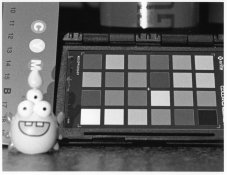
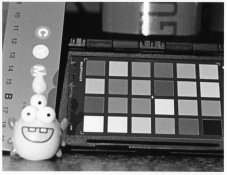
I'm getting the feeling that TX looks sharper on larger features, even thought it's really not. The text on the Xrite chart is definitely sharper in the TMY 8x10 print. I also made crop enlargements - TMY is way sharper at this level.

Again TMY then TX.
 

Attachments

  • 400-2tmy-print-crop-med.jpg
    400-2tmy-print-crop-med.jpg
    340.3 KB · Views: 197
  • 400tx-print-crop-med.jpg
    400tx-print-crop-med.jpg
    357.6 KB · Views: 194
I have negative scans of these negatives, but have not posted them here since they are neg scans.
 
I prefer the one of TX one
I wish if someone can do a little more tests with 2 different Kodak B&W at same ISO/ASA with different developers [say XTOL and D-76, or XTOL and T-Max] and see the differences.
 
It's my opinion that TMY-2 and Tri-X 400 are pretty similar in their appearance. Some people say they hate the TMY-2 grain, but it isn't that different from Tri-X. Just finer, what you'd expect from Plus-X.

Both are nice films. I use TMY-2 for most everything, and find that it's a very versatile film that can be exposed and processed to give many different looks. The difference in sharpness may be important if you print large.
 
I agree with you Thomas. Though I primarily shoot TX and will probably continue to shoot a lot of it, TMY isn't *that* different in look. It is significantly sharper on fine detail though, something which is evident at 8x10 and probably more so at larger sizes. At 11x14 and up, that might become quite handy. On the other hand, TX makes some details look sharper when the enlargement isn't as large. I'm guessing it's because it renders that fine detail as slightly blurry, making it larger. At modest sizes, it makes emphasizes that detail - kind of like outlining a small feature with a larger line.

I think I need to bump up my dev times a bit since it looks like it's slightly lower in contrast that TX.
 
TX and TMY-2 look diferent when it comes to shooting actual subject matter in specific lighting conditions.

I recently did some TX @ 6400, the correctly exposed shots for 6400 (as opposed to the other underexposed being too liberal) the grain is very fine.
 
I think I need to bump up my dev times a bit since it looks like it's slightly lower in contrast that TX.

Yes. If you look at the characteristic curves of TX400 and TMY-2, you will see less shoulder and toe on TMY-2. If you want the film to look more like TX400 you can tweak your exposure by exposing less, dropping some shadow detail into the abyss, and then over develop a hair. You can get negs that very closely match TX400. Processed correctly, I find that TMY-2 from 35mm will look a lot like TX400 from a 645 neg.
I have even been fooled to believe that 35mm TMY-2 in a 6x8 print was from a 4x5 negative, in the hands of a master.

Then, of course, there are long exposures, where TMY-2 is a better choice due to better reciprocity characteristics. It's perfect for pinhole photography.

- Thomas
 
You can get negs that very closely match TX400. Processed correctly, I find that TMY-2 from 35mm will look a lot like TX400 from a 645 neg.- Thomas

I agree. I primarily shoot Leica M and with modern glass TMY-2 reminds me an awful lot of Tri-X in 6x4.5 (back from my Pentax 645 days). The finer grain results in a smoother tonality and obviously more fine detail is resolved.

I think TMY-2 400 delivers the detail of a traditional 100asa film.

In terms of tonality I have noticed that when exposed at around 250-320 asa and developed in Barry Thornton's 2-bath I get contrast that looks a awful lot like Tri-X. One thing I really like about TMY-2 is the linear response. It seems to hold detail in the shadows better than Tri-X.
 
I
I have it written down that both shots were at f/4. It's possible that the shots are focused at slightly different points.

Impossible to tell on resolution anyway. The camera position for the two shots is different, as is the focus. You may very well have the center of focus on the same part of the same object in the scene, but the differing camera positions change everything else. Only way to make a meaningful comparison is to have everything set up exactly the same. That means the props don't move, the camera doesn't move, the focus doesn't move, and the lighting doesn't change.
 
Well, the props didn't change nor did the lighting. Not moving the camera is difficult in this case - it was a Leica M, so the bottom has to come off to reload it. I left the bottom attached to the tripod, but inevitably after shooting 6 rolls this way, the framing shifted bit by bit.
 
I too have had no problems with TMY2. The results have been consistantly good with either D76 1:1 or HC110 (dil B or H). TriX seems grainier and not really different, so I have been using TMY2. On the other hand, 100Tmax has never given me good results and makes me work too hard in the darkroom to get something acceptable. With results that end up looking apx. the same or slightly worse than the TMY, I'm not sure why I bother with the slower film.
 
Tim your test is not perfect but THANK YOU for posting. I keep going back and forth on what film I like best TX or TMY-2 or whatever. That is because I love one shot I took in one set of conditions then shoot another shot with a different combination. For example TX in a bar @ EI 1250 using Diafine vs a TMY-2 shot of my kids in the backyard in overcast conditions developed using Xtol. I think the subject and light have as much to do with a good negative or print as the film. There is no best film. There is the film that gives you what you desire. Only you know what you desire. That is why I feel so many experienced photographers hesitate to make these sort of tests and publish them. But I read every test I can find. You never know what you do not know until you read it and these tests point it out well to me and others. Thanks again.
 
Last edited by a moderator:
I recently did some TX @ 6400, the correctly exposed shots for 6400 (as opposed to the other underexposed being too liberal) the grain is very fine.

What?
 
Tri-X at EI 1250 in Diafine is unique. As good as TMY-2 is, there is something about the combination of Tri-X and Diafine that just works. I actually like it better than pushed TMY-2 for a lot of subjects because it handles a scene with a wide brightness range very well for a pushed film.
 
I would much prefer the Tri-X. I love Tri-X. It is my favorite film. I love the way it reproduces everthing in black and white. It really gives me the look that I love. The TMY-2 here almost seems to generally have a darker grey tone to everything...
 
Tim your test is not perfect but THANK YOU for posting.

No tests are - this definitely wasn't meant to be. I'm just beginning to investigate the differences between them. Glad you enjoyed it though.

Good light certainly trumps differences in film :D

I need to dig out my Diafine and try that again.
 
Photrio.com contains affiliate links to products. We may receive a commission for purchases made through these links.
To read our full affiliate disclosure statement please click Here.

PHOTRIO PARTNERS EQUALLY FUNDING OUR COMMUNITY:


Ilford ADOX Freestyle Photographic Stearman Press Weldon Color Lab Blue Moon Camera & Machine
Top Bottom