• Welcome to Photrio!
    Registration is fast and free. Join today to unlock search, see fewer ads, and access all forum features.
    Click here to sign up

TMAX developer with P3200

Recent Classifieds

Forum statistics

Threads
202,085
Messages
2,834,878
Members
101,106
Latest member
ludwigkirch
Recent bookmarks
0

jbl

Member
Allowing Ads
Joined
Dec 4, 2009
Messages
93
Location
California,
Format
35mm RF
I've got some P3200, some rolls shot at EI 1600, some at 3200, that I want to try developing with TMAX developer.

Page 9 of the Kodak J-86 document mentions time compensation for developing more than 16 rolls of 135-36 per gallon. I take it that it's referring to reuse of working solution, do people typically do that or do most users just use it one-shot?

The same page also says that "if you use this developer for push processing, discard it after processing one batch of film." In this case, would developing P3200 qualify?

Thanks,

-jbl
 

mts

Member
Allowing Ads
Joined
Feb 12, 2004
Messages
372
Location
Los Alamos,
Format
Multi Format
I consider the TMax family to be one-shot developers, the same as D76 1:1. You will be dealing with lots of grain in any case so don't expect much from it.
 

piu58

Member
Allowing Ads
Joined
May 29, 2006
Messages
1,545
Location
Leipzig, Germany
Format
Medium Format
I use the Tetenal Ultrafin Plus which has nearly the same formula. I always use it one shot, diluted 1+6. It works fine with TMZ.

Please keep in mind: TMZ has a "real" ASA of around 1000 and must pushed if you want to use 3200 ASA.
 

Jeff Kubach

Member
Allowing Ads
Joined
Sep 29, 2007
Messages
6,912
Location
Richmond VA.
Format
Multi Format
I have used T-Max developer and it is not that bad. It might be grainy, but that could be a good thing.

Jeff
 

pgomena

Member
Allowing Ads
Joined
Jun 25, 2003
Messages
1,391
Location
Portland, Or
Use it as a one-shot developer diluted from the concentrate as directed. P3200 is low-contrast ISO 800 film that gains contrast with push processing. It looks really good up to EI 1600, 3200 is fair, and you'll not get any decent shadow detail beyond that point. The grain is tight, gritty and sharp. It's great for a gritty fashion or photojournalistic look, but too grainy for "fine" portraiture. Skin texture starts to look like oatmeal.

Peter Gomena
 
OP
OP
jbl

jbl

Member
Allowing Ads
Joined
Dec 4, 2009
Messages
93
Location
California,
Format
35mm RF
Thanks, everyone.

I've always developed it in HC-110 before as that's what I've used the most of. A friend mentioned that he seemed to remember it working pretty well in TMAX developer, so I figured I'd try it. I was hoping to reduce the grain a bit, I understand 3200 is going to be grainy, but figured I'd at least experiment and see how I like it.

I've also considered trying D-76, any reason to prefer it over TMAX developer?

I shoot mostly Tri-X and have done almost all of my developing in HC-110 or D-76 with it.

-jbl
 

NB23

Member
Allowing Ads
Joined
Jul 26, 2009
Messages
4,307
Format
35mm
Can we stop with these "this or that film has a real speed of xxx"?

Kodak is very clear on their developing times with a given film rated on a given ISO. All this "real, undisclosed speed" versus what's onthe box only brings confusion.
 

pgomena

Member
Allowing Ads
Joined
Jun 25, 2003
Messages
1,391
Location
Portland, Or
P3200 is designed to be used with T-Max developer, especially for rating the film at higher exposure indices, but you certainly may process it in any developer you like. D-76 undiluted will reduce the grain as will undiluted Xtol, but you may or may not get the shadow detail you want at higher EIs. HC-110 will tend to increase midtone and highlight contrast at the expense of some shadow detail, depending on dilution and agitation, so it's not a great choice for your purpose. (Much depends on your intended purpose and anticipated results - all up to you.)

I had great results in controlled tests with P3200 in T-Max developer 1:4 from concentrate just by following Kodak's directions. It worked best at EI 800 to EI 1600. EI 3200 is about the outside limit, good for shooting basketball in dim, flatly-lit high-school gymnasiums. EI 6400 gave blank, textureless shadows.

When I tested the film, I ran it alongside my former favorite developer for processing Tri-X at EI 1600 in "push" situations, Diafine. Diafine failed miserably in comparison with the T-Max developer.

Peter Gomena
 
Joined
Jan 21, 2003
Messages
15,715
Location
Switzerland
Format
Multi Format
Can we stop with these "this or that film has a real speed of xxx"?

Kodak is very clear on their developing times with a given film rated on a given ISO. All this "real, undisclosed speed" versus what's onthe box only brings confusion.

The 3200 films are not ISO rated at 3200. They are in fact not ISO rated at all.
Link
They just list what's called an Exposure Index (EI) range for the film.
The recommendation of mentioning 'real' speed is actually helpful if you care about shadow detail, because at EI 1600 or higher you will lose shadow detail no matter what you do. The farther from EI 800 you get, the more of a compromise the film becomes.
 

Tim Gray

Member
Allowing Ads
Joined
Sep 2, 2006
Messages
1,882
Location
OH
Format
35mm
I've only ever developed this film in XTOL 1:1. Always worked out pretty well. I like it most at 800 and 1600, but have some good shots at 3200 as well. The only times I used it at 6400 were kind of 'Hail Mary' situations with incredibly poor lighting, so the results would have been crap no matter what with out significantly longer exposure times...

I've heard good things about TMAX developer and this film as well. I'd use it one shot.
 

pbromaghin

Subscriber
Allowing Ads
Joined
Sep 30, 2010
Messages
3,865
Location
Castle Rock, CO
Format
Multi Format
I have a 1/2 gallon that has processed 4 rolls and it still looks good to me.
 
OP
OP
jbl

jbl

Member
Allowing Ads
Joined
Dec 4, 2009
Messages
93
Location
California,
Format
35mm RF
One more question on this... I noticed that the times on the Massive Dev Chart are mostly for development at 24C. The TMAX data sheet lists a variety of temperatures. Is there some preference for the warmer temperature (24C instead of 20C)? Is it to reduce development time and therefore reduce grain?

-jbl
 
Joined
Jan 21, 2003
Messages
15,715
Location
Switzerland
Format
Multi Format
One more question on this... I noticed that the times on the Massive Dev Chart are mostly for development at 24C. The TMAX data sheet lists a variety of temperatures. Is there some preference for the warmer temperature (24C instead of 20C)? Is it to reduce development time and therefore reduce grain?

-jbl

T-Max developer was, if I remember correctly, designed to operate at a temp higher than the 'normal' 20°C.

Grain will not be minimized because of a shorter development time, especially when you compensate for the short time with higher temp.
 

Roger Cole

Member
Allowing Ads
Joined
Jan 20, 2011
Messages
6,069
Location
Atlanta GA
Format
Multi Format
Like everyone said - use it one shot.

I love this combo. Don't believe folks saying "don't expect much." Yes, it's grainy, but not as bad as you may expect. It has a great look for some things. I skimmed the other posts so not sure if anyone mentioned this but, for best results use the times Kodak gives for one stop more. That is, for your 3200 exposures, develop for the time Kodak recommends for 6400.

Kodak used 75F as the standard for T-Max and T-Max RS. I've pretty much settled on it for ALL my developers, dialing in time accordingly. In my case 1) in summer my darkroom is often warm enough that solutions are already close to (occasionally over) 75F, and 2) any time the temperature is lower, it's easier for my Jobo CPE2, which doesn't have a cold water inlet, to bring them up than for me to bring them down. 75F is fine.

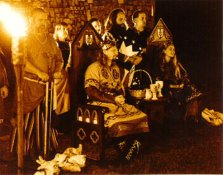
I have got some really good results at 6400 (using the times for 12500.) In the 90s (and for a while in the 80s, an old on again off again hobby of mine) I was active in the medieval group the Society for Creative Anachronism. I shot a roll of TMZ at an outdoor royal court and a candlelit feast, then printed the negatives on RA4 color paper filtered to look like torch light. Here's one of them, EI 6400 in T-Max developer.
 

Attachments

  • SCA_RoyalCourt1.jpg
    SCA_RoyalCourt1.jpg
    140.6 KB · Views: 136
OP
OP
jbl

jbl

Member
Allowing Ads
Joined
Dec 4, 2009
Messages
93
Location
California,
Format
35mm RF
So if I'm reading this correctly, there's not really a benefit or a detriment to developing at 20C, it just means a longer dev time.

-jbl
 

MDR

Member
Allowing Ads
Joined
Sep 1, 2006
Messages
1,402
Location
Austria
Format
Multi Format
Some developers produce grainier images when used at higher dev. temperature >20°C. Rodinal is a good example for that.

Dominik
 
Joined
Jan 21, 2003
Messages
15,715
Location
Switzerland
Format
Multi Format
Can you show examples of this? Two identical negatives, exposed and processed to identical contrast index.

Some developers produce grainier images when used at higher dev. temperature >20°C. Rodinal is a good example for that.

Dominik
 

vpwphoto

Member
Allowing Ads
Joined
Feb 21, 2011
Messages
1,202
Location
Indiana
Format
Multi Format
It worked SUPER well in T-max developer. ONE shot down the drain. For me I used to let it "rest" in tempered H20 after developemt and then into fixer. My rest seems to tempter the contrast and help shadow details develop a little more.
 
Joined
Jan 21, 2003
Messages
15,715
Location
Switzerland
Format
Multi Format
For me I used to let it "rest" in tempered H20 after developemt and then into fixer. My rest seems to tempter the contrast and help shadow details develop a little more.

That's a great idea and probably very useful when trying to extract extra shadow detail in low light / high contrast situations. I'll keep it in mind.
 

vpwphoto

Member
Allowing Ads
Joined
Feb 21, 2011
Messages
1,202
Location
Indiana
Format
Multi Format
@ Roger..

I think these "don't expect much" comments come from folks who never shot high school basketball or football at 1/125 at f 3.5 and were rating tr-x at 1600+ to do it. Negs like that barely printed but that was life in journalism in 1974-1987. Fast forward to f 2 and 2.8 lens offerings, sodium vapor and merc vapor lights and more of them then p3200 arrived I could shoot some arenas at 1/750 of a second at 2.8 with p3200 at 1600 and the prints were magnificent. It all depends on where you came from and expectations. ps and dirrect flash photos sucked this was in the land before 1/250 and 1/125 syc speeds.. this was the land of 1/60!
 
Last edited by a moderator:

vpwphoto

Member
Allowing Ads
Joined
Feb 21, 2011
Messages
1,202
Location
Indiana
Format
Multi Format
It's the same as using a water stop. In reality this "water bath" treatment produces essentially no compensating effect with current films and developers. You're better off with reduced agitation and/or dilute developers.

Rather THAN ASSUME!!! try it or not.. In college I had more than a few people comment on how damn good my high speed stuff looked compared to the other contrasty stuff shown around in the mid 1980's... and those compliments came from seasoned working photojournalists.


Rather than post again to Michael1974 calling me sort of a starry eyed fool!. I agree that agitation is also key! for me I swear by my water bath rest for some situations...not telling how long I go!!!! It is longer than stop!
 
Last edited by a moderator:

bill@lapetelabs.com

Member
Allowing Ads
Joined
Jul 5, 2009
Messages
54
Location
Boston, MA
Format
Large Format Pan
I've run TMZ (P3200) in T-Max dilute as a one shot developer and in TMRS as a replenished developer at the time recommended for 1600 or 3200 ASA and found better shadow detail and grain structure at 68 degrees and when I run 1600 at 3200 and 3200 at 6400. I've worked with TMZ since it first came out and with all its new and improved versions!
 
Photrio.com contains affiliate links to products. We may receive a commission for purchases made through these links.
To read our full affiliate disclosure statement please click Here.

PHOTRIO PARTNERS EQUALLY FUNDING OUR COMMUNITY:


Ilford ADOX Freestyle Photographic Stearman Press Weldon Color Lab Blue Moon Camera & Machine
Top Bottom