• Welcome to Photrio!
    Registration is fast and free. Join today to unlock search, see fewer ads, and access all forum features.
    Click here to sign up

Tips for DIY diffuse head for Durst 138s?

Recent Classifieds

Forum statistics

Threads
201,813
Messages
2,830,588
Members
100,968
Latest member
Enrico_S
Recent bookmarks
1

blacksquare

Member
Joined
Sep 8, 2015
Messages
90
Location
Czech Republic
Format
Large Format
Hello,

after a long and unsuccessful search for a functional CLS 301 color head on Ebay in Europe, I would like to build a diffuse light source for my Durst 138S. Unfortunately, HEILAND-type solutions are completely out of my budget.
I now have a condenser head with LED, it works, but I prefer the results from a diffuse light source (color head) on a second smaller enlarger.

I believe that someone here has already made something similar for their enlarger. I would really appreciate some push in the right direction, since I'm not an expert in designing electronic devices and I don't want to reinvent the wheel.

What do I need/don't need:
- purely diffuse light source that will sufficiently cover a 5x7 negative
- since I use the DA f-stop timer to my satisfaction and I want to continue using it, I don't need any controller. So I'm content with just a white light source and MG filters under the lens. But if it were possible to use green and blue LEDs, preset the "contrast", and then start exposure via a timer, just like with a color head, it would of course be great.

Current questions:
- I think that a light source other than LED doesn't make sense these days? Or should I consider a halogen bulb?
- Is a mixing chamber needed? Or can the LED array be placed directly above the negative, of course through a diffuser?
- what type of LED should I use? A few more powerful ones? Or a larger number of weaker ones, in the form of a strip? Heiland has 1600 LEDs in its source, which surprised me a lot.


Thank you very much for any advice.
Jan
 

cowanw

Member
Allowing Ads
Joined
Aug 29, 2006
Messages
2,306
Location
Hamilton, On
Format
Large Format
 

koraks

Moderator
Moderator
Joined
Nov 29, 2018
Messages
26,874
Location
Europe
Format
Multi Format
So I'm content with just a white light source and MG filters under the lens.
In that case you could either:
1: Put a white bulb where the bulb normally sits in the head, and place a piece of diffusion material in place of either (or both) of the condensers. This will not be very efficient, but since you can easily use a relatively high-power LED bulb, you should be able to get it to work OK. This will be the simplest option.
2: Replace the bottom condenser with a DIY contraption with white LED strips and a diffuser below them. A normal DC power supply as usually used for LED strips can be hooked up to your timer.

But if it were possible to use green and blue LEDs, preset the "contrast", and then start exposure via a timer, just like with a color head, it would of course be great.
You could do it like this: https://www.trippingthroughthedark.com/variable-contrast-led-head-for-durst-138s-progress/ which will be analogous to option #2 above. You would have to use two separate power supplies for the blue and green LEDs with a dimming option. Mount both dimming pots to a console so you can set blue and green power independently. Then hook up both power supplies to your existing timer.
Analogous to option #1 you could also mount a blue and a green LED source in the place where the bulb normally resides in the 138, bounce the light via the mirror onto a diffusor that sits where the condensers are now.

- I think that a light source other than LED doesn't make sense these days? Or should I consider a halogen bulb?
I don't see the advantage of a halogen bulb for what you're trying to do. I'd stick with LED.

- Is a mixing chamber needed? Or can the LED array be placed directly above the negative, of course through a diffuser?
A single LED source suspended above the negative that illuminates a simple diffusor probably won't give good evenness. You can solve this relatively easily (but at the cost of efficiency) by increasing the distance between the bulb and the duffisor. IDK if you're familiar with the Ilford 500 heads; those mount like a chimney on top of the 138 head where the mirror normally sits. You could do something like that as well. I've done that in the past and it worked OK, but it adds height to the enlarger.

- what type of LED should I use? A few more powerful ones? Or a larger number of weaker ones, in the form of a strip?
Either can work. Essentially, the bigger the light source, the easier it'll be to diffuse it, and vice versa.

There are many ways to skin this cat and the one thing they all have in common is that it'll require some testing to get even coverage. So decide on a concept, then do some tests and take it from there.
 
OP
OP
blacksquare

blacksquare

Member
Joined
Sep 8, 2015
Messages
90
Location
Czech Republic
Format
Large Format
Thanks for the tip, I send a PM to Claudius, I'll see.

In that case you could either:
1: Put a white bulb where the bulb normally sits in the head, and place a piece of diffusion material in place of either (or both) of the condensers. This will not be very efficient, but since you can easily use a relatively high-power LED bulb, you should be able to get it to work OK. This will be the simplest option.
2: Replace the bottom condenser with a DIY contraption with white LED strips and a diffuser below them. A normal DC power supply as usually used for LED strips can be hooked up to your timer.


You could do it like this: https://www.trippingthroughthedark.com/variable-contrast-led-head-for-durst-138s-progress/ which will be analogous to option #2 above. You would have to use two separate power supplies for the blue and green LEDs with a dimming option. Mount both dimming pots to a console so you can set blue and green power independently. Then hook up both power supplies to your existing timer.
Analogous to option #1 you could also mount a blue and a green LED source in the place where the bulb normally resides in the 138, bounce the light via the mirror onto a diffusor that sits where the condensers are now.


I don't see the advantage of a halogen bulb for what you're trying to do. I'd stick with LED.


A single LED source suspended above the negative that illuminates a simple diffusor probably won't give good evenness. You can solve this relatively easily (but at the cost of efficiency) by increasing the distance between the bulb and the duffisor. IDK if you're familiar with the Ilford 500 heads; those mount like a chimney on top of the 138 head where the mirror normally sits. You could do something like that as well. I've done that in the past and it worked OK, but it adds height to the enlarger.


Either can work. Essentially, the bigger the light source, the easier it'll be to diffuse it, and vice versa.

There are many ways to skin this cat and the one thing they all have in common is that it'll require some testing to get even coverage. So decide on a concept, then do some tests and take it from there.

Thanks a lot!
It didn't occur to me to remove the condensers and put a diffuser in there. I thought the light definitely wouldn't be uniform with sufficient coverage. I'll try that.

Regarding the placement of the light source instead of the condenser...I read here or maybe elsewhere that the Durst Lacoli, which is located instead of the condenser, does not give completely uniform results for 5x7 negatives and a diffuse source larger than the negative is optimal. But the link suggests that it should work.

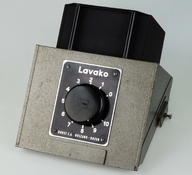
I know about Ilford 500, it's probably a similar solution to Agfa Color head + Durst Lavako adapter, which is now for sale on Ebay. I thought about it (agfa+lavako), but it's a really old model with hard to find lamp.

I have some LED floodlights at home (30W and 50W), so I'll try removing the condesors first and measuring the intensity and uniformity of light.
 

koraks

Moderator
Moderator
Joined
Nov 29, 2018
Messages
26,874
Location
Europe
Format
Multi Format
.I read here or maybe elsewhere that the Durst Lacoli, which is located instead of the condenser, does not give completely uniform results for 5x7 negatives and a diffuse source larger than the negative is optimal.
I have one of those Lacoli sources - but I've never used it since it was broken when I got it. It was gifted to me by someone who knew I've built several light sources for my 138 and he thought I might be able to use the thing to good use. It's still on my (long and rather embarrassing) to-do list. So I can't verify that claim, but I'm not surprised. The Lacoli is/was basically a fluorescent tube inside a housing that fits in one of the condenser slots (it's supposed to go in the lower position I assume). Since the light source is pretty close to the diffusor itself (which is really just a piece of glass that's painted with a translucent white paint), I can see how hot and cold spots might occur.

If I were to build something based on the Lacoli concept, I think I'd exploit the fact that there are two condenser bays: use the top one for a light source, which would be an array of LEDs that's spaced in such a way that the light will be fairly evenly distributed to begin with. Then use the lower bay for a diffusing filter, so that there's a reasonably distance between the light source and the filter. This will help in getting even illumination.
 
OP
OP
blacksquare

blacksquare

Member
Joined
Sep 8, 2015
Messages
90
Location
Czech Republic
Format
Large Format
I have one of those Lacoli sources - but I've never used it since it was broken when I got it. It was gifted to me by someone who knew I've built several light sources for my 138 and he thought I might be able to use the thing to good use. It's still on my (long and rather embarrassing) to-do list. So I can't verify that claim, but I'm not surprised. The Lacoli is/was basically a fluorescent tube inside a housing that fits in one of the condenser slots (it's supposed to go in the lower position I assume). Since the light source is pretty close to the diffusor itself (which is really just a piece of glass that's painted with a translucent white paint), I can see how hot and cold spots might occur.

If I were to build something based on the Lacoli concept, I think I'd exploit the fact that there are two condenser bays: use the top one for a light source, which would be an array of LEDs that's spaced in such a way that the light will be fairly evenly distributed to begin with. Then use the lower bay for a diffusing filter, so that there's a reasonably distance between the light source and the filter. This will help in getting even illumination.

Yeah, Lacoli in the lower position, Lacotra (powe supply) above. I don't like fluorescent light sources, so I didn't even think about Lacoli, especially for the money they sometimes come up for.
 

MattKing

Moderator
Moderator
Joined
Apr 24, 2005
Messages
55,182
Location
Delta, BC Canada
Format
Medium Format
FWIW, my relatively brief experience with the Ilford 500 head leads to a suggestion that you also add a red LED source to the blue and green sources - at least for the focusing part of the process. That blue and green light can appear quite dim!
 

MattKing

Moderator
Moderator
Joined
Apr 24, 2005
Messages
55,182
Location
Delta, BC Canada
Format
Medium Format
the advantage of adding red is that it also aids with visibility when dodging and burning - I should have mentioned that initially.
 

DREW WILEY

Member
Allowing Ads
Joined
Jul 14, 2011
Messages
14,873
Format
8x10 Format
Those ancient slip-in Lacoli cold lights - if you can even find one that hasn't been stomped underfoot by a Brontosaurus - are way undersized and underpowered for serious work.
 
OP
OP
blacksquare

blacksquare

Member
Joined
Sep 8, 2015
Messages
90
Location
Czech Republic
Format
Large Format
Oh, I'm sorry, I don't understand how I could have forgotten that in addition to the DA f-stop timer I also use the DA enlarging meter, so I really only need a white light source. I've kind of gotten used to that system...

the advantage of adding red is that it also aids with visibility when dodging and burning - I should have mentioned that initially.

That makes sense. I think Heiland lights up red for a few seconds before burn/dodge so that one can conveniently place the tools.
Those ancient slip-in Lacoli cold lights - if you can even find one that hasn't been stomped underfoot by a Brontosaurus - are way undersized and underpowered for serious work.

I have to admit that I like this prehistoric technique, but it's not much of a use anymore.
 

DREW WILEY

Member
Allowing Ads
Joined
Jul 14, 2011
Messages
14,873
Format
8x10 Format
Well, I have a cold light conversion atop one my of own 138 chassis, and like it a great deal; but that's a different story - a 12X12 inch Aristo V54 high-output blue-green model. It's timed with a Zone VI compensating timer, basically a light integrator probe plus a beeper.

The Brontosaur stomped sub-5x7 Lacoli is somewhere up on the loft in a big box of surplus components I never have used, including the entire original condenser head. I sold off all the condensers themselves long ago - looked like none of them had ever been used by anyone.

I don't think I'd want any system to light up by itself with red - what if you needed it for color printing too?
But Heiland would probably modify the controls if that were specified.

How the Durst did it for composition on black and white paper was with a swing away red filter holder under the lens. Now those come in handy for blue versus green split printing filters.
 
Last edited:
OP
OP
blacksquare

blacksquare

Member
Joined
Sep 8, 2015
Messages
90
Location
Czech Republic
Format
Large Format
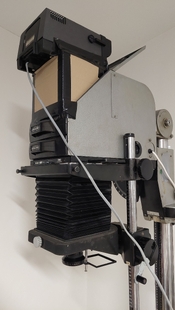
I was in the darkroom today and tried something. I saw an Ilford 500H head on a Durst 138, but with the information that it is only usable up to a 4x5 negative size. I tried to put a Meopta Color 4 color head, designed for 6x9, on the condensers using cardboard.

20251107_145625.jpg

What surprised me was that it cover 5x7 neg very evenly, with a loss in the corners of about 0.2 stop. There is not enough light for a 40x50cm enlargement, there is only one 100w halogen, but still......I wanted a purely diffuse light source, but maybe a more powerful head for 4x5 would be an intermediate step (a lot cheaper than CLS 301).
 

koraks

Moderator
Moderator
Joined
Nov 29, 2018
Messages
26,874
Location
Europe
Format
Multi Format
Nice! Yes, this approach works; since you have a reasonable distance between the diffusor/color mixer in the color head and the condenser array, you can still get OK coverage. Be sure to test it with prints on high contrast grade, or a (near-)neutral grey filtration on color paper. The proof of the pudding is after all in the testing.

An old friend of mine did color work this way as well; he used the color head from an old Agfa Variscop enlarger also on his Durst 138. The contraption involved, if memory serves, a metal salad bowl hacked into shape as an adapter. A little creativity goes a long way!
 
OP
OP
blacksquare

blacksquare

Member
Joined
Sep 8, 2015
Messages
90
Location
Czech Republic
Format
Large Format
Nice! Yes, this approach works; since you have a reasonable distance between the diffusor/color mixer in the color head and the condenser array, you can still get OK coverage. Be sure to test it with prints on high contrast grade, or a (near-)neutral grey filtration on color paper. The proof of the pudding is after all in the testing.

An old friend of mine did color work this way as well; he used the color head from an old Agfa Variscop enlarger also on his Durst 138. The contraption involved, if memory serves, a metal salad bowl hacked into shape as an adapter. A little creativity goes a long way!

Sure, it was just a test. The "window" of the lamp box, from which the light then reflects off the mirror into the condensers, is very similar in size to the bottom of the mixing chamber of the color head.
I was thinking about the Agfa head, but it's a very old model. The Durst Lavako that came with it also allows for height adjustment.

Screenshot_20251107_171105_Edge.jpg

If color heads for 5x7 weren't so expensive/unavailable in the EU, I would buy one straight away. But many times is it the price of almost the entire enlarger :/
 

koraks

Moderator
Moderator
Joined
Nov 29, 2018
Messages
26,874
Location
Europe
Format
Multi Format
Yeah, 5x7" color heads are rare. I think you're on the right path adapting another solution for your enlarger. Then if the 'correct' color head comes by you can always jump on it.
 

DREW WILEY

Member
Allowing Ads
Joined
Jul 14, 2011
Messages
14,873
Format
8x10 Format
Unless you're adapting the head to a big mixing box for sake of 8X10 film, or else really big enlargements, the CLS301 is total overkill - too much light and heat, and older electronics to contend with. Ideally, you want a somewhat oversized diffusion system for sake of even illumination - for example, 5x7 for 4x5 film use. But given the nature of the 138 chassis, if you only plan on using film up to 4x5, just adapt one of the popular 4x5 colorheads to that, plus effective diffusion above the negative stage.
 
OP
OP
blacksquare

blacksquare

Member
Joined
Sep 8, 2015
Messages
90
Location
Czech Republic
Format
Large Format
Unless you're adapting the head to a big mixing box for sake of 8X10 film, or else really big enlargements, the CLS301 is total overkill - too much light and heat, and older electronics to contend with. Ideally, you want a somewhat oversized diffusion system for sake of even illumination - for example, 5x7 for 4x5 film use. But given the nature of the 138 chassis, if you only plan on using film up to 4x5, just adapt one of the popular 4x5 colorheads to that, plus effective diffusion above the negative stage.

That's the problem, I have a Durst for 5x7 and 6x17.

Latibox 138 (mixing chamber used under CLS301) and Lacap are now available on ebay. I'll probably order that and use it as a basis for a LED diffusion head.
 

DREW WILEY

Member
Allowing Ads
Joined
Jul 14, 2011
Messages
14,873
Format
8x10 Format
Good idea to get ahold of those two items, which make a conversion easy. Remember, you can use more than one diffusion sheet in the mixing box if you need to.

There are also specialized kinds of diffusion plastic, which can basically "stretch" the evenness of illumination if you can't achieve perfect evenness of field by ordinary means.
 
OP
OP
blacksquare

blacksquare

Member
Joined
Sep 8, 2015
Messages
90
Location
Czech Republic
Format
Large Format
So ordered. I'll build a light box that will contain an array of LEDs (only white for now) and a diffuser, and I'll put it on the Latibox 138.
From what I've seen, the most commonly used are Cree XP-E2, ideally on star PCB. I see generic Chinese chips available in Europe, but it's probably better to stick to a proven manufacturer, right?

I don't know how to calculate the power consumption/luminous flux, I'll probably play it safe and maybe use more light. Is it safe to darken the LEDs somehow, in terms of changing the contrast? Or is it better to use an ND filter?
 

koraks

Moderator
Moderator
Joined
Nov 29, 2018
Messages
26,874
Location
Europe
Format
Multi Format
I see generic Chinese chips available in Europe, but it's probably better to stick to a proven manufacturer, right?

If you're going to use regular VC filters with it - really, it doesn't matter much what kind of LEDs you use.

I don't know how to calculate the power consumption/luminous flux, I'll probably play it safe and maybe use more light. Is it safe to darken the LEDs somehow, in terms of changing the contrast? Or is it better to use an ND filter?
The regular way to darken LEDs is to simply dim them. Will you be using LED 'stars' or strips? You can dim either, but the approach is slightly different. An ND filter will also work but of course just throws away light that you generated anyway, so I'd not choose that route personally.
 
OP
OP
blacksquare

blacksquare

Member
Joined
Sep 8, 2015
Messages
90
Location
Czech Republic
Format
Large Format
If you're going to use regular VC filters with it - really, it doesn't matter much what kind of LEDs you use.
That makes it significantly easier/cheaper.

The regular way to darken LEDs is to simply dim them. Will you be using LED 'stars' or strips? You can dim either, but the approach is slightly different. An ND filter will also work but of course just throws away light that you generated anyway, so I'd not choose that route personally.

I originally thought about using a strip because it would be easier for me (less soldering) and I thought it would be better for the homogeneity of the light ( and when I read how many LEDs Heiland uses...) But most people use LEDs around 3W, which I would definitely buy on the star PCB.

You're right, I used an ND filter when it was not possible to dim the light source otherwise.
 

koraks

Moderator
Moderator
Joined
Nov 29, 2018
Messages
26,874
Location
Europe
Format
Multi Format
For the star/bead LEDs, the best choice is a dimmable power supply; you calculate the voltage and current you need (depending on how you put the LEDs in parallel & series), then pick a power supply that will yield the desired amount of current and can work up the voltage needed under that load (this will likely not be a limit, really). For 3W LEDs the current is typically 700mA-1A per LED, or string of series-connected LEDs. Check the specifications of the LEDs you buy. I would recommend running them at <80% of their rated current. Then when selecting the power supply, make sure it's one that offers dimming, either linear or through PWM. There are undoubtedly power supplies with a knob/pot meter on them, or else you can connect one easily if it has a dimming input.
 
OP
OP
blacksquare

blacksquare

Member
Joined
Sep 8, 2015
Messages
90
Location
Czech Republic
Format
Large Format
Thanks a lot for the info. I'm looking into it, there are several control methods and often the power supply supports more than one at a time.

I'll probably start with an LED strip, it will be the easiest to test how it will behave and what kind of light will come out of the Latibox.
 

DREW WILEY

Member
Allowing Ads
Joined
Jul 14, 2011
Messages
14,873
Format
8x10 Format
If you have a somewhat oversized efficient LED panel array, you need to just space it a little bit away from the negative stage, along with a basic intervening translucent white acrylic diffusion sheet. No need technical need for a tall mirror box in between. The logistic question is a little different :

I still recommend you purchase the 5X7 mirror box and its housing while you have the opportunity, because it furnishes you with a lot more potential ways to get the job done. Off course, you can still use it with a LED panel array atop it - nothing wrong with that except more overall equipment height. And the mirror box housing makes accommodation to standard 138 negative carriers automatic - no further adaptation needed.
 
Photrio.com contains affiliate links to products. We may receive a commission for purchases made through these links.
To read our full affiliate disclosure statement please click Here.

PHOTRIO PARTNERS EQUALLY FUNDING OUR COMMUNITY:


Ilford ADOX Freestyle Photographic Stearman Press Weldon Color Lab Blue Moon Camera & Machine
Top Bottom