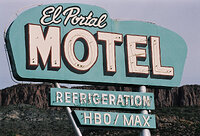
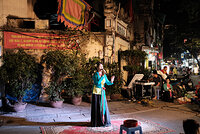
The ideal picture with a checker is a real picture with a checker in the scene, so that everything is balanced.
PE
Hard to argue with that. Next time you talk with Grant, please say that I enormously appreciated his hospitality (indeed, in Florida) and that I REALLY AM working my way through the book in sequence, not just cherry-picking.
I hate to appear rude but I do not know your real name; I salute you as one of those giants (of yesteryear, again at the risk of appearing rude) whose knowledge makes most of today's 'experts' look quite feeble. I am overcome with embarrassment when I think how unworthy I was to appear in the Oxford Companion as compared with those who contributed to the first and second Focal Encyclopaedias (though not later editions) or indeed with those who can discuss matters with Grant as an equal.
Edit: on further thought, and with some reflection upon objective colour processes (Lippmann) versus subjective, do I not recall correctly thar reproduced colours are (or were until recently) almost always less saturated than real life? In other words, even if the Macbeth chart is reproduced accurately, how much does this mean, given that it is a printed chart to begin with?
I realize that this queston verges on the mystical/meaningless (if spectral response asnd brightness match, they are the same thing) but equally there is the question of the very limited brightness range across which colour can be convincingly reproduced (including printed charts) -- a far more limited range than we can 'read' in real life.
As I say, I am but a novice in such matters compared with yourself; but I flatter myself that I know (just) enough to ask the right questions on occasion, and sometimes to understand the answers, when talking to/corresponding with those who really do have some understanding of the subject -- such as the question of 'sparkle' in monochrome prints, which both Mike Gristwood and Dr. Hubert Nasse assure me is a function of very high MTF values at relatively low frequencies.
Cheers,
Roger