

• Welcome to Photrio!
    Registration is fast and free. Join today to unlock search, see fewer ads, and access all forum features.
    Click here to sign up

The Minox frame counter: who knows how to read it correctly?

Recent Classifieds

Forum statistics

Threads
204,274
Messages
2,866,510
Members
102,207
Latest member
gustavocf
Recent bookmarks
1

tjwspm

Subscriber
Joined
Dec 23, 2023
Messages
384
Location
Germany
Format
Sub 35mm
Actually, I just wanted to give a tip about the Minox frame counter. It's about a mistake I always made when reading the frame number without realizing it. But once I started thinking about it, more and more questions came up.

First, here's the initial question. What number does this frame counter on a Minox A show?
Minox frame counter.jpg


Until now, I would have said: 0. Unfortunately, that's wrong—it shows 1!
And what is this figure supposed to tell us? The number of pictures taken so far? Wrong!

Why is this important? What are the two functions of the Minox frame counter? What does this mean for the correct insertion of the film? How are the photos stored on the Minox negative strip? How long and how thick is a Minox film? How much space is there between the negatives? ... These are not academic questions, but facts that can have a serious impact on the practice of Minox photography!

In the end, it turned into a whole article with lots of pictures and facts. EVERYTHING you need to know about the Minox counter and film. If anything is missing, please post it here. I will try to add it. Here is the article (select the language at the top left):
 
Well, this is interesting. I've got (so far) four of the old metal cassettes, the ones originally sold with 50 frame rolls (they're unused NOS, so they've still got long-expired film strips inside). This suggests that even with those cassettes I might be unable to load 50 exposure rolls of color film (not that I'm likely to shoot color in the Minox). UNLESS the metal cassette has thinner material and thus a fraction of a millimeter larger inside diameter. I won't know that for a while -- I'll have to slit and load at least a couple rolls first.

I do note, however, that it looks like a 50 exposure load is almost exactly the length of a 120 film -- which is why I'm aiming mainly for 50 exposures with my Minox B and 6-strip from 120 slitter, and why I bought the 50 exposure cassettes.
 
Unfortunately, I don't own any of these Minox metal cassettes. However, I can't imagine that the casing walls are thinner than those of the later plastic cassettes. So there probably won't be any more space inside them either. This means that ADOX CMS 20 will probably be used to accommodate 50 exposures.

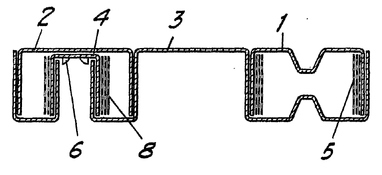
This is the sectional drawing of the metal cassette from the original patent specification. You can see that the film chambers have double walls.
Minox cassette.jpg

If you ever open one of your cassettes, please let us know how big the inner diameter of the film chambers is.
 
Unfortunately, I don't own any of these Minox metal cassettes. However, I can't imagine that the casing walls are thinner than those of the later plastic cassettes. So there probably won't be any more space inside them either. This means that ADOX CMS 20 will probably be used to accommodate 50 exposures.

This is the sectional drawing of the metal cassette from the original patent specification. You can see that the film chambers have double walls.
View attachment 414013

If you ever open one of your cassettes, please let us know how big the inner diameter of the film chambers is.

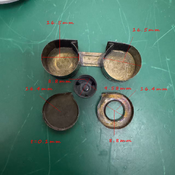
These are the dimensions I measured previously, so they may not be entirely accurate.
 

Attachments

  • minox.png
    minox.png
    976.7 KB · Views: 73
On the LX the “0” indicates no more left; frame 36 or 15 depending on which of the two start dots were used.
 
These are the dimensions I measured previously, so they may not be entirely accurate.

If those measurements are even fairly accurate, I should be okay with most modern B&W films in the metal cassettes -- those seem to have more than a millimeter larger inside diameter than the modern plastic ones. I'll know when I get my darkroom cleaned up enough to slit a roll and run it through the camera into the takeup chamber (likely going to start with XP-2 Super, which has no reason to have the thickness of color, but will let me get EI 640-800 via bleach bypass).
 
These are the dimensions I measured previously, so they may not be entirely accurate.

Thanks for taking the measurements. If you don't mind, I'll add your measurements to the article on my website. Then we'll have everything in one place.
 
If those measurements are even fairly accurate, I should be okay with most modern B&W films in the metal cassettes -- those seem to have more than a millimeter larger inside diameter than the modern plastic ones. I'll know when I get my darkroom cleaned up enough to slit a roll and run it through the camera into the takeup chamber (likely going to start with XP-2 Super, which has no reason to have the thickness of color, but will let me get EI 640-800 via bleach bypass).

Once you have cut a roll and placed it in the metal cartridge, please post your findings here. That would be very interesting.
 
Once you have cut a roll and placed it in the metal cartridge, please post your findings here. That would be very interesting.

Getting it into the supply chamber isn't the problem -- it's being able to wind the full 30 inches (~760 mm) of the strip onto the takeup spool without jamming that's the question.
 
Thanks tjwspm, that's an interesting article. I never knew about the cam that makes frame spacing consistent.
 
Thanks tjwspm, that's an interesting article. I never knew about the cam that makes frame spacing consistent.

I had assumed something like that. I've had a number of Minolta 16 and Kiev 16 mm cameras that use a similar mechanism -- in their case, the cam is visible when the shell is off the camera body for loading, and automatically resets to zero then the shell is removed. A slightly different method is used in 120 cameras with "turns counter" frame counters (like the Graflex 23, 22, and RH series roll backs, as well as -- at least -- Zeiss 532/16 Super Ikonta B), where a wheel has notches with decreasing spacing.
 
When you reload, how do you mark the starting end of the film to show “unexposed”? Cutting a notch seems excessive; how about just marking it with an O or S or X?
 
Unfortunately, I don't own any of these Minox metal cassettes. However, I can't imagine that the casing walls are thinner than those of the later plastic cassettes. So there probably won't be any more space inside them either. This means that ADOX CMS 20 will probably be used to accommodate 50 exposures.

This is the sectional drawing of the metal cassette from the original patent specification. You can see that the film chambers have double walls.
View attachment 414013

If you ever open one of your cassettes, please let us know how big the inner diameter of the film chambers is.

Since you are collecting info on Minox format films here are two other things you might be interested in looking at.

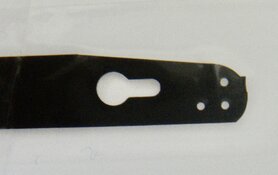
About 40 years ago when I was at the Minox factory in Heuchelheim they supplied me with the punch codes that are located on the ends of the films used to identify which film types were which. They also supplied me with the camera identifying codes that are imprinted on each frame that identify which camera was used to take the images. These are the small pips on the outside of each frame that are in different places on the frame depending on the camera type. Unfortunately a lot of time has past and I lost that information. It might be interesting to try and restore that information for all the Minox users. The film code punches in the picture attached was for a very old Minichrome sample.

Good luck
 

Attachments

  • DSC02620 2.jpeg
    DSC02620 2.jpeg
    423.2 KB · Views: 13
  • DSC02621.jpeg
    DSC02621.jpeg
    219.7 KB · Views: 13
Since you are collecting info on Minox format films here are two other things you might be interested in looking at.

About 40 years ago when I was at the Minox factory in Heuchelheim they supplied me with the punch codes that are located on the ends of the films used to identify which film types were which. They also supplied me with the camera identifying codes that are imprinted on each frame that identify which camera was used to take the images. These are the small pips on the outside of each frame that are in different places on the frame depending on the camera type. Unfortunately a lot of time has past and I lost that information. It might be interesting to try and restore that information for all the Minox users. The film code punches in the picture attached was for a very old Minichrome sample.

Good luck

Thanks for the tip and the photos. I’ll look into this and write a summary.

I have the information on camera type codes somewhere, but I don’t have the point codes for film types. I’ll look into that, though. If anyone here can help, please post here.
 
Photrio.com contains affiliate links to products. We may receive a commission for purchases made through these links.
To read our full affiliate disclosure statement please click Here.

PHOTRIO PARTNERS EQUALLY FUNDING OUR COMMUNITY:


Ilford ADOX Freestyle Photographic Stearman Press Weldon Color Lab Blue Moon Camera & Machine
Top Bottom