• Welcome to Photrio!
    Registration is fast and free. Join today to unlock search, see fewer ads, and access all forum features.
    Click here to sign up

The Meyerbeer Dilemma

Recent Classifieds

Forum statistics

Threads
203,602
Messages
2,856,972
Members
101,922
Latest member
Trevor2026
Recent bookmarks
0

Gerald C Koch

Member
Allowing Ads
Joined
Jul 12, 2010
Messages
8,129
Location
Southern USA
Format
Multi Format
Just where does the creative responsibility of a photographer end? Is it with the click of the shutter or with the print on the wall.

I have always taken a jaundiced view of those photographers who delegate the printing to someone else. Would you buy a painting knowing that the artist had given a rough sketch to an assistant who made the actual painting. As far as the marketplace is concerned the answer is obvious. The cost of a posthumous print is a fraction of that of a print made by the photographer.

For those that wonder at the title of this thread it is based on an old joke. "It this Meyerbeer or is this yourer beer?."
.
 
I think that the creative responsibility stays with the photographer even when delegating the actual printing to someone else. Cartier-Bresson didn't print all (or any?) of his prints but he did give instructions and feedback to his printer. That doesn't seem to affect the value of "his" prints. A posthumous print is different in that respect from a delegated print. No more involvement from the photographer. I like printing so I do it all myself. I get all the "glory" and reward myself with a nice beer for a nice print.
 
Would you buy a painting knowing that the artist had given a rough sketch to an assistant who made the actual painting
But the tradition of the artist in his (historically usually his) atelier with a host of assistants doing a lot of the leg-work stretches back hundreds of years at the very least.
Many of the large scale renaissance works bear the mark of the master, but his assistants would have painted in backgrounds and minor figures.
Rodin had dozens of assistants who worked up his small maquettes to the full size figures which would be used for casting - some significant figures in 20th C art had an apprenticeship in his workshop.
The examples go on and on.
 
It depends on the photographer, I have bought a few prints over the years from well known photographers all of whom made their own prints. However one did use someone else to do some of her printing but you' struggle to see a difference.

I prefer to do my own printing because I pre visualised the image, I do little re-interpretation in the darkroom, but others work differently and I would by a posthumous print made by the original photographers choice of printer, but not by someone else.

Ian
 
Would you expect a composer to play every instrument in an orchestra?

If we consider the Ansel Adams comment about the negative as the score and the print as the performance, why shouldn't others be allowed to 'perform' the score?
 
I'm currently without access to a local darkroom for enlargements - I do what I can with what I have at hand, and contract prints out.

If what comes back to me does not meet my specifications and intended look, then the print goes to the bin.


Would you watch a movie knowing that someone sat there and simply told everyone else what to do, and didn't do it all themselves?! What a hack of an artist that would be! Directing others, deciding what is and isn't good enough for the final piece, not operating the camera themselves, or the sound gear, or making all the costumes, props, and sets for things... What kind of bloody slacker of an artist wouldn't even get in front of their own camera to act all the roles in a movie, and then run around the country to setup the projectors and audio gear to make sure everything was perfect and exactly as it should be displayed!


In short, and a more serious response, use the tools and methods you have on hand to achieve your end goals. If the print you wanted hangs on your wall at the end of the day, then why should you care what road you took to get it there if you enjoyed the drive?
 
Just where does the creative responsibility of a photographer end? Is it with the click of the shutter or with the print on the wall.

I have always taken a jaundiced view of those photographers who delegate the printing to someone else. Would you buy a painting knowing that the artist had given a rough sketch to an assistant who made the actual painting. As far as the marketplace is concerned the answer is obvious. The cost of a posthumous print is a fraction of that of a print made by the photographer.

For those that wonder at the title of this thread it is based on an old joke. "It this Meyerbeer or is this yourer beer?."
.

Some people cannot afford the cost or space of a darkroom. Remember standing on principle when one does not make any sacrifice s for the principle is not a virtue. It is being a righteous pain in the ass.
 
I'm reading "Drawing on the Right Side of the Brain" by Betty Edwards, a book I've recommended before based on a summary... now I'm digging into it.

I was struck by something in the introduction:

"When you see in the special way in which experienced artists see, then you can draw. This is not to say that the drawings of great artists such as Leonardo da Vinci or Rembrandt are not still wondrous because we may know something about the cerebral process that went into their creation. Indeed, scientific research makes master drawings seem even more remarkable because they seem to cause a viewer to shift to the artist's mode of perceiving."

So it seems to me that if you show one of your prints to someone, if it is good enough, it might cause that person to feel as if they made the print and were showing it to you.

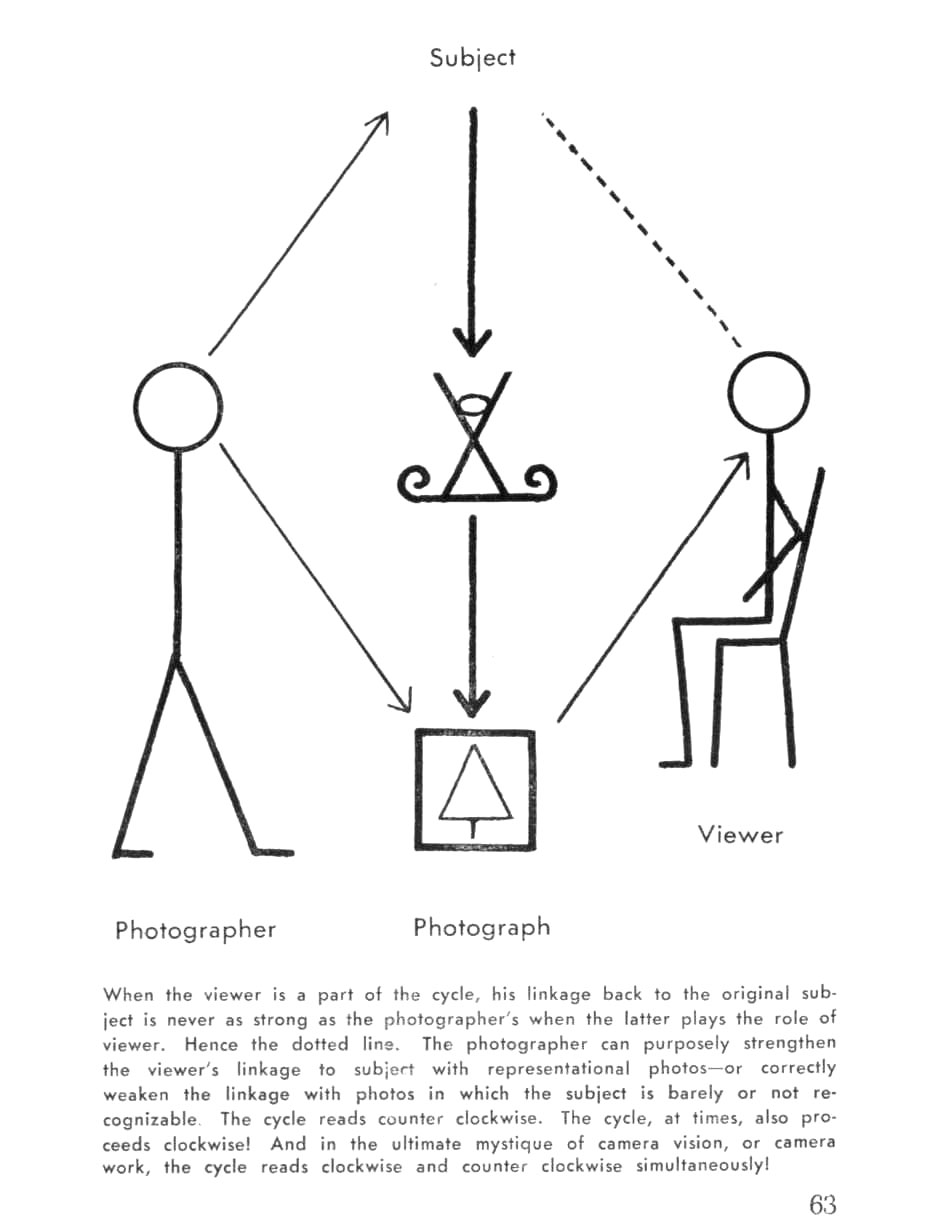
It reminds me of Minor White's cycle of photographic communication:

white_cycle.jpg
 
Just where does the creative responsibility of a photographer end? Is it with the click of the shutter or with the print on the wall.

I have always taken a jaundiced view of those photographers who delegate the printing to someone else. Would you buy a painting knowing that the artist had given a rough sketch to an assistant who made the actual painting. As far as the marketplace is concerned the answer is obvious. The cost of a posthumous print is a fraction of that of a print made by the photographer.

For those that wonder at the title of this thread it is based on an old joke. "It this Meyerbeer or is this yourer beer?."
.
It seems to me that this is a question of business model not creative responsibility.

When I use a pro lab they work to my specs and if I don't like their work I have them change it to suit my preferences. It strikes me as odd to think that HCB wouldn't be considered to be similarly creatively in control from end to end.
 
i think it is called "outsourcing" artists and photographers are no different than anyone else.
if they can and they want to they get someone else to do it for them. i shouldn't be telling you this
but someone else has been responding to posts for me here on apug for years, since about 2009 so i can
watch videos of kittens on you tube, lately though i will type something and it just gets "edited" after i post it.
i use a ghost writing service overseas... they usually do the photography part for me too
since i barely know how to screw a tripod into the camera.

 
Last edited:
It depends on the genre. If someone is selling their wares under a fine landscape and still life printer banner, they'd better be printing them. If they're a street photographer their time is better employed on the street shooting than in the darkroom. Fine artists whose work sells for millions do not make their own stuff as a rule, although there are exceptions. Most come up with a concept and employ craftsmen to do the practical stuff.

I've worked as a professional printer in the past, and I'm pretty good, but if I could pay others who are better I'd do it in a shot. A professional musician practices his scales every day, he doesn't turn up at a concert hall and hope to play Beethoven's Fifth once a month.
 
many famous artists prints ( lithographs, etchings, woodcuts, and photographs) WERE PRINTED BY SOMEONE ELSE. Many instances the drawings or process was executed by someone else, only leaving the signing to the artist. The argument for this approach is . . .. . . this is the artists idea. Who owns the idea, signs the print. The shop lacky who printed it does not get any credit. some may say thats unfair or misrepresentation,,,, but. . .. . .thats the way it is. . .
 
It depends on the photographer, I have bought a few prints over the years from well known photographers all of whom made their own prints. However one did use someone else to do some of her printing but you' struggle to see a difference.

I prefer to do my own printing because I pre visualised the image, I do little re-interpretation in the darkroom, but others work differently and I would by a posthumous print made by the original photographers choice of printer, but not by someone else.

Ian
As Ian said, to each his own. If your artistic vision extends to darkroom work (as does mine and Ian's) then that's the way that works for you. Others stop with the "click". It's all good, but if you still shoot film you owe it to yourself to at least try a session or two in the darkroom. I still get a kick out of it and love the look on my students faces the first time someone has a print come up in a tray.
 
someone else has been responding to posts for me here on apug for years, since about 2009 so i can
watch videos of kittens on you tube, lately though i will type something and it just gets "edited" after i post it.
i use a ghost writing service overseas... they usually do the photography part for me too
john to be honest, I'm not sure how much longer I can keep doing this for you at just 5c/100 words.
Plus it takes a lot of time in between my stitching MAGA on all those red caps, and I only get a $1/100 for those too.
 
There is another thread recently, where the discussion is basically would AA be shooting digital and how easy it is to make a digital print...

I think these discussions as well as the one in this thread are missing the point: a good image is a good image regardless of the medium or process used: A Rembrandt oil painting is a great image (even if reproduced photographically and printed in a book) and yes the original is much more impressive and yes, Rembrandt had to be a master of the medium to get his artistic vision onto the canvas. But that says nothing about a Van Gogh (who basically couldn't draw) or about a polaroid by Chuck Close or your and my photos.

For the recipient of art, the process does not matter and ultimately should not: any great art requires no explanation and works across time. The painful process of getting there, the blood and sweat are the business of the artist alone. Ever saw a ballet sitting in the front row?

A mediocre landscape image doesn't get any better just because it was done with a 8x10 view camera, printed in Pt/Pd on washi paper by the photographer himself. Of course, if your artistic vision requires a 8x10 negative and the tonal scale of Pt/Pd etc. and you have the craftsmanship to produce a final print expressing this vision, you have all of my admiration. But the converse is not true, a classical case of a syllogism gone wrong.

To summarize, an exotic medium (and I am afraid, today, analogue photography and dark room printing are exactly that,) is no substitute for artistic vision and going even further, a great image can be made with the most modest tools if you have a vision.

Since the process doesn't really matter to the recipient, so why would the point at which the photographer delegates work matter?

Of course, to me it matters greatly where I stop and what process I am using, but this is my problem alone. And yes, if I see an image I like, I am very interested to learn how it was made, but this is from one craftsman to the other.
 
Last edited:
Where I was going with my post... I think a photographer's work is done when the viewer can see the work... I know it's only tangentially related to this thread but maybe darkroommike is thinking like me here...

If your artistic vision extends to the darkroom... then part of what you want the viewer to see and understand is the physical print itself. Then you have to do your own printing or partner with someone who can make prints that you like. Because then someone looking at your print might sense the work that you did.

If it doesn't, then... heck... your responsibility ends whenever you feel like it's yours.

I wonder what kind of prints Leonardo da Vinci would have made if he could have fixed the images...
 
Fraunhofer, I was thinking of Ansel Adams too, how many people looking at his prints "get it" and then internalize it and turn around and go out to do the same thing because they see like he saw. Last time in Yosemite, I got into that mode of seeing and felt like I was channeling his spirit.

Last night was funny... I dreamt of a mountainous campsite with nobody around but our troop... then went for a short afternoon hike to chase the golden light, just as I passed the first hill there was a great tourist restaurant and highway with people everywhere... it was all good in the end though because there was an art supply shop where I could get a sheet of mat board to use as a reflector for the shot I wanted.
 
many famous artists prints ( lithographs, etchings, woodcuts, and photographs) WERE PRINTED BY SOMEONE ELSE. Many instances the drawings or process was executed by someone else, only leaving the signing to the artist. The argument for this approach is . . .. . . this is the artists idea. Who owns the idea, signs the print. The shop lacky who printed it does not get any credit. some may say thats unfair or misrepresentation,,,, but. . .. . .thats the way it is. . .
This marginalizes the creative aspect of darkroom printing. The equivalence to the print of the lithograph, etching, and woodcut is the digital print, after the photographer has finished manipulating the print in PS/LR, and all that is left to do is press the print button.
 
i shouldn't be telling you this
but someone else has been responding to posts for me here on apug for years, since about 2009 so i can
watch videos of kittens on you tube
John:
You should pay them more, so they can get their "Caps" key fixed:whistling:
 
Matt

i would but i am very busy
watching videos of cut mini-pigs + kittens

they give me a discount for all lowercase, i can't afford much more, sorry pdeeh !
 
Last edited:
I make photographs but I also collect photographs by paying for them with my own money. My rule is that the picture has to be physically connected to subject matter, made out of light-sensitive materials, and completed start to finish solely by the person who signs it. This restricted approach is a personal way of avoiding:
Digital folderol.
Controvery about authorship.
Controversy about authenticity.
The scholarship of singular art objects by sole authors stays rock solid no matter how aesthetic fashions change.
 
What an odd statement. Who else's money would you spend.
Brings rise to thoughts of Donald Trump, but that would definitely be off topic.:whistling:
 
I'm currently without access to a local darkroom for enlargements - I do what I can with what I have at hand, and contract prints out.

For most of my life I have never had a dedicated darkroom. What was available were either waterless spare rooms, closets or occasionally a spare bathroom. Yet I muddled thru and won a few ribbons for my prints. As you say one makes do with what one has. But this is lack of facilities or equipment not lack of will.
 
Last edited:
Photrio.com contains affiliate links to products. We may receive a commission for purchases made through these links.
To read our full affiliate disclosure statement please click Here.

PHOTRIO PARTNERS EQUALLY FUNDING OUR COMMUNITY:


Ilford ADOX Freestyle Photographic Stearman Press Weldon Color Lab Blue Moon Camera & Machine
Top Bottom