
• Welcome to Photrio!
    Registration is fast and free. Join today to unlock search, see fewer ads, and access all forum features.
    Click here to sign up

The largest aperture...

Tompkins Square Park

A
Tompkins Square Park

  • 4
  • 0
  • 68
Siesta Time

A
Siesta Time

  • 2
  • 0
  • 52

Recent Classifieds

Forum statistics

Threads
202,859
Messages
2,846,679
Members
101,573
Latest member
IanSeehorn
Recent bookmarks
1

Ray Rogers

Member
Allowing Ads
Joined
Aug 27, 2005
Messages
1,543
Location
Earth
Format
Multi Format
While posting to the thread:

"How much over exposure? or A-Max (a REALLY big apeture)"

I started to wonder what the largest F/value ever produced was...

I have used a wonderful but heavy 105mm (135mm?) 1.2 lens...
but what are the practical and theoretical limits?

How low can you go?

:confused:
 
Canon had an f0.95 lens and Zeiss made an f0.7 for NASA.


Steve.
 
I would imagine that it was the Canon 0.95, that was fitted to the Canon 7. Leicas' F1 Noctilux goes close, and is a damn sight better. BTW, what was the 105mm 1.2 that you mention, the fastest 105 that I have seen is the 1.8 Nikkor.
The other good one is Canons' 1.2 85mm.
 
I have the 85mm 1.2 which is outstanding.
I'll second that - the 85mm/1.2L is a thing of beauty.

I've been looking on Fleabay to see if I can pick up the FD mount version as well, but it seems they hold their value rather too well for my budget!
 
BTW, what was the 105mm 1.2 that you mention, the fastest 105 that I have seen is the 1.8 Nikkor.

Good question...
I don't know; certainly it was not from one of the big camera mfg... I got it either from 42st Photo or Freestyle, and did not expect much... but I was very happy with it...

Unfortunately, it was stolen with a lot of other gear many years ago, and not being a name I knew, I have forgoten it.
 
For lenses working in air the theoretical limit is not quite down to 0.5. The problem that intrudes and limits relative aperture is total internal reflection at the glass to air interface. A cone of rays promising an aperture larger than 0.5 can exist inside the glass of the lens but the peripheral rays just can't get out.

If one designs a lens system so that the focal plane coincides with the surface of the rear lens element and one is prepared to oil a film to this surface (to keep the air out and keep total internal reflection at bay) then apertures wider than 0.5 can be delivered.

A system resembling this, but with the light rays going in the reverse direction, is regularly used in high resolution oil-immersion microscopy.
 
I think this was the fastest mass-produced 'consumer' lens: F 0.90 Switar. If someone knows anything faster, please post.
50kern_11.jpg

Non-rex.jpg
 
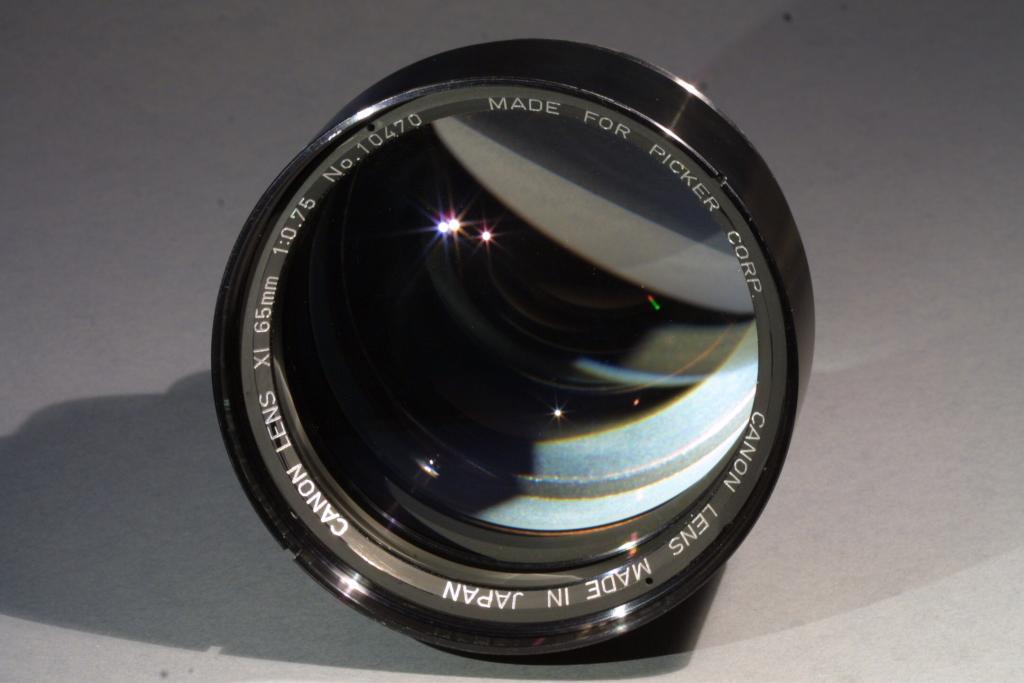
No mention of Zoomar? They produced both a 180/1.3 and a 240/1.2 (the 240 even covered medium format). If you include effective aperture, the Zeiss N-mirotar is about f/.03, but it is just a f4 or so mirror lens with a couple of image intensification tubes. Nikon also made a 58/1.0; one popped up on ebay a couple years ago, I'll try to post pictures if I can find them. If anyone's curious, the macrolenses.de site has some pictures of a couple of f/0.75 lenses. As Maris mentioned, oil immersion microscope objectives exist that are larger than f0.5.
 
If anyone's curious, the macrolenses.de site has some pictures of a couple of f/0.75 lenses. As Maris mentioned, oil immersion microscope objectives exist that are larger than f0.5.
Nice! Anyone know what these fast lenses "X-Ray" lenses were used for? Pictures from dim fluroscopy screens maybe?
IMG_5966_wp_b.jpg
 
You would just expose the film longer in screen cameras. Not use very expensive fast lenses.

Why do you call this an "X-Ray" lens?
(For those who don't know, it's not the obvious, since you can't focus X-rays with glass lenses. :wink:)

P.S.
Thanks to Google:

The Picker Corporation presented ELCAN Optical Technologies with their problem: the proposed system was optically inefficient and could not produce bright enough images. The challenge lay in optimizing the coupling of the radiographic image intensifier's output to the recording media (film) in order to maximize the brightness and resolution of the image. The system required an extremely high performance lens that could capture and focus the available light.

Typical of ELCAN Optical Technologies, the solution was derived from working backward from the limiting factor - the sensitivity of the film. High-speed imaging necessitated the maximum amount of light reaching the film and high definition of the individual X-ray images onto the film.

The ELCAN - Picker lens solution was a projection lens with maximum transmission capabilities, an "F:1" lens. The extremely bright F:1 lens optimized the aperture (without compromise to image quality) , therefore maximizing the amount of light captured. The result was a clear, sharp x-ray image revolutionizing the medical imaging market.

SOURCE: ELCAN Optical Technologies

They would need "high speed imaging" because they were taking moving pictures, not stills. So my "expose the film longer" was not an option.
 
Photrio.com contains affiliate links to products. We may receive a commission for purchases made through these links.
To read our full affiliate disclosure statement please click Here.

PHOTRIO PARTNERS EQUALLY FUNDING OUR COMMUNITY:


Ilford ADOX Freestyle Photographic Stearman Press Weldon Color Lab Blue Moon Camera & Machine
Top Bottom