• Welcome to Photrio!
    Registration is fast and free. Join today to unlock search, see fewer ads, and access all forum features.
    Click here to sign up

The Ilford Manual of Photography

Forum statistics

Threads
203,442
Messages
2,854,778
Members
101,845
Latest member
azak
Recent bookmarks
0

wahiba

Member
Allowing Ads
Joined
Mar 19, 2004
Messages
194
Location
Keighley, UK
Format
Analog
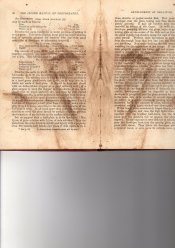
I have been on the look out for a decent copy for years. Today for £2.50 I acquired a 1950 reprint of the 1949 4th edition. Glossy paper and just very slight, if any yellowing. Only had a quick glance on the bus home and discovered 'Negative Card' a low-priced substitue for plates or films for use in the camera. Seems prints were made by taking a picture of the negative image with normal paper. I never heard of this before, which mades the purchase really worthwhile.

The section on close up work looks particularly interesting. I might even re-discover some long forgotten technique!
 
....discovered 'Negative Card' a low-priced substitue for plates or films for use in the camera. Seems prints were made by taking a picture of the negative image with normal paper. I never heard of this before,

Camera emulsions on paper were not uncommom.

Typical application was in WWII and during the post-war years with lack of raw stocks for the civilian market. There even was an enlarger for printing from such negatives in reflected light.
 
Camera emulsions on paper were not uncommom.

Typical application was in WWII and during the post-war years with lack of raw stocks for the civilian market. There even was an enlarger for printing from such negatives in reflected light.
I assume a reflecting enlarger works on the same principal as the epidiascopes we had at school in my day used to project flat pictures onto a screen.
 
I assume a reflecting enlarger works on the same principal as the epidiascopes we had at school in my day used to project flat pictures onto a screen.

Epidiascopes, as the name indicates, are dual use, they can project as well a transparency as an opaque print.
The same does the enlarger I had in mind.
 
Last edited:
I have the 7th Edition as well and find it an invaluable assistant for all of my photography. I seriously doubt I would have progressed anywhere near as well as I have without it. Between this book and Mees's much older Fundamentals of Photography (also 7th Edition though printed 42 years earlier) I have usually been able to sort out what I needed to keep progressing technically.
 
I have the 7th Edition as well and find it an invaluable assistant for all of my photography. I seriously doubt I would have progressed anywhere near as well as I have without it. Between this book and Mees's much older Fundamentals of Photography (also 7th Edition though printed 42 years earlier) I have usually been able to sort out what I needed to keep progressing technically.

I'll check it out- paperback classics reprint for $2.94 (Amazon)! Classic books and film cameras- two great things you can get for a very reasonable price these days.
 
Mees reprint neither on offer on Amazon.com nor .de.
 
Mees reprint neither on offer on Amazon.com nor .de.

Appears to be still available for a bit higher price.

I think other sellers have it: https://www.amazon.com/gp/product/1331898188/ref=ppx_yo_dt_b_asin_title_o00_s00?ie=UTF8&psc=1

Mees.jpg
 
Thank you. In any case something strange is going on at Amazon, I get other results than you, using the same site.
Furthermore there seem to be 2 reprints made, 2010 and 2015.
 
Camera emulsions on paper were not uncommom.

Typical application was in WWII and during the post-war years with lack of raw stocks for the civilian market. There even was an enlarger for printing from such negatives in reflected light.
sounds very good but why not contact printing it?
 
Because then you would have the old issue of George Eastman: diffusion by the paper base

Futhermore this depends on the thickness of that base. As far as I know, different thicknesses of base were used by the resp. manufacturers.
 
I have about 5 or 6 copies varying in age and editions, actually checking I have 8 different versions dating back to pre-1900, and the a Selo Manual of Photography

sounds very good but why not contact printing it?

These card negatives were designed for enlarging. Here in the UK there was a huge shortage of film base almost all went for military use. Ilford imported film base from DuPont in the US, Kodak from the US as well so during the war supply was patchy. It's possible the card base was a little thick for contact printing.

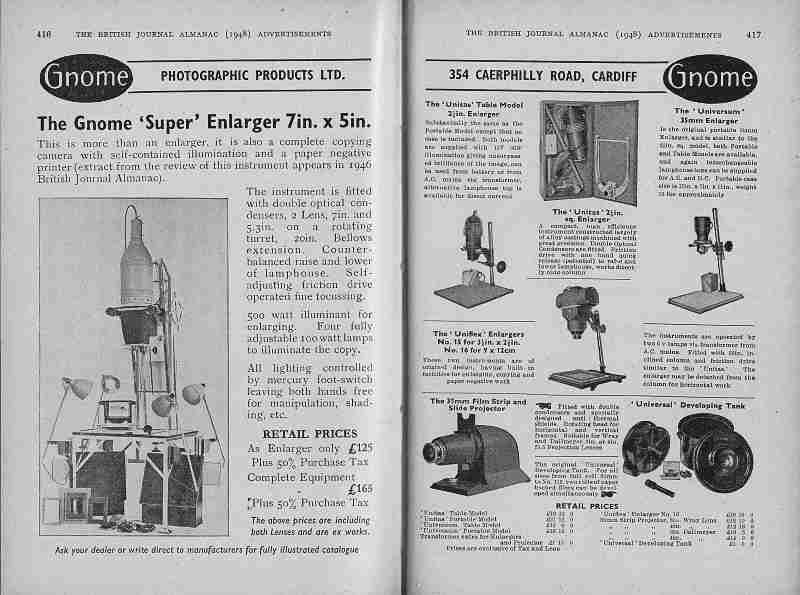
Enlargers were made with built in illumination to enlarge card negatives or were an extra.

gnome1948.jpg


Gnome was a owned by a German Jew who had fled the Nazis and was founded in 1938, they must have been manufacturing for the military during the war. The 7x5 enlarger has an illuminated carrier for card negatives (not shown) and the enlarger in the middle of the 2nd page is for card negatives.

At one time (probably the 60;s) 80% of enlargers sold in the UK were made by Gnome.

Ian
 
I never came across any English language photography text book or magazine over here. I bought them all abroad.
 
The Gevaert Manual of Photography is another nice book I have a couple, one pre WWII the other post.

Ian

For $9 I'll check it out (2nd edition, hardcover). Thanks.
 
For $9 I'll check it out (2nd edition, hardcover). Thanks.

The Gevaert Manual of Photography

This is a beautiful book (1962 edition) with great B&W and color reproductions on quality paper, and it looks like great information also (just got it).
 
Epidiascopes, as the name indicates, are dual use, they can project as well a transparency as an opaque print.
The same does the enlarger I had in mind.

The Durst M600 enlarger can be used in this way.
 
Enlarging an opaque source, image on paper, was a necessity when there were no more films, but manufacturers had to use a paper base instead for taking materials.

The Durst M 600 cannot enlarge in reflected light from an opaque source. No Durst enlarger can do so.

You mix this up with using a Durst enlarger as repro camera.
This however typically involves minimizing the image, and is a different set-up, with the source on the base-board and not in the negative stand.
 
Last edited:
Saw this thread and picked up the 7th edition (1978, renamed "The Manual of Photography") on Amazon. Very detailed and interesting reference. Thanks!
That’s the edition I have. A really good all-around resource.
 
AgX, thank you for your important correction. I've had and given away, at least 2 Durst M600 enlargers and though I never tried to us it as anything other than a photo enlarger, I have harbored the belief that they would perform as I said, above.

It's funny, but even finding out I was wrong in that operation of the Durst enlarger, it's still nice to learn something 'new' about a piece of kit I though I knew pretty well!

Cheers.

.
 
Photrio.com contains affiliate links to products. We may receive a commission for purchases made through these links.
To read our full affiliate disclosure statement please click Here.

PHOTRIO PARTNERS EQUALLY FUNDING OUR COMMUNITY:


Ilford ADOX Freestyle Photographic Stearman Press Weldon Color Lab Blue Moon Camera & Machine
Top Bottom