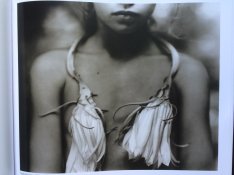

So I was over at a friends house, and I happened to notice this photograph in a frame, it had been sent to her by her sister, and was a postcard, the image looks very familiar and it was driving me crazy because I knew that I knew the artist and I thought that I need the model too, it just looks so familiar.
After staring at it for a long time I realize that it was Sally Mann.
Anyway, I got to thinking about her book that had been given to me by my ex for a Christmas gift, and this has nothing to do with the content, but the greys...
Here's the postcard image...
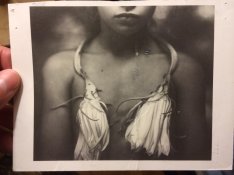
This is obviously a photograph taken with the digital camera of another photograph, but I hope that the image will translate so that you can see what I'm talking about.
There's just no black it all, it's all gray, and that struck me as interesting, now as many of you know I do develop my own film, I often like a higher contrast image, but also on top of all that, I scan... *ducks*
I realize that on a computer you can just move the slider and remove some of the blacks so that everything kind of goes gray, but in traditional film photography my question to you is was this done as part of the exposure itself in the camera, or was the removal of blacks somehow accomplished in the darkroom?
I know that this can be a little bit of both, and very much opinionated, but it just made me think, I've definitely taken an image and made it low contrast by over exposing and under developing to give it a certain low contrast look, but I don't see this image as a low contrast image, it's different somehow, very defined edges yet soft, and the lighting is smooth, but I know that Sally mostly shot around the house with her 8x10, and this probably was not studio lit...
However I've inly done the "over expose and under develop" in landscape work, not with people, so I'm not familiar with how it looks.
So is there something about the actual exposure and development process that mostly accomplish this goal, and then printing was the secondary method, or was this once a normal contrast and normal black-and-white negative that she was able to print to this amount of softness of grays in the darkroom?
Thanks.
After staring at it for a long time I realize that it was Sally Mann.
Anyway, I got to thinking about her book that had been given to me by my ex for a Christmas gift, and this has nothing to do with the content, but the greys...
Here's the postcard image...
This is obviously a photograph taken with the digital camera of another photograph, but I hope that the image will translate so that you can see what I'm talking about.
There's just no black it all, it's all gray, and that struck me as interesting, now as many of you know I do develop my own film, I often like a higher contrast image, but also on top of all that, I scan... *ducks*
I realize that on a computer you can just move the slider and remove some of the blacks so that everything kind of goes gray, but in traditional film photography my question to you is was this done as part of the exposure itself in the camera, or was the removal of blacks somehow accomplished in the darkroom?
I know that this can be a little bit of both, and very much opinionated, but it just made me think, I've definitely taken an image and made it low contrast by over exposing and under developing to give it a certain low contrast look, but I don't see this image as a low contrast image, it's different somehow, very defined edges yet soft, and the lighting is smooth, but I know that Sally mostly shot around the house with her 8x10, and this probably was not studio lit...
However I've inly done the "over expose and under develop" in landscape work, not with people, so I'm not familiar with how it looks.
So is there something about the actual exposure and development process that mostly accomplish this goal, and then printing was the secondary method, or was this once a normal contrast and normal black-and-white negative that she was able to print to this amount of softness of grays in the darkroom?
Thanks.