• Welcome to Photrio!
    Registration is fast and free. Join today to unlock search, see fewer ads, and access all forum features.
    Click here to sign up

The effect of camera movements and their use

Burial Ground

A
Burial Ground

  • 2
  • 2
  • 59
Beach Girl-3

Beach Girl-3

  • 0
  • 0
  • 141

Recent Classifieds

Forum statistics

Threads
202,483
Messages
2,841,376
Members
101,351
Latest member
pavdee
Recent bookmarks
0

snaggs

Member
Allowing Ads
Joined
Feb 18, 2005
Messages
323
Location
Perth, Austr
Format
35mm
I'm sure there is more than just me here who is inexperienced in LF. What would be really interesting would be to see some example photo's shot using different camera movements and some description of the effect and why you use it.

Any one willing to step up to the plate and show some of your techniques off and explain how they were achieved?

Cheers,

Daniel.
 
It could be a good article, but most introductions to the view camera have this sort of thing, like Steve Simmons' book, _Using the View Camera_; Ansel Adams' _The Camera_; Strobel's _View Camera Technique_; the Sinar manual, etc.
 
Daniel,

The book that, IMHO, answers your question best is the one by Jack Dykinga entitled, "Large Format Nature Photography."

In it, he describes and illustrates the camera movements associated with each of the images.

Great reference book... and very reasonably priced as well! :smile:

Cheers
 
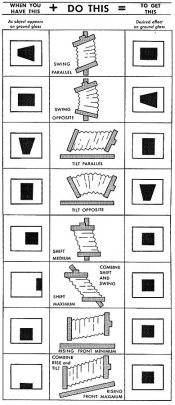
this might help a little

This helped me get my head around some of it:
 

Attachments

  • vcmovements2.jpg
    vcmovements2.jpg
    75.4 KB · Views: 289
There are plenty of excellent books, but the principles are far simpler than first appearances.

If you have a camera just search Wikipedia and then have a play, here's a link to get you started: View Cameras

In reality there is now no need for a book at all.

Ian
 
Just a quick answer: You use tilts, either back or front, to control depth of field. In other words, by tilting the front standard (which holds the lens) towards the scene, you can increase your depth of field without changing your aperture.
In the same way, you can use swings to do the same thing in a vertical plane. For example, if you are photographing a building that is at an oblique angle to the camera, swinging the front can put the entire wall of the building in focus.
The lens board can be elevated to control perspective and avoid the "building falling over backwards" effect, or converging verticals. Horizontal shift of either back or front can accomplish the same thing if you are not directly in front of the building you are photographing.
These are examples from architectural photography, but of course they could be applied to landscapes, product photography, etc. They are not usually employed for portraits, except for groups, where you can use the tilt to get an entire group in focus.
 
Having learned the effects of view camera movements in a commercial / table top settings there are a few things I can assure you of.

The movements you see in camerra advertisements will never be that extensive in the environment nor in a studio setting most of the time.

Whenever possible always use the rear standard to gain focus as it "steals" much less of the image circle to alter the plan of focus.

A formula I live by, examine the composition you have chosen, if it resembles a cube, then the only thing that will help with depth of field is F stops. If the composition resembles a rectangle in any way, then swing or tilt the "lens" in the "direction of the longest plane of the rectangle". Likewise, if necessary to correct perspective you can swing or tilt the rear standard in the "opposite direction of the longest plane of the rectangle".

Cheers!
 
From a technical perspective, the most important tool in learning to use your cameras movements is a gridded ground glass.

From a personal perspective, the most important step after learning the movements is getting rid of the gridded ground glass...
 
ok, here's another question...I've had and used my 4x5 camera for 7 years, but the whole time with a 90mm lens, recessed board, bag bellows and short rail. Can i use a 210mm lens on this without changing anything....except for maybe a flat lens board? If not, how long a lens can I use without putting the regular bellows and longer rail on?
 
ok, here's another question...I've had and used my 4x5 camera for 7 years, but the whole time with a 90mm lens, recessed board, bag bellows and short rail. Can i use a 210mm lens on this without changing anything....except for maybe a flat lens board? If not, how long a lens can I use without putting the regular bellows and longer rail on?
Depends on how far your bag allows you to separate the standards. Do this: extend the front standard as far from the rear as the bag will allow. Then measure from the plane of the lensboard to the film plane. Let's say you measure 150mm; then you could mount a 150mm lens, but only focus it at infinity. Not very useful. You could mount a 135mm lens and have 15mm of lens extension available. And so forth...
I doubt very seriously you could mount and focus a 210mm lens without some kind of "extension tube" lensboard... if at all. It just depends on how "baggy" your bag is, and the length of your short rail.
 
Ok, extended the bellows out all the way, giving me around 255mm of space. The bag, in fact, would probably give me more with the longer rail. So, would the 210mm lens work...with some room to focus?? or should I go with, lets say, the 180mm lens? Thanks for any help...
 
Yeah, that should be okay. In general you want about 25% more bellows than your longest focal length, but if you're not going to be shooting very close, you could get away with 255mm bellows for a 210mm lens. 180mm will give you a little more breathing room and is a nice counterpart for a 90mm lens.
 
oops a little late on the post...
 
Last edited by a moderator:
Ok, extended the bellows out all the way, giving me around 255mm of space. The bag, in fact, would probably give me more with the longer rail. So, would the 210mm lens work...with some room to focus?? or should I go with, lets say, the 180mm lens? Thanks for any help...
A 210mm lens at 255mm from the film plane should allow you to focus to about 1.2m; just under 4 feet.
 
Great thread. Thank you all.

Thank you especially jstraw. That beautiful little diagram sums up so many pages, chapters and books. A wonderful quick reference to memorize and use almost as a reflex action.

I like the Nike ad saying to "just do it". Practice. Look at your results. Ask yourself how can I make it better? Ask a better photographer to look at your work and answer the same question. Most of all enjoy it, because that will become your motivation.

John Powers
 
Reading books is my favorite way to learn things. But this is one of the things that is quite complicated for me to understand from a book. I just couldn't start understanding it for real until I bought my Tachihara.
/matti
 
Great thread. Thank you all.

Thank you especially jstraw. That beautiful little diagram sums up so many pages, chapters and books. A wonderful quick reference to memorize and use almost as a reflex action.

I like the Nike ad saying to "just do it". Practice. Look at your results. Ask yourself how can I make it better? Ask a better photographer to look at your work and answer the same question. Most of all enjoy it, because that will become your motivation.

John Powers

Happy to help.
 
Having learned the effects of view camera movements in a commercial / table top settings there are a few things I can assure you of.

The movements you see in camerra advertisements will never be that extensive in the environment nor in a studio setting most of the time.

Whenever possible always use the rear standard to gain focus as it "steals" much less of the image circle to alter the plan of focus.

A formula I live by, examine the composition you have chosen, if it resembles a cube, then the only thing that will help with depth of field is F stops. If the composition resembles a rectangle in any way, then swing or tilt the "lens" in the "direction of the longest plane of the rectangle". Likewise, if necessary to correct perspective you can swing or tilt the rear standard in the "opposite direction of the longest plane of the rectangle".

Cheers!

Thanks for these tips; quite informative!
 
Photrio.com contains affiliate links to products. We may receive a commission for purchases made through these links.
To read our full affiliate disclosure statement please click Here.

PHOTRIO PARTNERS EQUALLY FUNDING OUR COMMUNITY:


Ilford ADOX Freestyle Photographic Stearman Press Weldon Color Lab Blue Moon Camera & Machine
Top Bottom