
• Welcome to Photrio!
    Registration is fast and free. Join today to unlock search, see fewer ads, and access all forum features.
    Click here to sign up

testing fix on exhaustion

Fold

H
Fold

  • 0
  • 0
  • 0
Procession (2)

Procession (2)

  • 2
  • 0
  • 16

Recent Classifieds

Forum statistics

Threads
202,925
Messages
2,847,664
Members
101,539
Latest member
disami
Recent bookmarks
0

maarten m

Member
Allowing Ads
Joined
Apr 7, 2010
Messages
147
Location
gent belgium
Format
Medium Format
hello guys,

is there a simple trick to check if your fix bath is still OK?
i know there are strips and drops to test this, and a piece of undevelopped film to drop in the filmfix,
but what are other ways to check if the paper-fix is still OK?

thanks,
maarten.
 
What I do is keep re-using my fixer working solution until it does not work any more. Then I just mix some fresh solution and keep going. Another way is to get a piece of the undeveloped film, drop it in the fixer solution and record the time it takes until it gets clear. If it is in the 3 minutes ballpark then you are o.k.
 
Maarten,

Manufacturers normally include this information on the bottles or instruction guides. For example, Ilford Rapid Fixer states

General purpose film | 1+4 | 24x135–36

RC paper | 1+4, 1+9 | 80 sheets of 20.3x25.4cm (8x10in) m2 (44ft2)
 
zanxion,
that is OK with film fix, but how can you tell your print is fixed?
i mean, you can't "see" if your print is well fixed, can you?

ghostman: that's the theory, but i don't keep track of how many films/prints i make.
also, sometimes i just store the solution for weeks before the next batch of developing ...
 
I use film strips both for film fixer and paper fixer.
- With new fixer, measure the time to clear a piece of b/w neg film. Should be 20-25s with "film strength" dilution (1+4) and ~1min for "paper strength" dilution (1+9). Granted, some procedures (e.g. Ilford archival) use 1+4 for paper.
- At beginning of session, check clearing time. Fix for twice clearing time. Hard to over-fix paper (except, for Ilford archival procedure, fixing time must be controlled)
- When clearing time has doubled, discard fixer (or transfer to Fixer#1 in case of paper double fix).
is there a simple trick to check if your fix bath is still OK?
Is that simple enough for you? No extra chemicals to buy, takes ~1min out of a lab session, and gives positive assuranec on theh state of your fixer.
 
What bernard said. That's all there is to it. You can really complicate it up w/ other tests for this and that, but what he said works. There's also hypo clear on the paper washing end to clear the fixer and speed up the washing process (w/ fiber papers).
 
Are you guys sure that film clearing time is representative of paper fixer exhaustion? You do know that film uses mostly Silver Bromide and Silver Iodide, whereas paper uses mostly Silver Bromide and Silver Chloride, yes?
 
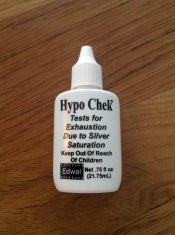
What Bernard said. Though I usually just make fresh fix if I'm doing fiber anyway. RC is usually proofs or contact sheets and not that crucial. I also have "hypo-check" that makes a precipitate if the fixer is bad - though mine is usually tossed before it gets to that point.
I don't really try to use chemicals all the way to the edge of their usability - that's a false economy, imo. My time is more precious and if I have to reprint something because the fixer was exhausted, I will NOT be happy.
 
What I do is keep re-using my fixer working solution until it does not work any more. Then I just mix some fresh solution and keep going. Another way is to get a piece of the undeveloped film, drop it in the fixer solution and record the time it takes until it gets clear. If it is in the 3 minutes ballpark then you are o.k.

Extremely bad advice unless it is an attempt at humor. Your method can seriously impair the stability of processed film and prints. It contradicts what is known about the fixing process and what is recommended by every reputable manufacturer.
 
Last edited by a moderator:
There must be a kazillion posts on this very topic.

You can see when film is cleared and you know it is fixed at 2x that time. You know when the fix is going bad when the clear time begins going up. BUT, with paper you don't know by any visual check of the paper.

There are 2 tests for paper, one complex which I leave out here and the other simple.

Buy a bottle of retained silver test solution. Many places carry it if they carry photo supplies.

Treat a piece of paper according to kit instructions and place 1 drop of solution on the paper. If there is retained silver, a dark spot appears. Thats it!

PE
 
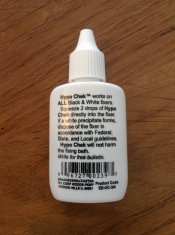
I use one of the commercially available Hypo check solutions. I put a drop or two in the hypo and if it is bad the drops will appear cloudy.
 
This is a method that needs a lot of practice with to become useful or reliable. It depends on whether film or paper was used for the majority of the fixation.

PE
 
I must admit that some people mystify me. They will readily spend money for film, paper, and developer but then suddenly become Scrooge when it comes to filxer and stop bath. Perhaps it is the unglamorous roles of these two chemicals that makes them appear to be not quite as important aspects of the process. This is really a foolish attitude. An improperly fixed film or print will soon become damaged by various argento-thiosulfate complexes remaining from overworked fixer. In addition these complexes are much harder to remove with washing. You will see this attitude repeatedly on APUG. People will appear to be quite smug about "beating the system" in extending the life of stop baths and fixers past their useful capacity.

There exist test solutions for determining when a fixer has reached its useful capacity. However they must be used carefully and the results can be hard to interpret. But there is a very simple and effective way to determine the useful life and that is to keep track of the number of in2 of film or paper passed through a bath. Then simply discard it when the manufactures recommended capacity is reaching. Simple, effective and no interpreting "iiffy" test results.
 
There is also this:

attachment.php
attachment.php
 

Attachments

  • IMG_0739.JPG
    IMG_0739.JPG
    577.4 KB · Views: 343
  • IMG_0740.JPG
    IMG_0740.JPG
    598.8 KB · Views: 349
What I do is keep re-using my fixer working solution until it does not work any more. Then I just mix some fresh solution and keep going. Another way is to get a piece of the undeveloped film, drop it in the fixer solution and record the time it takes until it gets clear. If it is in the 3 minutes ballpark then you are o.k.

by using the two-bath fixing method,you always finish with a fresh bath of fixer.There is a fixer test solution containing iodine but it is unreliable.I use test stripsfrom Tetenal or makw sure a fresh bath of fixer is always used.:smile:
 
I must admit that some people mystify me. They will readily spend money for film, paper, and developer but then suddenly become Scrooge when it comes to filxer and stop bath. Perhaps it is the unglamorous roles of these two chemicals that makes them appear to be not quite as important aspects of the process. This is really a foolish attitude. An improperly fixed film or print will soon become damaged by various argento-thiosulfate complexes remaining from overworked fixer. In addition these complexes are much harder to remove with washing. You will see this attitude repeatedly on APUG. People will appear to be quite smug about "beating the system" in extending the life of stop baths and fixers past their useful capacity.

There exist test solutions for determining when a fixer has reached its useful capacity. However they must be used carefully and the results can be hard to interpret. But there is a very simple and effective way to determine the useful life and that is to keep track of the number of in2 of film or paper passed through a bath. Then simply discard it when the manufactures recommended capacity is reaching. Simple, effective and no interpreting "iiffy" test results.

+1

David.
www.dsallen.de
 
Fixing and washing is temperature dependent (like development!)

I always make up a fresh pair of A & B bath for a production run of a print (say six off 8x10). For test strips which I do a lot off, I will use fix from a previous production run. Most strips don't get from stop to fix instead end up in wet waste basket, I use a white light after stop, and plain sodium thiosulphate fix (with some preservative).

I hold at 20C or near.

I do use Kodaks HCA on paper prints.

My negatives are rubbish in terms of every thing shadow detail, high light burn, midtones too flat, etc. most people think they (the subject) is funny, but want the burning and dodging different...
 
I over 60 years of photography, I have had only one case of bad fix/wash. That was with FB paper and was one of my first attempts at an age of about 10 or 12. I have never used an HCA or any other post fix bath.

I use the manufacturers instructions strictly. They work.

PE
 
I always know when my stop bath is exhausted by the "taste test". I place a drop on a chip and if it tastes OK then I carry on with it. The key is the experience of knowing exactly what a chip with a drop of stop bath should taste like.

Unless you come from the North of England or anywhere in Scotland gaining this knowledge is impossible as you will never had had enough fish and chips to know.

It is truly the one advantage we have over both the South of England and the rest of the World. The only downside is the odd outbreak of rickets and an obsession with L.S. Lowry paintings :D

pentaxuser
 
Don't try the above. It could lead to some serious health problems.

Do however, enjoy fish and chips with real malt vinegar on them! :D

PE
 
What I do is keep re-using my fixer working solution until it does not work any more. Then I just mix some fresh solution and keep going. Another way is to get a piece of the undeveloped film, drop it in the fixer solution and record the time it takes until it gets clear. If it is in the 3 minutes ballpark then you are o.k.

I don't think that's any indication for paper fix as the OP was asking.paper fix should not have accumulated more than 0.5-1.0 gof silver /liter.The Tetenal test strip is the only test I know of measuring the silver contentreosanably accurately.:smile:
 
zanxion,
that is OK with film fix, but how can you tell your print is fixed?
i mean, you can't "see" if your print is well fixed, can you?

ghostman: that's the theory, but i don't keep track of how many films/prints i make.
also, sometimes i just store the solution for weeks before the next batch of developing ...

Wellyou could apply a drop of developer to a blank white border.If there is any silver left,it will give you a stain.if fixed well, it will stay white.But that's a bit late .


You could however do it with a blank test sheet;just a thought.:smile:
 
I use film strips both for film fixer and paper fixer.
- With new fixer, measure the time to clear a piece of b/w neg film. Should be 20-25s with "film strength" dilution (1+4) and ~1min for "paper strength" dilution (1+9). Granted, some procedures (e.g. Ilford archival) use 1+4 for paper.
- At beginning of session, check clearing time. Fix for twice clearing time. Hard to over-fix paper (except, for Ilford archival procedure, fixing time must be controlled)
- When clearing time has doubled, discard fixer (or transfer to Fixer#1 in case of paper double fix).

Is that simple enough for you? No extra chemicals to buy, takes ~1min out of a lab session, and gives positive assuranec on theh state of your fixer.

overfixing paper is not hard. It is preferred to fix strong (1+4)and short(<2min total)fixing much longer will make it unnesecarily hard to wash fixer residue out of the paper:smile:.
 
Photrio.com contains affiliate links to products. We may receive a commission for purchases made through these links.
To read our full affiliate disclosure statement please click Here.

PHOTRIO PARTNERS EQUALLY FUNDING OUR COMMUNITY:


Ilford ADOX Freestyle Photographic Stearman Press Weldon Color Lab Blue Moon Camera & Machine
Top Bottom