
• Welcome to Photrio!
    Registration is fast and free. Join today to unlock search, see fewer ads, and access all forum features.
    Click here to sign up

Test strips

Filling In

H
Filling In

  • 1
  • 1
  • 9
Painted Hills # 3.jpg

H
Painted Hills # 3.jpg

  • 4
  • 0
  • 71

Recent Classifieds

Forum statistics

Threads
203,208
Messages
2,851,369
Members
101,721
Latest member
rptn
Recent bookmarks
0

cliveh

Subscriber
Allowing Ads
Joined
Oct 9, 2010
Messages
7,910
Format
35mm RF
Have any of you found you are making smaller test strips in view of the increasing cost of paper. Although I evaluate more negs through scanning before printing them, I still find I am making smaller test strips in the darkroom, being conscious of the cost of paper these days.
 
Actually no.

If I want a test strip I'll use a Kodak projection print scale on 5x7 paper.

More typically though I find exposure and contrast with my Beseler PM2L color analyzer and start at whatever print size I am after, mostly 11x14.

That analyzer, once I "got it" and once I get to know where any particular paper's B&W points are, can provide exposure and contrast settings that get me very close to the "right" base exposure on the first try.

At that point I want to see the whole thing to make sure there are no hidden issues I could not see with a loupe.

And yes.

I minimize paper use with the analyzer.
 
Use a paper cutter.

I use test strips, but if I am going to make a large print once I am close I will use a full sheet. A full sheet is necessary to see if dodging and burning are necessary.

The rising cost of paper has not changed my methods.
 
Last edited by a moderator:
I've always cut strips of paper for test strips - about 5 or 6 per sheet. I've gotten fairly good at finding a stripe of the print where I can have light and dark areas all along it. Works for me. My practices haven't changed with prices, but I'm pickier about what images I print to begin with, I think. Though I have less time to print these days anyhow. I'd guess I'm spending less on photography now than I was 3 years ago.
 
I find test strips too small are not that useful.

I usually use one no smaller than 4x6 and test an important part of the image. Once that's right, I do a full print and go from there. Often, I do Kodak projection scale "thing" as my first test print to get my bearing.
 
I make test strips on a full sheet of 8x10" paper, and then go on and print my usual 9x12" or 9x9" on 11x14 paper. It's good enough, and about 1/2 the cost of a sheet of 11x14". Since I work with Ilford papers they are consistent enough from box to box that it works out very well that way. Sometimes, if I'm unsure about the test strip, I'll make a full exposure on another 8x10 before I move to the bigger size. This doesn't work as well for 16x20", but every little bit helps. I'm reaching the threshold of not being able to afford Ilford paper, however, even the regular Multigrade, which is very sad to me. Everything I do circulates around making negatives that print well on that paper. It'll be a real change to switch to something less expensive, and of lesser quality and consistency.
 
Most of what I print on right now is 8x10 and most of what I shoot is 35mm so a couple of years ago I started cutting the 8x10 down to 7x10 for a perfect (almost) fit. Doing this I of course end up with a box of 1x10" test strips and I never used them all. I used to just tear up a piece of paper if I needed to do a test. I guess I save a few sheets a box this way although it wasn't really my intent. I think I make more test strips now than I used to. I have noticed that. Back in the day I never made test strips, I just eenie meenied the exposure and contrast.

Yes paper is getting expensive unfortunately. At least it is still available. The way I look at it though is I have the best equipment of my life, the most knowledge I have ever had, am probably printing better than I ever have and it is a lot cheaper than me going through the computer even though I know how to do that too. You just can't beat a silver print. There is nothing else like it.
 
I cut 11x14 sheets down to 2 7x10's and 2 1x7's, so I wind up with way more little strips of 1x7 paper than I could ever use.

So no, the rising cost of paper is not causing me to use smaller test strips.
 
No.

I don't use test strips except for large prints from roll paper – then I'll cut a couple before cutting an entire sheet to place across areas of critical exposure. But by that time I have already printed sizes ranging from 8x10 to 20x24 and have a pretty good idea of a negative's printing regime for the same paper/enlarger. I use full sheets for normal prints beginning with the general exposure test print, the practice being that I need to evaluate exposure in context with the entire print. Cutting test strips for normal sheet sizes has always been a wasteful, time consuming, sometimes frustrating, false economy for me.
 
I find every negative to need a different approach to printing and test strips. For most, I find the test strip printer using the template in "Way Beyond Monochrome" a perfect option for finding the correct highlight exposure. Some images need larger areas shown in the test strip and in that case this test strip printer will not work. So for those I go with the classic steps arcoss the image with the card covering small areas at a time. You can never skimp on test strips. I don't try to skimp on the size of test strips, but rather I try to get to the first work print with the least amount of test strips.
 
I've got a paper safe with shelves that I swear I put test strips of grade #2 on shelf 2, #3 on shelf 3.

When I "run out" of test strips, I take the big scissors and go to town on a sheet of 11x14.

I cut about 2-inch strips from the 11-inch side. Last night when I did that, I had a strip that was a little less than 4x11 inches remaining. I decided not to cut it in half.

Only problem I have to deal with at the moment - I swear I picked Grade #2 strips last night but they proved to be #3. And I cut a #2 sheet of paper last night and added it to the sheets on shelf 2.

I have no idea which is which any more so I might have to throw out the strips and cut a new sheet.

I hate this prospect and am thinking of marking in pencil on the top and bottom backs of each sheet... "A - A" "B - B" etc. and then snipping an inch and popping a sensitometer test on a tiny piece of each sheet.

Going forward, I think I will pencil the grade on the back when I cut strips to prevent future mix-up.
 
Only problem I have to deal with at the moment - I swear I picked Grade #2 strips last night but they proved to be #3. And I cut a #2 sheet of paper last night and added it to the sheets on shelf 2.

Problem last night proved test strip was #2 and print was on MGIV, I grabbed the wrong box. My greenish Aristo must be giving me Grade 0 unfiltered. Tonight on Galerie 2, the print from last night matched the test strip very nicely.
 
It'll be a real change to switch to something less expensive, and of lesser quality and consistency.

Hi Thomas,

I like Ilford papers best, but they are too expensive for me. I was using Fotokemika paper, but since it is gone - now I think best value for money are Foma papers.

regards
 
I only use test strips, regularly, for prints over 20x24 inches. Since I now use the Heiland Splitgrade system, my initial exposure gets me in the ballpark, and dodging/burning is easier to determine (for me, anyway) in the context of the entire print.
 
+1 I like full sheets as well- Murals I cut a large piece of paper off the roll and do a single exposure.
No.

I don't use test strips except for large prints from roll paper – then I'll cut a couple before cutting an entire sheet to place across areas of critical exposure. But by that time I have already printed sizes ranging from 8x10 to 20x24 and have a pretty good idea of a negative's printing regime for the same paper/enlarger. I use full sheets for normal prints beginning with the general exposure test print, the practice being that I need to evaluate exposure in context with the entire print. Cutting test strips for normal sheet sizes has always been a wasteful, time consuming, sometimes frustrating, false economy for me.
 
BTW (and FYI for those reading this thread who are less experienced), in reviewing some of the responses, it seems to me that some are inadvertently confusing "test strips" with "test prints". I believe the OP was posing the question regarding the cutting of enlarging paper (test strips) to determine either general print exposure or specific areas in need of dodging or burning, in order to avoid the "wastage" of an entire sheet of paper (not my preference).

A test print, whether by printing device or the simple overlay of a burn card, is made by over exposing a single sheet of paper, of the desired enlarged size, to progressively greater, uniform, amounts of light in order to determine base exposure for the entire print, as well as areas in need of either additional light (burning) or withholding of light (dodging).

Test Print


It will all get you to the same place, sooner or later, easier than not, more or less expensively, depending on preference.
 
Last edited by a moderator:
ROL,

Your illustration is a classic, and I like the way you further refine it on your site. You provide a lead that is worth following.

It doesn't provide as much information, but I try to accomplish the same goal using a 2x11 strip of paper laid diagonally over the important subject. With the strip behind my back, I turn the focus switch so I can see where I have to put the strip. Then I turn off the enlarger and drop the strip where it needs to be.

I make four or five slivers by moving a piece of cardboard about a half-inch in "third-f/stop" increments. I'm most satisfied when I see it go from "too dark" to "too light".
 
I made the test strip printer described in Way Beyond Monochrome by Ralph Lambrecht and Chris Woodhouse. You can get the instructions here. It allows you to get up to 7 different exposures of the same area of the negative on one 5x7 sheet of paper. After selecting a base exposure for the highlights, you can repeat the test strip in 1/3 or 1/4 stop increments to select the level of contrast. You'll have to buy the book to get the specific instructions:wink: (ps. I don't get any royalties).
 
I made the test strip printer described in Way Beyond Monochrome by Ralph Lambrecht and Chris Woodhouse. You can get the instructions here. It allows you to get up to 7 different exposures of the same area of the negative on one 5x7 sheet of paper. After selecting a base exposure for the highlights, you can repeat the test strip in 1/3 or 1/4 stop increments to select the level of contrast. You'll have to buy the book to get the specific instructions:wink: (ps. I don't get any royalties).

A-ha! It does both kinds of test strips, Localized and Continuous! I didn't notice that first time I saw these instructions.
 
The last few years I have been printing mostly square from shots with my Bronica and Perkeo. For that I cut 11x14 down to square and make test strips of the offcuts. But I don't print much, only a few of the best to enter in shows. On my last print session I was thinking maybe some sort of electronic assistance might be nice, but I seem to manage with my archaic methods. There is a certain intuition gained with experience as to spotting where to stick a small test piece to get the essentials.

I also print 5x5 test prints and winnow out a few of the marginal shots before hauling out the full sheets. At that small enlargement I use a 2-stop ND filter on the enlarger. Removing that to go to 10x10 or so makes the same timer setting remarkably close, at which point I use a small test strip on a critical area before the final print attempt.
 
... There is a certain intuition gained with experience as to spotting where to stick a small test piece to get the essentials...

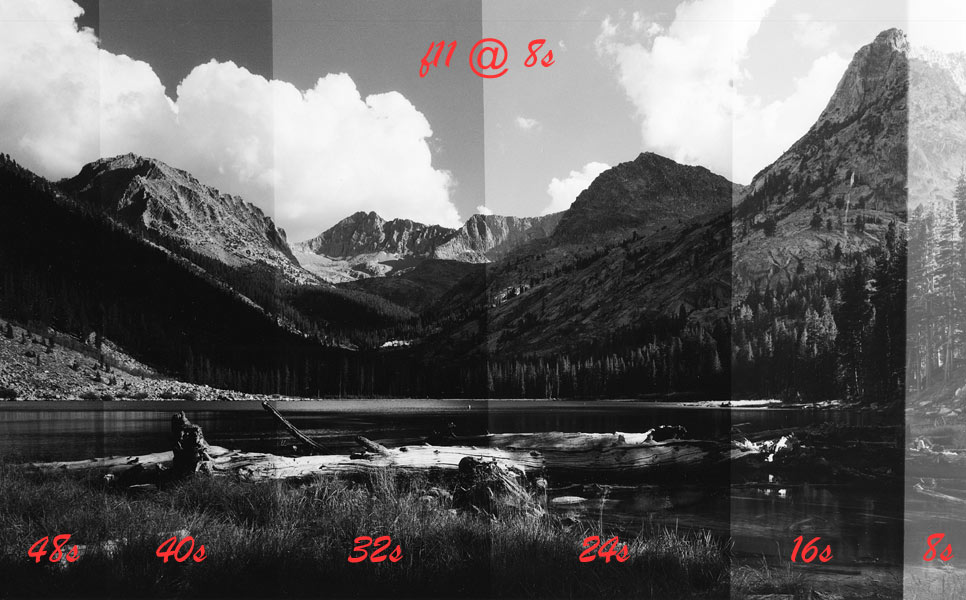
It's always a pleasure when the "just right" strip has part of the essential subject... the "too light" strip contains a sliver of subject and the "too dark" strips give you some cloud, sky and water.
 
Even Ansel Adams suggests making test prints with even increments of exposure. ??? Proportinal increases make more sense. For example; 4, 5.6, 8, 11, etc. seconds
 
Photrio.com contains affiliate links to products. We may receive a commission for purchases made through these links.
To read our full affiliate disclosure statement please click Here.

PHOTRIO PARTNERS EQUALLY FUNDING OUR COMMUNITY:


Ilford ADOX Freestyle Photographic Stearman Press Weldon Color Lab Blue Moon Camera & Machine
Top Bottom