• Welcome to Photrio!
    Registration is fast and free. Join today to unlock search, see fewer ads, and access all forum features.
    Click here to sign up

Tessar, Sonnar, Sumicron, Plannar?????

Recent Classifieds

Forum statistics

Threads
203,474
Messages
2,855,357
Members
101,862
Latest member
Justagram
Recent bookmarks
0
"Where can I learn about the difference in all of these lens classifications? I have no idea what these classifications mean."

The main thing they mean to me is how they produce distinctive images.

As for the physical make-up, I think it was Lynn Jones who years ago had a running series in View Camera magazine about the history of lens design, which might be informative.
 
So, on the topic, what exactly does it mean when you say a lens is a Petzval? I heard that it was some sort of early apochromatic triplet, but I don't really know jack... Help out a younger member of the photo community!
 
I
Also, it seems like the tendency to use the name as an indicator of the design went out of vogue sometime in the latter half of the last century, leading to things like the Olympus convention where a prefixed letter tells you how many elements there are ("D.Zuiko"==4 elements, "E.Zuiko"==5 elements, &c.).
-NT

Pre-AI Nikkors also used letters to indicate the number of elements; Nikkor-H, Nikkor-P and so on.

I think no current manufacturer is doing that, it probably isn't considered immediately important information any more.

There is a *tendency* with Zeiss and Leitz to give their different aperture lenses different signatures. What I've noticed is that fast Zeiss and Leica lenses 35/1.4, 35/2.0, 85/1.4 & 90/2.0) tend to be more pictorial with a nice 3-d effect, bokeh and all that. Slower lenses (35/2.8, 85/2.8 & 90/2.8) tend to be more technical/analytical: High contrast, flat field, even lower distortion.

From what I've read, the differences between the Zeiss ZM 21/2.8 and 21/4.5 should be similar.
 
A "telephoto" lens is a telephoto by design, not by focal length. In essence it moves the nodal points.

Correct. And the 35/2.8 of the Olympus XA is a wideangle telephoto design.
 
Is it?

Is there a diagram of it somewhere?


(P.S.
One perhaps should say that not the nodal points, but the glass is what is moved by tele-photo and retrofocus constructions.
The glass is what is moved closer to, or farther away from the film, while the (rear) nodal point/principal plane is where a similar focal length lens of 'normal' construction has its nodal point/principal plane.)
 
Stradibarrius,
So far it's really only Zeiss & Leica terms being bandied about.
What about Schneider? Angulon, Super Angulon, Xenar?
I don't know that knowing a particular name of a lens will help you pick out a good lens or not but it can help identify a family of lenses.
 
The mysterious -ar, -or, and -on suffixes carry meaning when talking about Rodenstock, and possibly also Schneider, lenses.
Not in Zeiss' 'nomenclature'.
 
??? Did anyone say that the Summicron wasn't Leica?

BTW: I've had excellent results with Tessars at f/8.0 and even 5.6...
Exactly so -the Tessars in late Contaflexes are among the best of lenses.
And the wide angle 35mm Planar for Contax is superb.
 
The benefit of old age is that I can sit and watch this discussion mit amusement. Almost all postwar lenses are 'sharp enough'. That leaves the rendition of out of focus details as the wothwhile subject for consideration- aka 'bokeh'.
My barbecued suishi is about ready and I have a beer in the microwave.
Mark
 
The benefit of old age is that I can sit and watch this discussion mit amusement. Almost all postwar lenses are 'sharp enough'. That leaves the rendition of out of focus details as the wothwhile subject for consideration- aka 'bokeh'.
My barbecued suishi is about ready and I have a beer in the microwave.
Mark

Mark, you forgot to include these in your post!
:munch::munch::munch::munch::munch:

Steve
 
Mark,
You've barbecued a suishi? Aren't they on some list or another?
 
it is all a bunch of hype :munch:

lenses tend to show their signature / distinct characteristics of lens design when shot wide open ...
i am no expert by any stretch of the imagination, but would say stopped down, a lot of lenses tend to look similar, no matter
what "mystique" surrounds them.

i wonder if the experts (here or elsewhere)
can really tell the difference between one "mystical" lens and another "not so mystical" if both are shot at f16 or 22, in a blind test ... :munch:

there is no silver bullet ...
 
jnanian,

Please pass the popcorn back, I'm getting the munchies again.

Steve

:munch::munch::munch::munch:
 
jnanian,

Please pass the popcorn back, I'm getting the munchies again.

Steve

:munch::munch::munch::munch:

sorry steve, i'm still snacking !


i have a 3.5 tessar and only shoot it wide open,
i get great results ... :munch:


john
 
John,

No prob man ... I'll just herb up on some of that good stuff you brought over to smoke while I wait for you to pass it back.

Steve
 
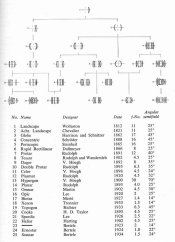
I hate to pour gas on the fire- here is a scan of my info on lenses from my copy of the 1963 encyclopedia of photography
 

Attachments

  • img022.jpg
    img022.jpg
    79 KB · Views: 233
Nice, I just wish it was a little more readable.

Steve
 
steve, click on the image, and then click on the attachment that pops up ... it enlarges quite well :smile:

thanks mike!

john
 
No large enough to clearly read the number 14 on the chart. The resolution is too low. Check the MTF.

Steve
 
Photrio.com contains affiliate links to products. We may receive a commission for purchases made through these links.
To read our full affiliate disclosure statement please click Here.

PHOTRIO PARTNERS EQUALLY FUNDING OUR COMMUNITY:



Ilford ADOX Freestyle Photographic Stearman Press Weldon Color Lab Blue Moon Camera & Machine
Top Bottom