

• Welcome to Photrio!
    Registration is fast and free. Join today to unlock search, see fewer ads, and access all forum features.
    Click here to sign up

TEA is a slow destroyer? (yellow and red)

Recent Classifieds

Forum statistics

Threads
202,083
Messages
2,834,855
Members
101,104
Latest member
tcruicks
Recent bookmarks
1

albada

Member
Allowing Ads
Joined
Apr 10, 2008
Messages
2,177
Location
Escondido, C
Format
35mm RF
I mixed up some Instant Mytol in organic solvents (TEA and PG) a couple of months ago. (there was a url link here which no longer exists) Here's what it looks like now:
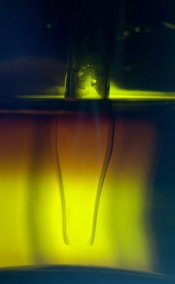
InstMytolColors.jpg

It's turned yellow, with a red haze along the top. Red! I noticed this after 7 weeks, but I hadn't been looking before that. This concentrate has been in a stoppered glass bottle the entire time. I also have some concentrate that's two weeks old of a different formula that contains no TEA, and it's still clear. The other ingredients are the same, making me wonder if TEA is destroying something else in the brew.

Any idea what's happening?

Mark Overton
 

Gerald C Koch

Member
Allowing Ads
Joined
Jul 12, 2010
Messages
8,131
Location
Southern USA
Format
Multi Format
It looks like oxidation to me. When you say stoppered do you mean you are not using a screw cap? I can't tell from the picture.
 
OP
OP

albada

Member
Allowing Ads
Joined
Apr 10, 2008
Messages
2,177
Location
Escondido, C
Format
35mm RF
It looks like oxidation to me. When you say stoppered do you mean you are not using a screw cap? I can't tell from the picture.

I meant a screw cap. This is an amber bottle sold by the Formulary, the kind that has a built-in dropper. The cap has a rubber seal.

Mark Overton
 

Gerald C Koch

Member
Allowing Ads
Joined
Jul 12, 2010
Messages
8,131
Location
Southern USA
Format
Multi Format
TEA being alkaline will hasten oxidation. However it looks worse than it actually is because the oxidation products are dark in color. Once the oxygen at the top of the bottle is exhausted it will stop. I doubt you will find any noticeable change in activity.

I would not use a cap with a dropper as it may leak air into the bottle more easily that a regular cap.
 
OP
OP

albada

Member
Allowing Ads
Joined
Apr 10, 2008
Messages
2,177
Location
Escondido, C
Format
35mm RF
TEA being alkaline will hasten oxidation.

I haven't read any reports of problems like this from users of PC-TEA, so mixing P&C into TEA seems okay. What Instant Mytol adds is propylene glycol. It makes me wonder if TEA and PG don't get along (at least when used with P&C).

Your improved PC-TEA formula which you posted long ago to the pure-silver list used TEA+PG+vitaminC+dimezoneS. Do you recall any long-term storage issues with it?

Mark Overton
 

Gerald C Koch

Member
Allowing Ads
Joined
Jul 12, 2010
Messages
8,131
Location
Southern USA
Format
Multi Format
I haven't read any reports of problems like this from users of PC-TEA, so mixing P&C into TEA seems okay. What Instant Mytol adds is propylene glycol. It makes me wonder if TEA and PG don't get along (at least when used with P&C).

Your improved PC-TEA formula which you posted long ago to the pure-silver list used TEA+PG+vitaminC+dimezoneS. Do you recall any long-term storage issues with it?

Mark Overton

The reason for using the PG and TEA mix was to avoid adding the developing agents to hot TEA which caused some initial rapid oxidation. By first dissolving them in PG and allowing the solution to cool before adding the TEA I found that the color of the concentrate was less than when the developing agents were added to the hot TEA. This concentrate also darkened less with age. Darkening indicates oxidation.

As an added bonus using a PG+TEA mix allows you some adjustment the pH of the working strength developer.

Agfa Studional (Rodinal Special) uses a high concentration of TEA (approximately 40% of the concentrate) and has a long shelf life. I would conclude from this that TEA has no special adverse effect of developers. All alkalies will hasten the oxidation of the developing agents but TEA seems no worse than say sodium carbonate or other common alkalies.

It is best to avoid overheating the PG when adding the developing agents as this also accelerates initial oxidation. I put the Dimezone and ascorbic acid into room temperature PG in appropriate size glass bottle and cap it. They will eventually dissolve with shaking at room temperature if one is patient, You can put the bottle in a warm water bath and periodically crack the cap to allow air to escape. When everything is dissolved then add the TEA to the bottle and mix.

There will always be a problem with ascorbic acid as it is more susceptable to oxidation than other common developing agents. I have had a bottle go dark brown in less than a year while I have some hydroquinone that is 25 years old which shows no discoloration.
 
Last edited by a moderator:

mrred

Member
Allowing Ads
Joined
Mar 8, 2009
Messages
1,251
Location
Montreal, Ca
Format
Multi Format
I remember reading a thread on pyro510 where Jay Defehr mentioned that some forms of TEA had more water than others. When there was a higher amounts of water it promoted early oxidation.
 

benjiboy

Subscriber
Allowing Ads
Joined
Apr 18, 2005
Messages
12,008
Location
U.K.
Format
35mm
Tea is a slow poison, if you drink enough of it over your lifetime, but you would need to live to around be150 for it to actually kill you :smile:.
 

mrred

Member
Allowing Ads
Joined
Mar 8, 2009
Messages
1,251
Location
Montreal, Ca
Format
Multi Format
I found the Jay Defehr reference in the large format photog board......

"Wait, 85% TEA? Don't use 85% TEA, it contains 15% water, and will activate the TEA as a base, and oxidize your concentrate. If you have to use it, dry it in a shallow glass dish in your oven at 250F to evaporate as much of the water as possible. If you've already added your chemicals, it's too late. Never use 85% TEA for developer concentrates."

"http://www.chemistrystore.com/Chemicals_S_Z-Triethanolamine.html

this is TEA 99%."
 
OP
OP

albada

Member
Allowing Ads
Joined
Apr 10, 2008
Messages
2,177
Location
Escondido, C
Format
35mm RF
I found the Jay Defehr reference in the large format photog board......

"Wait, 85% TEA? Don't use 85% TEA, it contains 15% water, and will activate the TEA as a base, and oxidize your concentrate. If you have to use it, dry it in a shallow glass dish in your oven at 250F to evaporate as much of the water as possible. If you've already added your chemicals, it's too late. Never use 85% TEA for developer concentrates."

"http://www.chemistrystore.com/Chemicals_S_Z-Triethanolamine.html

this is TEA 99%."

Quick note: That link to chemistrystore is 404. They probably shuffled their site around. Anyway...

I bought my TEA from Photographer's Formulary (photoformulary.com), and I just now looked up their MSDS for the TEA they sell. Here it is: http://stores.photoformulary.com/images/store_version1/Triethanolamine%20Msds.pdf
Surprise! The stuff is 85%! This could explain the troubles I'm having with TEA. Thanks for pointing this out!

Mark Overton
 

mrred

Member
Allowing Ads
Joined
Mar 8, 2009
Messages
1,251
Location
Montreal, Ca
Format
Multi Format
That was the same thing that happend to they guy in the thread. Knowing that before hand, you can always do the oven fix. probably too late for you.
 

dynachrome

Member
Allowing Ads
Joined
Sep 16, 2006
Messages
1,850
Format
35mm
I think my TEA came from the same place. The PC-TEA I made worked but the developing times were longer than I expected. After the PC-TEA mixture cools it turns from a pale tan to a dark green/brown over time but still works fine.
 

mrred

Member
Allowing Ads
Joined
Mar 8, 2009
Messages
1,251
Location
Montreal, Ca
Format
Multi Format
I just went over to their site, and there is no mention of it's purity. The MSDS sheet clearly states it though. You would think something like that would be on the product page.....
 

Gerald C Koch

Member
Allowing Ads
Joined
Jul 12, 2010
Messages
8,131
Location
Southern USA
Format
Multi Format
Checked with The Chemistry Store site and their TEA is said to be 99% pure. The price is also very reasonable. It is the TEA that I use. BTW, the same caveat also applies to the glycol that you use. This is why I don't recommend using antifreeze which can contain water.
 
OP
OP

albada

Member
Allowing Ads
Joined
Apr 10, 2008
Messages
2,177
Location
Escondido, C
Format
35mm RF
Checked with The Chemistry Store site and their TEA is said to be 99% pure.

I did an experiment: I weighed 10 ml of my TEA five times, and the average g/ml was 1.108.
The specific gravity of TEA is 1.126, and an 85-15 mixture of water works out to a g/ml of 1.107.
That's very close. I think that confirms that PhotoFormulary's TEA contains about 15% water.

I'm sure the manufacturer added water to boost profit. I hope they used distilled water and not tap water or recycled sewage. :confused:

PhotoFormulary will be hearing from me in a day or two, encouraging them to use 99%. That 85% stuff is not suitable for developers.
BTW, I checked their propylene glycol: It's 100%, so at least that's the good stuff.

Mark Overton
 

analog what is that?

Member
Allowing Ads
Joined
Nov 26, 2010
Messages
170
Format
Multi Format
Mark if you did click on Photograpers Formulary's MSDs for their TEA, you would see that they state it is definitely 85%........

Just click on the link and scroll down a little, it is a scan of a typed letter obviously copied over and over so it i nearly illegible, but is says 85%.
I think you will be told off if you contact them. Check before you buy!
 

Photo Engineer

Subscriber
Allowing Ads
Joined
Apr 19, 2005
Messages
29,018
Location
Rochester, NY
Format
Multi Format
Don't forget that TEA can be a mixture of TEA, DEA and MEA, and this will change the properties slightly in terms of silver halide solvent capability, pH and sg. And, sg is sensitive to temperature. You have to know the temperature of the reference reported in the literature and use that for your test.

TEA is hygroscopic, which means that it absorbs water from the atmosphere rapidly. It is often difficult to prevent TEA from becoming more dilute with time.

I use Formulary TEA at home here with no problem and I won't get a kickback from them for this comment. I am neutral in this, and merely pointing out the facts regarding TEA.

And, BTW, the melting point is a key item in determining the purity of any organic compound. For TEA it is 20.5 deg C. So, in the average room at 68 deg F or 20 deg C, TEA should be slush. If it is impure, at that temperature, it would be liquid. It appears as a pale yellow slush. My room is 68 deg F and my TEA is a pale yellow rock! I have to warm it to get it out.

PE
 

Hexavalent

Member
Allowing Ads
Joined
Nov 19, 2009
Messages
592
Location
Ottawa, Onta
Format
Multi Format
Don't forget that TEA can be a mixture of TEA, DEA and MEA, and this will change the properties slightly in terms of silver halide solvent capability, pH and sg. And, sg is sensitive to temperature. You have to know the temperature of the reference reported in the literature and use that for your test.

TEA is hygroscopic, which means that it absorbs water from the atmosphere rapidly. It is often difficult to prevent TEA from becoming more dilute with time.

...
PE

The MSDS at PF lists TEA >= 85 % <= 89% with the balance being DEA (not water). Of course, once the lid is off the jar, water practically jumps in.
 

Gerald C Koch

Member
Allowing Ads
Joined
Jul 12, 2010
Messages
8,131
Location
Southern USA
Format
Multi Format
I would not recommend the PF's TEA because of the amount 11% to 15% DEA in it. DEA being more basic than TEA will throw off the pH of any developers made using it. What PF is selling is designated as technical grade TEA.

Here are approximate pH values for a series of 4% solutions; TEA 99% 10.1, TEA technical grade 10.4, DEA 11.4, MEA 11.9
 
Last edited by a moderator:
OP
OP

albada

Member
Allowing Ads
Joined
Apr 10, 2008
Messages
2,177
Location
Escondido, C
Format
35mm RF
I would not recommend the PF's TEA because of the amount 11% to 15% DEA in it. DEA being more basic than TEA will throw off the pH of any developers made using it. What PF is selling is designated as technical grade TEA.
Here are approximate pH values for a series of 4% solutions; TEA 99% 10.1, TEA technical grade 10.4, DEA 11.4, MEA 11.9

I just mixed a 4% solution of my TEA and got (at 20C) a pH = 10.85.
That was hard to believe, so I checked the pH of my 10.01 buffer solution (at 20C), and got pH = 10.04.

Also, the temperature of my TEA this morning was 17.5C, and it was viscous but pourable liquid. I had no trouble swishing the thermometer-probe around in it.

The specific gravity of DEA is 1.090 versus 1.126 for TEA. My TEA's sg is 1.108.

All the above measurements are telling me that my TEA has far more than 15% DEA in it. The sg says it's 50% DEA.
That would also explain why my Instant Mytol was much "hotter" than expected: It had a pH approaching 9.0 instead of the expected 8.2.

Mark Overton
 

Photo Engineer

Subscriber
Allowing Ads
Joined
Apr 19, 2005
Messages
29,018
Location
Rochester, NY
Format
Multi Format
What did you actually measure in the developer Mark?

Also, note what it says above about water uptake. DEA and TEA are very hygroscopic.

You should also note that Density is not additive. You cannot be assured that you can take 1 gram of each of 2 compounds and get the density half way between when you mix them. It does often work though. But, you have to use mole ratios not weights IIRC.

PE
 
OP
OP

albada

Member
Allowing Ads
Joined
Apr 10, 2008
Messages
2,177
Location
Escondido, C
Format
35mm RF
What did you actually measure in the developer Mark?
Also, note what it says above about water uptake. DEA and TEA are very hygroscopic.
You should also note that Density is not additive. You cannot be assured that you can take 1 gram of each of 2 compounds and get the density half way between when you mix them. It does often work though. But, you have to use mole ratios not weights IIRC.
PE

I mixed Instant Mytol before I had the pH-meter, so I measured the pH of the working solution with pH-strips. Close to 9. And results were much denser than XTOL, consistent with a too-high pH. I mixed the stuff when I got the TEA from PhotoFormulary, so water hopefully hadn't gotten in at that point.

But I'm mostly wondering why my 4% solution of TEA has pH=10.8 when 10.1 was expected. I figure there's too much DEA in it.

Mark Overton
 

mrred

Member
Allowing Ads
Joined
Mar 8, 2009
Messages
1,251
Location
Montreal, Ca
Format
Multi Format
Ron, was Jay's idea of heating the tea in the oven sufficient to get rid of the water? Could we make this source usable?
 

Photo Engineer

Subscriber
Allowing Ads
Joined
Apr 19, 2005
Messages
29,018
Location
Rochester, NY
Format
Multi Format
Heating TEA in a microwave or regular oven is NOT a good idea. It is very hard to drive the water out. But, having water present is not bad per se. The problem can come from the DEA which is different in solvent effects and pH. Once you standardize on that, there is no big prblem. So, that is why I use TEA with 15% DEA in it. I have standardized on it and it works. Not everyone should or could do that, but as I say, it works for me! :D

PE
 

Gerald C Koch

Member
Allowing Ads
Joined
Jul 12, 2010
Messages
8,131
Location
Southern USA
Format
Multi Format
Just to add to what PE said; you should never heat chemicals in a microwave oven or regular oven that is also used for food. Heating TEa or glycols above 100 C can cause them to "bump" as steam is released. This can cause spatters. TEa is flammable and heating it can cause a fire if there is an open flame.

Standardizing on a mix of TEa and DEA is OK but makes your formula non-portable to others. Technical grade TEA contains a variable amount of DEA and even some MEA and so its properties are variable from sample to sample. TEa of 99% purity is readily available but always read the MSDS before purchase.
 
Photrio.com contains affiliate links to products. We may receive a commission for purchases made through these links.
To read our full affiliate disclosure statement please click Here.

PHOTRIO PARTNERS EQUALLY FUNDING OUR COMMUNITY:


Ilford ADOX Freestyle Photographic Stearman Press Weldon Color Lab Blue Moon Camera & Machine
Top Bottom
