• Welcome to Photrio!
    Registration is fast and free. Join today to unlock search, see fewer ads, and access all forum features.
    Click here to sign up

Taking notes at shooting

Recent Classifieds

Forum statistics

Threads
203,467
Messages
2,855,246
Members
101,855
Latest member
Minoltalan
Recent bookmarks
0

mindthemix

Member
Allowing Ads
Joined
Jun 14, 2012
Messages
178
Location
Miami
Format
Multi Format
What kind of information you keep when taking photos?

I'm not good taking notes but I'd like to learn from your experience.

Thanks.
 
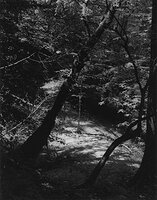
I only do it with large format, and very occasionally in cases where I'm using rollfilm for studies of something that will eventually be shot in LF. All I write down (in a post-it on the darkslide) is basic equipment-and-exposure info: camera, lens, filter, date, film and EI, shutter and aperture, and the location if it won't be obvious from the image. This is way more information than I've ever needed, but I can at least imagine wanting to have it later.

Normal rolls just get the date, camera/lens, and EI if different from box speed. It's pretty hard to fit more than that into the space on a 120 roll anyway.

-NT
 
When I do it, I usually record the date, exposure or filmholder number, a description of the location and subject, camera, format if it's a camera that shoots more than one format, lens, filters used, aperture, shutter speed, film, developing instructions for film speed and contrast (like "Efke 100, EI 50, ABC Pyro +1" or "TXP, EI 640, Acufine"). I like to use unlined Moleskine notebooks. If the exposure is complicated, I might write down the bellows factor and reciprocity factor, just to be sure I haven't forgotten something.
 
Last edited by a moderator:
Like Nathan, I only do it for sheet film. I write down the holder number, lens, fstop/ss, filter, date/time, how it was metered (I use a spot and will note what I metered off- i.e. " shadow under bush for Zone III" and what development I will use- N, +1, -1, etc. With Readyloads, I write it on the cardboard. If I'm using holders, it goes in a notebook, so I can unload it into the proper box for development. Also, like Nathan, it's more information than I probably need, although time of day has helped if I plan on returning to a location.
Sometimes I'll sketch the scene, noting the Zone placements, but not very often.
 
I pre-wrap all my 35mm rolls w/ a piece of masking tape. After I expose the final frame of the roll, I mark the piece of tape with the date and camera used. During development, I transfer the tape to the Patterson tank and later to the negative clip while drying. Once I cut the negatives, I move the tape to the storage sleeve. In the notes section of the sleeve, I also note developer type, dilution, time and temperature.
 
I'm not good at either, but I generally do it when shooting 8x10. Lens, aperture, shutter speed, film type and subject. Hand written in a moleskin that fits in my back pocket.
 
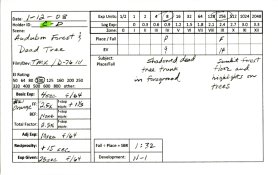
This is what I do, not really uncommon from what anyone else might do who is into the zone system way of doing things......I used to take notes in the field, but came to not wanting to fuss with writing while in the field. I find it far easier now to just use a digital voice recorder to document the notes, then, usually in the truck before leaving, I'll quickly put them on a card like this. It takes practically no time to do........I find that notes not only help diagnose problems but they also reinforce what went right on those occasions too.
 

Attachments

  • exp-dev-notes.jpg
    exp-dev-notes.jpg
    274.7 KB · Views: 213
I second the digital voice recorder. That's what I generally use when on "serious" projects with medium format. The Sony that I have is about the size of a candy bar and can record two hours of my silly blather. For me, this is way easier, a one-handed operation, than trying to scrawl stuff in a notebook while the wind flaps the pages around (not to mention more readily understood weeks later than my handwriting!)

The saved files can be downloaded as MP3s and stored "forever" on the computer, if desired. For the Bronica I record back number, film, lens used, meter used and date. I then note the subject, shutter speed and aperture, and any filter, plus any lens changes, and any unusual conditions for each frame as I go along. What I like about the recorder is I can also blather sudden thoughts -- 'note to self' -- that may or may not be directly related to the project. ("Should come back here and check out the old farm across the road some day.") I can record way too much info and edit later.

At home I transcribe the basic info into an Excel page for each roll. Some of the non-related stuff may go to a "to do" list or future photo project/destination list. Eventually the developer, time and temperature (and agitation), and maybe a one sentence assessment of the results, wind up on the page for a given roll.

If I'm just taking a few snaps on a hike with one of my folders, I may not bother with all those details. I still create a page for each roll detailing the subject matter.
 
I have little pre-printed sheets that go in the ziplocks with each 4x5 filmholder that are similar to CPorters above.


I'll note the aperture, shutter and dynamic range of the scene. Then I'll note what development will be appropriate.
Then I'll note the lens used, and filters of course.
Date, location etc….
 
At one point in time, I was jotting down zone values and development adjustments for each roll of B&W in a little notebook I keep in my camera bag... I used to make my own little zone diagram like CPorter's example provided. I haven't really done that lately, since I generally don't take that camera bag (along with the little notebook) out with me. I keep trying to get back in the habit, but it's been to easy to be lazy. I just hate it when I get a nice exposure and I can't remember how I captured it...

I think everyone's contributions above just might help me get back into the habit of recording information again! Hopefully!
 
Nothing at all.

I used to take notes - Then I realised that I never made any use of them!


Steve.
 
If you're starting out with view cameras, making the notes is really a good thing to remind you what everything looks like when you made the exposure. Then you look at the negative and see if you "got" what you thought you did. Then you can adjust your future exposures based on that. Two things to remember about this.

1. If you make notes in the field, make sure you study them and use them. (Thanks to Steve for adding that really important point.) Data is no good unless and until you convert the data into knowledge.

2. Once you gained the knowledge from those notes, you can dispense with the note taking. Why? Because all that note taking slows down the creative process of photography. And isn't that why you're doing photography in the first place? To make photographs, not to do sensiometric studies.
 
Thank you so much everyone for all your input and detailed feedback.

I'm new to film and taking notes is one of the pending tasks that I need to resolve. I love guessing and taking reading at the same level.

Right now I'm delighted with the film experience and paying more attention to the composition but I'm sure the notes will provide some organized knowledge.

Thanks again for your prompt to my post.

Happy New Year!
 
I do 99% sheet film. I have color coded, paper gaffer's tape for emulsions which I affix to both sides of a holder. I record the subject, date, filtration, lens, rated film speed, aperture, shutter speed and zones. If I have a notion about development, I record that. Once I develop the film, I add that little bit of info to the tape, peel it from the holder and stick it on the negative envelope. Never have to transpose, correlate, copy or maintain a log or spreadsheet of the information..it's automatic..
 
None. One picture is worth a thousand words. I might take a picture for the purpose of reminding me what I was doing, such as a lighting set up.
 
I've been taking notes for more than 40-years. If you're learning, I'd suggest you write down everything - aperture, shutter speed, meter readings, Zone placement if you're using that system, subject, location, date, any observations about weather or light, then when developing write down the developer, time, temperature, fixer used, etc. All of this will greatly help you analyze what your doing and help you make mistakes into learning moments.

I still make these notes for large format - for roll film, i make a general note about the roll.

When I go back and print old negatives, the notes help me decide how to print, and help me remember just when and where the negative was exposed.
juan
 
2. Once you gained the knowledge from those notes, you can dispense with the note taking. Why? Because all that note taking slows down the creative process of photography.

It's a free country :smile:, all are entitled to their opinion, but I urge the OP not to listen to these "types" of replies------what that really means is that, and this is my opinion, note taking is not good for you, but that is what is more appropriately known as a "you" problem and has nothing to do with a want or desire to make notes. Just sayin, that's all...........
 
It's a free country :smile:, all are entitled to their opinion, but I urge the OP not to listen to these "types" of replies------what that really means is that, and this is my opinion, note taking is not good for you, but that is what is more appropriately known as a "you" problem and has nothing to do with a want or desire to make notes. Just sayin, that's all...........

I suppose for people for whom it works, it's not really a "problem", just a way of working.

-NT
 
If you make a small amount of photographs, come home and develop them, it's probably not important. I make dual exposures and make between 1500 and 2000 sheets a year. Sometimes it can be months before I develop and I like to have all the info right at hand when I process.
 
...all that note taking slows down the creative process of photography.

I understand what you're saying, but can't completely agree. In my case, note taking can improve the creative process. It's just one more opportunity to assess my decisions. In fact, I probably do it for this reason more than any other. Sheet film shooting is inherently slow to begin with. The note taking is the quickest part of the process. I view it like a pilot going through a pre-flight checklist. They already know how to fly, but going through the checklist (or taking notes) is usually a positive thing.
 
Where did you get these sheets? That's quite clever! I'm finding that while in the field, I'm attempting to write down details about each shot, but this takes time and it is annoying when it's 15 degrees (which it is here is PA today!).

That said, I find it to be vital to learning precisely what happens with what exposure settings. Any other advice would be welcome.

Thanks!
 
I pre-wrap all my 35mm rolls w/ a piece of masking tape. After I expose the final frame of the roll, I mark the piece of tape with the date and camera used. During development, I transfer the tape to the Patterson tank and later to the negative clip while drying. Once I cut the negatives, I move the tape to the storage sleeve. In the notes section of the sleeve, I also note developer type, dilution, time and temperature.

Wow this is a great idea!!!


~Stone

Mamiya: 7 II, RZ67 Pro II / Canon: 1V, AE-1, 5DmkII / Kodak: No 1 Pocket Autographic, No 1A Pocket Autographic | Sent w/ iPhone using Tapatalk
 
This is what I do, not really uncommon from what anyone else might do who is into the zone system way of doing things......I used to take notes in the field, but came to not wanting to fuss with writing while in the field. I find it far easier now to just use a digital voice recorder to document the notes, then, usually in the truck before leaving, I'll quickly put them on a card like this. It takes practically no time to do........I find that notes not only help diagnose problems but they also reinforce what went right on those occasions too.

What kind of analog guy are you?? Shooting an recording with DIGITAL devices... Get a stenographers recording machine already, go buy some recordable tape cassettes and bring that along! Or be ostracized by the community! :whistling:


~Stone

Mamiya: 7 II, RZ67 Pro II / Canon: 1V, AE-1, 5DmkII / Kodak: No 1 Pocket Autographic, No 1A Pocket Autographic | Sent w/ iPhone using Tapatalk
 
Photrio.com contains affiliate links to products. We may receive a commission for purchases made through these links.
To read our full affiliate disclosure statement please click Here.

PHOTRIO PARTNERS EQUALLY FUNDING OUR COMMUNITY:



Ilford ADOX Freestyle Photographic Stearman Press Weldon Color Lab Blue Moon Camera & Machine
Top Bottom