
• Welcome to Photrio!
    Registration is fast and free. Join today to unlock search, see fewer ads, and access all forum features.
    Click here to sign up

t-max 400 TMY2 and tonal separation in shadow areas?

Recent Classifieds

Forum statistics

Threads
201,760
Messages
2,829,644
Members
100,927
Latest member
Rudy Bachelor
Recent bookmarks
0

wiggywag

Member
Allowing Ads
Joined
Aug 2, 2006
Messages
115
Format
4x5 Format
Hi!

I have learned that to get good separation in shadow areas it is best to half the true ISO-speed of the film. E.g. my true speed for FP4 is 100 in DDX 1:9, but I use it as a 50 ISO film to make sure that shadow details are in the a straight line portion of the negative for better separations in the shadows.

I'm planning to use T-max 400/TMY2 to get better speed and I've heard that TMY-2 has a straighter curve than most classic film. My question is; is it not necessary for me half the the true ISO, because Zone 3 is already on a straight line on TMY2, and it has good separation here? Anyone with experience?

Thanks,
Stig
 

BobNewYork

Member
Allowing Ads
Joined
Jan 1, 2008
Messages
1,067
Location
Long Island,
Format
Medium Format
From my perspective your E.I. is the one which results in negatives that print easily, (in most instances) the way you want them - in your camera, with your meter, and your developer, with your technique in your darkroom. It's different for everyone.

If say, you and I both like our negatives to look exactly the same. If I choose to place my shadows on Zone II and you choose to place yours on Zone III I would use an E.I. of half yours, (assuming same meter, camera, development etc.) Both our negs would look identical - we'd just be using a different method to achieve that same goal. If, on the other hand, I used the same E.I. as you then our negs would differ - on a full range subject I'd have greater highlight separation and you'd have better shadow separation.

Box ISO is fixed and refers to a fixed exposure to light and fixed processing with a specific developer - under laboratory conditions which we will likely never experience in our photography. The behaviour of the film is also fixed under each processing variant. If the processing is consistent - then so too will be the film's response to it.

If you get what you want then the E.I. you used to achieve it is exactly the correct E.I. - for you. It's just that there's more than one way to skin a cat!

Bob H
 

Bruce Watson

Member
Allowing Ads
Joined
Mar 28, 2005
Messages
497
Location
Central NC
Format
4x5 Format
The big differences, to me, between TMY-2 and FP4+ are that TMY-2 is a short toe film, and it has much better reciprocity characteristics.

People do tend to over expose and under develop traditional films. They over expose to move the image data up the response curve and away from the non-linear toe (to improve shadow detail). They under develop to compensate for the over exposure so the highlights aren't so dense that printing becomes difficult (AKA "blown out highlights"). This is the right thing to do -- it's classic "expose for the shadows and develop for the highlights."

Modern short toe films do considerably less compression of the shadow details, so the need for over exposure is less.

The reciprocity thing is more interesting in large format photography. Basically, the bigger the format the smaller the taking aperture, which also means the slower the shutter speed. I shoot 5x4 exclusively anymore, and I seldom use a shutter speed over 1/15 second with even 400 speed films. It's just the nature of the beast.

What this means is that often shadow areas go into reciprocity failure. To maintain shadow detail in these conditions means... more exposure. And we've come full circle. Modern films like TMY-2 have much better reciprocity characteristics than traditional films, so one only has to deal with reciprocity failure under "extreme" conditions.

In the end, if you want to gain control of the situation, you should consider doing the Zone System tests to find your personal EI for your film, developer, process, and equipment. Then do the tests to find your "N" development time. This will go a long way toward improving your understanding of what's going on, and therefore your control of the process.

Why guess when you can know?
 

c6h6o3

Member
Allowing Ads
Joined
Oct 16, 2002
Messages
3,215
Format
Large Format
I both rate the film at 200 and place the shadows on Zone IV. This gives me plenty of detail in the shadows and good midtone separation.
 

david b

Member
Allowing Ads
Joined
Oct 20, 2003
Messages
4,026
Location
None of your
Format
Medium Format
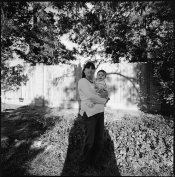
I am just starting to mess with TMY-2 and think it's a rather terrific film.

I shot this photograph at 400 and developed in xtol 1+1.
No fancy tricks, no plus or minus.

This is a scan of an RC print.
 

Attachments

  • treeshadow.jpg
    treeshadow.jpg
    169.5 KB · Views: 304

Chazzy

Member
Allowing Ads
Joined
Jan 17, 2004
Messages
2,942
Location
South Bend,
Format
Multi Format
Hi!

I have learned that to get good separation in shadow areas it is best to half the true ISO-speed of the film. E.g. my true speed for FP4 is 100 in DDX 1:9, but I use it as a 50 ISO film to make sure that shadow details are in the a straight line portion of the negative for better separations in the shadows.

I'm planning to use T-max 400/TMY2 to get better speed and I've heard that TMY-2 has a straighter curve than most classic film. My question is; is it not necessary for me half the the true ISO, because Zone 3 is already on a straight line on TMY2, and it has good separation here? Anyone with experience?

Thanks,
Stig

How do you know that you won't like the film at box speed, if you don't give it a try? Or are you planning to use a developer which loses speed?
 

Alex Hawley

Member
Allowing Ads
Joined
Jul 17, 2003
Messages
2,892
Location
Kansas, USA
Format
Large Format
Based on my experience, rating TMY at half the box speed will give very dense and contrasty negatives. Its probably only necessary to this for some of the alt processes. For (there was a url link here which no longer exists), I rated at 2/3 box speed (~260) and developed for N+1 (pyrocat-hd) with shadows set in Zone IV. It gave a very dense and contrasty negative, contrasty enough to print at grade 0.5. I made the prints using split grade exposure.

Therefore, I rate at 400 and set shadows in zone III. Works using pyrocat -hd at 2:2:100 and 8 minutes.

You're right about TMY's curve. About as linear as it gets.

This film has a great deal of exposure latitude. I dare say the most of any film on the market. Perhaps equal to or greater than the legendary Super XX.
 

RJS

Member
Allowing Ads
Joined
Jan 4, 2005
Messages
246
Location
Southern Cal
Format
Multi Format
I shot a considerable amount of TMX a few years back, and while it is fine film, very sharp I think and practically grainless, I went back to Fp4 and HP5+. TMX, for me, had an almost 'glassy' look, very hard to define, but I found it somewhat cold looking. None of that makes sense beyond a personal preference for or against a particular 'look'. As to film speed, one must make tests with your own equipment, developers etc. No one can give you more than a starting point. Usually, following manufacturers recommendations will give quite usable negatives, but you can improve on their numbers by testing for yourself. For me, there is more than grain and 'sharpity' to consider with a film/developer combination.
 

kompressor

Member
Allowing Ads
Joined
Feb 8, 2008
Messages
192
Location
Norway
Format
Medium Format
My shot

I am just starting to mess with TMY-2 and think it's a rather terrific film.

I shot this photograph at 400 and developed in xtol 1+1.
No fancy tricks, no plus or minus.

This is a scan of an RC print.

Here is one of mine TMY-2 shots.

http://www.tmax100.com/peopleimages/pl_images/ogs.jpg

Its a portrait of the worlds most famous Norwegian. Its dev time is 8 min in Xtol 1:1 rated at 400 ISO done in just naturally ligthening. No reflectors or flags. Just me, some windows and my 500C.
 

Shawn Dougherty

Member
Allowing Ads
Joined
Jul 22, 2004
Messages
4,129
Location
Pittsburgh
Format
Multi Format
I've been rating TMY2 (120) at 320 and developing in Rodinal Semi-stand. The following pictures were made with this combo:

(there was a url link here which no longer exists)

I basically put the shadows on Zone IV and changed my dilution to tame the highlights. Hope this helps. Shawn
 

Harry Lime

Member
Allowing Ads
Joined
Dec 10, 2005
Messages
495
Format
35mm RF
A two bath developer. Lots of shadow detail and you won't blow the highlights.
Do a search for Barry Thornton's 2-bath. I use it with Tmax-2 400 and it works very, very well. Three ingredients, simple to mix and completely idiot proof in operation.
 
Photrio.com contains affiliate links to products. We may receive a commission for purchases made through these links.
To read our full affiliate disclosure statement please click Here.

PHOTRIO PARTNERS EQUALLY FUNDING OUR COMMUNITY:


Ilford ADOX Freestyle Photographic Stearman Press Weldon Color Lab Blue Moon Camera & Machine
Top Bottom