
• Welcome to Photrio!
    Registration is fast and free. Join today to unlock search, see fewer ads, and access all forum features.
    Click here to sign up

T-max 100 and ID-11 dev times?

Recent Classifieds

Forum statistics

Threads
201,723
Messages
2,829,126
Members
100,914
Latest member
WyattRad
Recent bookmarks
0

S Raff

Member
Allowing Ads
Joined
May 16, 2008
Messages
47
Location
North Devon,
Format
Multi Format
I'm having one of those bad frozen mind moments and struggling to understand something very simple.

I'm looking to develop a roll of Kodak T-max 100 using Ilford 1D-11. So looking on the chart supplied for 1D-11 it states El = 100/21 and at a 1+1 ratio 11mins. The thing I'm not clear on is what 'El' stands for as it doesn't say. I'm guessing the 100 is the film speed and the 21 the temp but not sure.

Many thanks.
 

df cardwell

Member
Allowing Ads
Joined
Jul 16, 2005
Messages
3,358
Location
KY USA
Format
Multi Format
EI = exposure index, the practical term for film speed. It means that is how you set your meter. '21' is the temperature, in C.

Since ID-11 is Ilford's version of D76 and is functionally identical,
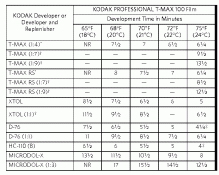
here is Kodak's chart for TMY. Assume agitation for 5 seconds every 30 seconds.

Good Luck.
 

Attachments

  • tmy-times.gif
    tmy-times.gif
    10.6 KB · Views: 534

Keith Tapscott.

Member
Allowing Ads
Joined
Jun 11, 2005
Messages
1,842
Location
Plymouth. UK
Format
Multi Format
The 100 is the old A.S.A number and the 21 is the old D.I.N number, long superceded by I.S.O. which incorporates both speed rating numbers hence 100/21.
The processing time is for 20C (68F).
 

fschifano

Member
Allowing Ads
Joined
May 12, 2003
Messages
3,196
Location
Valley Strea
Format
Multi Format
EI is the exposure index, not the ISO rating. So if you see an EI of 200 for a 100 ISO speed film, you can safely assume that the processing time given is for a 1 stop push process. TMax films' documentation is a little different in this regard. The normal time given by Kodak is for an EI of 100 or 200. They claim that a sufficiently good negative for many applications can be had with normal processing and one stop under exposure. I've tried it and they're right. Shadows suffer some, but all in all you get a decent negative that you can work with.

And yes, ID-11 is functionally equivalent to D-76, so do use the Kodak recommended times and procedures. I used to use ID-11 when it was less expensive than D-76. Now the pricing is the other way around for me, so I use D-76. Can't tell the difference between the two.
 
OP
OP

S Raff

Member
Allowing Ads
Joined
May 16, 2008
Messages
47
Location
North Devon,
Format
Multi Format
Thank you for all the help.
Just developed the film and the results are poor but think its from the exposure rather than the developing, time to investigate.

S Raff
 

df cardwell

Member
Allowing Ads
Joined
Jul 16, 2005
Messages
3,358
Location
KY USA
Format
Multi Format
the 21 is the old D.I.N number

uh, yeah.

Oops. Nice catch Keith. No power tools for me today.
 
OP
OP

S Raff

Member
Allowing Ads
Joined
May 16, 2008
Messages
47
Location
North Devon,
Format
Multi Format
Well I'm still scratching my head a little here and now after spending a bit of time with my head in the books it looks a possibility that the film could be under-developed, I'm going on the weak looking negatives and fairly faint edge numbers. How I read it was following the Kodak chart at 1+1 and 20' the time would be 9.5 mins. Any thoughts?

Thanks
S Raff
 

df cardwell

Member
Allowing Ads
Joined
Jul 16, 2005
Messages
3,358
Location
KY USA
Format
Multi Format
If the temp was correct, and the exposure was OK, you should be close.

Contact print them and see how they look.
The eye is a poor judge.
 

fschifano

Member
Allowing Ads
Joined
May 12, 2003
Messages
3,196
Location
Valley Strea
Format
Multi Format
The eye is a very poor judge with TMX negatives. They can look awfully thin if you are accustomed to examining negatives from something like Tri-X or HP5+, but they do print well.
 
OP
OP

S Raff

Member
Allowing Ads
Joined
May 16, 2008
Messages
47
Location
North Devon,
Format
Multi Format
Unfortunately I'm not kitted out just yet for contact printing or enlargements although its very close on the horizon. The only other film I have developed and then printed using a friends darkroom is FP4 and the negatives look very different. Another thing I noticed, when washing the negatives using a 5 turn 10 turn 20 turn etc method that I had to wash them exceedingly before all signs of pinky/purple disappeared. Again I hadn't noticed this with the FP4, is that characteristic of the Tmax?

S Raff
 

fschifano

Member
Allowing Ads
Joined
May 12, 2003
Messages
3,196
Location
Valley Strea
Format
Multi Format
Yes, it is. As you've learned, the stain does come out in the wash. A lot of folks still believe that the magenta stain is an artifact of insufficient fixing. While it is true that TMax films take longer to fix, the stain remains after the film is fully fixed out. Extra time in the fixer will remove the stain, but so will a wash in processing temperature water with agitation.
 
OP
OP

S Raff

Member
Allowing Ads
Joined
May 16, 2008
Messages
47
Location
North Devon,
Format
Multi Format
Thank you Frank, so could this partly account for the thin negative?
 
Last edited by a moderator:

fschifano

Member
Allowing Ads
Joined
May 12, 2003
Messages
3,196
Location
Valley Strea
Format
Multi Format
Not sure I understand. TMX negatives can look thin, compared to older style emulsions, even when exposure and development are optimal. I doubt that over fixing bleached the image back, that would take an awfully long time. Washing cannot bleach the image back, but if you left the film in a tank of water over night, the emulsion might peel off the support.

Here's a question that you can answer yourself. When you examin the negatives under a loupe, do you have detail in the shadow (least dense) areas? If yes, then your exposure is good. If the prints look flat and lack contrast when printed on a grade 2 or 3 paper, then your development time is too short, or the temperatures too cool. Maybe your thermometer reads high. It can happen. I don't have any two thermometers that read exactly the same, and the dial type thermometers are particularly bad.
 
OP
OP

S Raff

Member
Allowing Ads
Joined
May 16, 2008
Messages
47
Location
North Devon,
Format
Multi Format
Thanks again, lots of things to look into. Really need to get some sort of temporary darkroom set up rather than just having a pile of negatives.
 
Photrio.com contains affiliate links to products. We may receive a commission for purchases made through these links.
To read our full affiliate disclosure statement please click Here.

PHOTRIO PARTNERS EQUALLY FUNDING OUR COMMUNITY:


Ilford ADOX Freestyle Photographic Stearman Press Weldon Color Lab Blue Moon Camera & Machine
Top Bottom