
• Welcome to Photrio!
    Registration is fast and free. Join today to unlock search, see fewer ads, and access all forum features.
    Click here to sign up

Svinotype: A Photographic Process Using Easily Available Reagents

Forum statistics

Threads
201,813
Messages
2,830,576
Members
100,968
Latest member
Enrico_S
Recent bookmarks
0

Chromium VI

Member
Joined
Jan 10, 2026
Messages
17
Location
Tomar, Portugal
Format
Multi Format
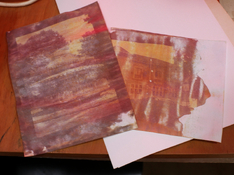
So... I've done a first experiment with borax added to the solution. Most of the copper was reduced to metallic copper, but a very very faint image was formed. The faint image disappeared after drying. I also discovered that if the first wash is made in a weak solution of hydrochloric acid, the contrast is much increased and white backgrounds are obtained, resulting in red over white pictures. The problem is that pictures produced this way don't last the drying step, turning into verdigris. I tried converting the metallic copper to CuO (a light-fast black pigment) w/ some Hydrogen Peroxide, with no success.
 

Jan de Jong

Subscriber
Allowing Ads
Joined
Jul 20, 2022
Messages
126
Location
Germany
Format
Analog
for what it is worth, i have done some free style quick tests to see if I can get anything with Copper Sulfate and ascorbic acid.
I coated the paper with this and then covered it with plastic wrap to keep it moist. then on top a negative inkjet foil. this showed very little reaction. However there after I removed it and tried some intense UV exposure with a UV Flashlight. Which did show for a short moment while drying a reaction, it is about 100 times (guess) slower than cyanotype and only works for a short moment while drying. After that it does not change and is no longer sensitive for UV light. In that case no washing is required.

I would have to do the experiment again to get a better way of working with it. The 3 points is the imprint of the 3 LEDs in that light.
WhatsApp Image 2026-01-12 at 22.40.21.jpeg
 

Chromium VI

Member
Joined
Jan 10, 2026
Messages
17
Location
Tomar, Portugal
Format
Multi Format
for what it is worth, i have done some free style quick tests to see if I can get anything with Copper Sulfate and ascorbic acid.
I coated the paper with this and then covered it with plastic wrap to keep it moist. then on top a negative inkjet foil. this showed very little reaction. However there after I removed it and tried some intense UV exposure with a UV Flashlight. Which did show for a short moment while drying a reaction, it is about 100 times (guess) slower than cyanotype and only works for a short moment while drying. After that it does not change and is no longer sensitive for UV light. In that case no washing is required.

I would have to do the experiment again to get a better way of working with it. The 3 points is the imprint of the 3 LEDs in that light.
View attachment 415991
That's very interesting...
 

AntonKL

Member
Allowing Ads
Joined
Jun 23, 2025
Messages
23
Location
Europe
Format
35mm
So... I've done a first experiment with borax added to the solution. Most of the copper was reduced to metallic copper, but a very very faint image was formed.
So everything turned black/brown? Or yellow? The "whites" are supposed to be strongly yellow before fixing (unless you pre-treat the paper with chloride/bromide instead of alkali).

I also discovered that if the first wash is made in a weak solution of hydrochloric acid, the contrast is much increased and white backgrounds are obtained, resulting in red over white pictures. The problem is that pictures produced this way don't last the drying step, turning into verdigris. I tried converting the metallic copper to CuO (a light-fast black pigment) w/ some Hydrogen Peroxide, with no success.
You can get stable images by first fixing with alkaline (Na-)Thiosulfate solution, then toning with either silver bearing fixer, ferricyanide (takes quite long) or polysulfides.
 

AntonKL

Member
Allowing Ads
Joined
Jun 23, 2025
Messages
23
Location
Europe
Format
35mm
@Jan de Jong the system is pH sensitive, if you just mix copper sulfate and AA it does not do much. For it to be able to plate out metallic copper or quickly react to form copper (I) halides you need to raise the pH just slightly by adding e.g. NaHCO3 or Na-Ascorbate to the mix. Raising the pH too much is also bad, it will make the solution spit out Cu2O(?), sometimes with a significant delay depending on temperature and concentration. This freshly precipitated compound is not immediately light sensitive, IIRC it needs to be exposed to a lowered pH first. Maybe it's initially CuOH or has some mix of OH- and O2-.

This solution is not light sensitive itself, you need to make it precipitate CuCl, CuBr or Cu2O on the paper, the light converts these compounds into the seeds for the physical development. With UV light and high contrast negatives I'd try bromide first.
 
Last edited:

Jan de Jong

Subscriber
Allowing Ads
Joined
Jul 20, 2022
Messages
126
Location
Germany
Format
Analog
@Jan de Jong the system is pH sensitive, if you just mix copper sulfate and AA it does not do much. For it to be able to plate out metallic copper or quickly react to form copper (I) halides you need to raise the pH just slightly by adding e.g. NaHCO3 or Na-Ascorbate to the mix. Raising the pH too much is also bad, it will make the solution spit out Cu2O(?), sometimes with a significant delay depending on temperature. This freshly precipitated compound is not immediately light sensitive, IIRC it needs to be exposed to a lowered pH first. Maybe it's initially CuOH or has some mix of OH- and O2-.

This solution is not light sensitive itself, you need to make it precipitate CuCl, CuBr or Cu2O on the paper, the light converts these compounds into the seeds for the physical development. With UV light and high contrast negatives I'd try bromide first.
Hello Anton, yes, you are right. I just used tap water which has PH 8, I tried various other things later on that also adding KBr, and NaHCO3. the KBr was making it worse. What did work, but expected was adding Thio sulfate, but then we are back to the "cuprotype" more or less based on thio (fix) I was also thinking about borax but did not try that. I have to start over and do bit more controlled experiments.
 
Photrio.com contains affiliate links to products. We may receive a commission for purchases made through these links.
To read our full affiliate disclosure statement please click Here.

PHOTRIO PARTNERS EQUALLY FUNDING OUR COMMUNITY:


Ilford ADOX Freestyle Photographic Stearman Press Weldon Color Lab Blue Moon Camera & Machine
Top Bottom