• Welcome to Photrio!
    Registration is fast and free. Join today to unlock search, see fewer ads, and access all forum features.
    Click here to sign up

Struggling With Rangefinders

Forum statistics

Threads
202,630
Messages
2,843,239
Members
101,413
Latest member
USMC46
Recent bookmarks
0
"quiet and low vibration"

I had forgotten that when covering a wedding, funeral, some type of event in a church I would take both rangefinders, one with a 28 the other with a 50m with a 90 or 100mm in my bag.
 
For my, my R4 and R6 play their strength with 21mm and 135mm lenses, for the WYGIWYS factor. But both lenses make the relatively small Leica R bodies heavy like a beast.

The delicate dimensions of film M bodies, combined with the almost toy-like 50mm M lenses are a delight. In certain settings, and in others the heft of a 135mm lens on a R body feels "right".

Luckily, in photography, you can have one cake while eating another one.
 
Try a smaller SLR perhaps? Nikon FM, F3, FA are all smaller than a F2AS

I have an F2AS and last week I bought an F3. I have to say they are the most inspiring of the 35mm cameras I have used. Its like owning a 70's Ford Granada and an 80's Sierra
 
For me a Leica rangefinder camera is the only choice. Try using a Leica II Barnack camera and set the shutter and aperture for the light and subject and then concentrate on focus, composition and timing. The camera is so tactile, it is like part of your own body.
 
Last edited:
A RF is not a SLR, totally different beast. RF had there day as fast shooting in sports, street, war, etc. What you see in the VF only approximates what you see on film. It's very easy and quick to focus with a RF and you are not distracted by DOF, shutter speed, apertures, etc.
 
For me a Leica rangefinder camera is the only choice. Try using a Leica II Barnack camera and set the shutter and aperture for the light and subject and then concentrate on focus, composition and timing. The camera is so tactile, it is like part of your own body.

I agree. But if I need consistent and accurate framing the rangefinder stays home. Even my K1000 gives better framing accuracy.
 
I agree. But if I need consistent and accurate framing the rangefinder stays home. Even my K1000 gives better framing accuracy.

Of course your K1000 gives better focusing. It’s not a RF.
 
Even with my Argus C3 I get good focus, the magnified rangefinder window works really well, what suffers if the framing, step back a few steps and crop when printing. On the other hand I use depth of field preview a lot.
 
There's no requirement to like rangefinders, even if certain of them are "legendary." They are just different, a different way of looking, and so it might suit some people and not others. Similarly, many people find a waist-level finder weird the first time they use one, some grow to love it, and some never do.

I am not sure if the issues described by the OP fall entirely into imperfections (less accurate framing), or limitations (having only one lens for the system), or if they're a combination. Sometimes, the way to use or benefit from a system is to accommodate to its limitations and use them, rather than trying to work around them. For a small example, it can be a useful discipline to use only one focal length for a day and just see the way it sees, rather than continually changing lenses or zooming.

Viewfinder issues can be real in rangefinders - even Leica-philes divide over which viewfinder magnification they like. I know in a thread like this, everyone suggests their own different piece of kit, so as another distraction: I think one of the best viewfinders is in the humble Konica auto s2 fixed-lens RF. It has a nice large VF with parallax corrected frame lines, a good 45/1.8 lens, and doesn't cost much. The meter is often dead by now, but it works fine in manual mode, and if you're used to a separate meter that's not a problem.

 
If you not forgetting to remove the lens cap when shooting then RF's are fun. Yes, that imprecise framing what makes the RF interesting and more over you will be seeing whats int the frame even during the exposure.
 
If you not forgetting to remove the lens cap when shooting then RF's are fun. Yes, that imprecise framing what makes the RF interesting and more over you will be seeing whats int the frame even during the exposure.

1769027616508.png


Victoria Beckham taking a photograph.
 
Not all rangefinders are created equal.

I love my Retina iic for it's ultra-quiet leaf shutter that's really suited to street photography.

At the other end of the scale, taking street photos with my Fuji GW690 ("Texas Leica") can be embarrassing, I swear that shutter can be heard at 100 metres!

I've never worried that there is some uncertainty between the viewfinder view and the image recorded on film, but then I'm not into serious "composition" either.

Hey, go with whatever you like, isn't that why we call it a hobby?
 
I have an F2AS and last week I bought an F3. I have to say they are the most inspiring of the 35mm cameras I have used. Its like owning a 70's Ford Granada and an 80's Sierra

Surely you’re kidding. The Granada is probably one of the worst cars ever made.
 
If it want an SLR experience in a small, rangefinder-sized body, I would suggest the Olympus Pen F/FT/FV. Both the Pen F and LTM rangefinders have a film-to-flange distance that is about 17mm shorter than your Nikon F, so the body can be that much thinner.

The Pen FT shutter is hardly quiet though, and it is becoming harder to find one where the partially silvered mirror for the light meter has not degraded. To avoid that, the Pen FV is better, but rarer.
 
I tend to take better photographs with my rangefinder cameras. I attribute it to keeping my mind on pre visualization of what I want the photograph to be, instead of being forced to look through a tunnel if that makes any sense (a heavy, bulky, and noisy tunnel I might add). I let my almost unconscious/practiced skills take care of the details of focus and exposure while most of my mind is consciously just taking the photograph using the viewfinder or simply shooting from the hip with wide glass, both of which show me more than just what’s in the frame.

It’s like riding motorcycles. When you first start it’s almost overwhelming what you have to do to safely go one block. But after riding for years the muscle memory is so ingrained that all one has to think about is, “Go there, do that,” and you get to really enjoy the ride.

Whatever tools you use is up to you - just my take.
 
Last edited:
An SLR can show precise focus and exact framing in the viewfinder, so there’s a tendency to concentrate more on composition. With a rangefinder, focus is abstract and framing is approximate, so more attention can go to finding decisive moments.

Another aspect of rangefinders is the tendency to use just one or two fixed focal-length lenses. As others have noted, after those fields of view get learned, pictures can frame themselves in the mind’s viewfinder even before the camera goes up to the eye.
 
I am trying to say that, through experience, it is possible to look at a scene, once you know the field of view, to think about how it will look on film. You need to think about composition, including how the light falls on the elements in the scene. An artist does that when he/she puts paint to the canvas of a scene.

I completely agree.
 
I bought a Canon 7S and a VTDeluxe and a 50mm f1.2 LTM. I’ve been a professional landscape / travel photographer for 20 years, so I’m highly experienced.

The whole rangefinder experience has turned out to be a detachment for me creatively but I’m trying to like this format.

1. I feel detached from the precise framing of the F2AS I own. These rangefinders lack versatility and I get quickly bored of the restrictions.
2. I am far from enjoying composition with the 7S 50mm frame lines, the VT’s rotating viewfinder prism is better. I bought a 35mm to end this on the 7S, but the lens was a eBay Japan dud so I’m stuck with frame lines until I get a 35mm.
3. I use my 50mm f1.2 LTM digitally with my Canon R3 to great effect so I’m certainly keeping this beautiful lens. I have to say this lens is the only really good thing I have taken from this rangefinder experience.

Should I rethink my strategy with this kit?

Any help gratefully received!

I grew up with SLRs and could never warm up to RF. I like to see what the camera sees.
 
I find the exact opposite. I want to see and avoid all my potential mistakes, what to include / exclude especially on the edges, explore visual dynamics, highlight my creative focus and blur. I find rangefinders to be a total disconnect with all these important criteria.

If I’m just walking about in a city, or just snapping, then not much of this above is as important. The moment I start to try something more creative, rangefinders makes me feel as though I’m back to being a complete amateur again.

You’re accustomed to Nikon’s 100 % viewfinder and probably not shooting color slides.

I was always envious of that (Pentax / Olympus don’t do more than about 97%).

Of several rangefinders I have, a few have framelines with parallax correction, that’s important to keep from cutting off people’s heads.

Even with parallax correction you have to be aware it pertains to the foreground and the background does not move (so you use framelines for your subject but keep the sliver of mountains where they were at infinity focus, outside the close-up frame).

These are things you can grow accustomed to, but I totally understand your annoyance.
 
Leica film RF cameras have a focal plane shutter, limited to synching at 1/60 or slower. Maybe 1/125 for newer ones.

I am poor for Leica Sir :smile: and yes, they got focal plane shutter.
 
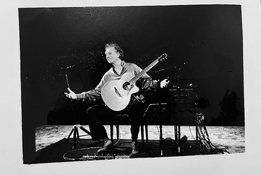
It's hard to beat a rangefinder for the front row of an acoustic guitar concert, or a small jazz clubIMG_9479 3.JPG
 
Photrio.com contains affiliate links to products. We may receive a commission for purchases made through these links.
To read our full affiliate disclosure statement please click Here.

PHOTRIO PARTNERS EQUALLY FUNDING OUR COMMUNITY:


Ilford ADOX Freestyle Photographic Stearman Press Weldon Color Lab Blue Moon Camera & Machine
Top Bottom