
• Welcome to Photrio!
    Registration is fast and free. Join today to unlock search, see fewer ads, and access all forum features.
    Click here to sign up

Street photography without pissing people off?

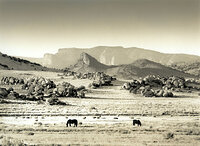
Two Horses

A
Two Horses

  • 2
  • 1
  • 10
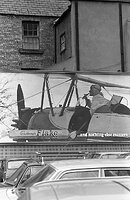
Billboard, Cork city 1977

H
Billboard, Cork city 1977

  • Tel
  • Mar 17, 2026
  • 0
  • 0
  • 19

Recent Classifieds

Forum statistics

Threads
202,799
Messages
2,845,690
Members
101,539
Latest member
UwBouwMeester
Recent bookmarks
0
taking pictures without being noticed takes a bit of skill, but surprisingly little -- ditch the digital slr and find a small point and shoot -- Olympus XA, leica CL, something small and black and inconspicuous to start with.

pre-focus, learn to shoot from the hip, even be looking in a different direction while you shoot.

i've had this happen often -- I will snap a coupla shots of a homeless person, begger or something of that sort, and then the person will notice the camera, at that point smile, say hi, ask if you can shoot them, give them a buck, take a couple of posed shots (everyone loves to post) and then when they are tired of your game they will go back about their business and you can shoot them without them noticing again, but this time with their permission.

A rolleiflex, by the way, makes a GREAT camera for this -- everyone is trained to look for big honking digital cameras, or telephones, or something. Nobody is looking for this black thing hanging at waist level that you look down into a few times.

all about being something other than what people are used to seeing.
 
Don't know about France but it the USA it depends on how it is published too.

My understanding is that for news there is almost no protection for the subject, as long as the reporter/photographer is in a public space or has permission to shoot from the property owner.

For commercial uses, advertising and stock, a release is required before publishing.

Art though is different. So street (public) photography sold by a photographer through a gallery for display in an office or at home doesn't require a release.
 
There's a lot of talk about how French law regarding photography would differ from what is in place in the rest of the world. When somebody happens to actually cite a norm, it turns out that it is just like exactly in the rest of the world.

The blog cited in post #150 ends up quoting norms whereby you can take pictures of anybody in the street without their consent (as is everywhere). Publishing follows the old common rules: commercial use needs release, non-commercial use doesn't. Not hard to grasp. And yes, derogatory use is not admitted without consent. That's more or less all there is to know, in France as elsewhere.

The Tour Eiffel at night can be photographed and published just like any other building, and the Moulin Rouge can also be photographed just like any other building. There are laws for buildings, there are not specific laws for Tour Eiffel and Moulin Rouge.

As a stock photographer I wrote twice to the Tour Eiffel guys - they have a web site where they say that I cannot take pictures of the tower at night - asking them to quote the norm which they think should apply. I asked that once in French and once in English, stating both times that in case of no answer I will obviously continue to take pictures of the Tower in every way and to distribute it as I see fit. Never received an answer.

The problem is that ignorance runs so high that I know a couple of agencies that have withdrawn their pictures of the Moulin Rouge after receiving an email from the cabaret. Your rights are useless if you don't know, understand and exercise them. We'll end up living in a society governed by dogs' barks rather than laws if we don't begin understanding the basic principles of Law.

Fabrizio

PS The only peculiarities I know are:

USA and Belgium: sculptors have rights on publication of pictures of sculptures also when they are on permanent exhibition (normally a sculptor would not have right on the publication of pictures of his work if it is on permanent exhibition).

Germany: the "right of panorama" is explicitly restricted to the ground level, it does not apply to pictures taken from a higher floor (such as a picture taken from a restaurant terrace). That's according to cited jurisprudence and one always ask to wonder how correctly the sentence(s) is read or understood.

In any case this only refers to publishers. Photographers, by and large, take pictures, maybe sell them, and it's generally fine. It's publication which crosses lines. Those are crossed by the publisher, not the photographer.
 
Last edited by a moderator:
I replied similarly to a thread about taking photographs in France. When I found the actual law, it stated that it did not apply to photographs taken in a public place - just like most of the rest of the world.

II. Criminal offences relating to violations of privacy.
The offences which relate to violations of privacy derive from the Act of Parliament of 17 July 1970; as amended in 1994, they now constitute articles 226-1 to 226-9 of the new Penal Code. Under article 226-1 of the Penal Code it is an offence, intentionally and by means of any process whatsoever, to infringe another’s privacy:
1. By receiving, recording or transmitting, without the consent of their author, words uttered in private or confidentially;
2. By taking, recording or transmitting, without his or her consent, the picture of a person who is in a private place.
In both cases, therefore, the offence requires the absence of the person’s consent, and such consent is presumed where the recording or the taking of the picture takes place in a meeting and openly and publicly. The purpose of article 226-1 is to curb the behavior of the paparazzi.
By virtue of article 226-1.2, privacy is not protected where the violation is committed in a public place.

Last line made bold by me.


Steve.
 
Last edited by a moderator:
There's a lot of talk about how French law regarding photography would differ from what is in place in the rest of the world. When somebody happens to actually cite a norm, it turns out that it is just like exactly in the rest of the world.

Possibly it does match up against the same laws in other countries, undoubtedly, I never opposed that in my post.

For more details see here:

http://translate.google.com/transla...w.bepub.com/view_fiche_pratique.php?id_fic=18


Regarding your Eiffel photos:

"According to the Civil Code, only the owner has the right to use his property in any form whatsoever. However, after many trials abusive jurisprudence believes that "the ownership of a property situated in the public domain and exposed to the view of all does not authorize the holder to oppose the exploitation of image of the property, but can only act against abuse and damaging the image. "
 
Last edited by a moderator:
Regarding your Eiffel photos:

"According to the Civil Code, only the owner has the right to use his property in any form whatsoever. However, after many trials abusive jurisprudence believes that "the ownership of a property situated in the public domain and exposed to the view of all does not authorize the holder to oppose the exploitation of image of the property, but can only act against abuse and damaging the image. "

When I take a picture of the Eiffel tower I dont "use" it in any way. I am taking a picture of it. The Eiffel tower might well be in "private property". It would be possible to create some form of entity, "Tour Eiffel Trust", to endow it with the property of the land it stays on, and then to claim that it cannot be photographed without authorization, but it wouldn't work in preventing me from taking pictures and selling them.

I can actually take a picture of any private house from the public land, whether or not the house itself sits on private ground or public, and make most any use I like of it, excluding commercial use and derogatory use.

Actually this operation (creating a Trust etc.) was made with the Tour Eiffel and the Tour Eiffel "Trust" does not even try to ask payments for pictures taken during the day - which they would if the Civil Code said what the quotation above says - they only try to extract payments for pictures at night.

Regarding the Tour Eiffel, the myth actually is that it cannot be photographed by night, because the light scheme is copyrighted. The myth was spread by the Tour Eiffel "Trust" which so claims in its web site. So what? Every building design is "copyrighted" by default as soon as it is born on paper. I cannot copy it (I cannot build an identical building without the architect's consent) but I can take pictures of it. Taking pictures is not "copying it" in any way. Neither it is "using it".

Copyrighting a building does not prevent me from photographing it and copyrighting a light scheme of a building does not prevent me from photographing it at night.

@ Felinik, I'm not saying this as if I disagreed with you, I refer in general to the myths regarding France and certain (especially French, but not only French) buildings. The Sidney Opera house being another famous case. If you ask a number of stock photographers you will find that most believe that the Sidney Opera house is "copyrighted" and cannot be photographed.

Apparently people believe this is a privilege granted to only that one Opera house in the planet... or maybe they believe that in Sidney they are smart people while in the rest of the world people is dumb and don't copyright buildings.
 
Last edited by a moderator:
Shoot with a beautiful camera.. ? I go out with my FE or Rollei.. So people are very curious on the camera and come to me. It's a great segway for me to ask to take thier picture. Either a street portrait, or the activity they are engaged in.

Todd
 
Shoot with a beautiful camera.. ? I go out with my FE or Rollei.. So people are very curious on the camera and come to me. It's a great segway for me to ask to take thier picture. Either a street portrait, or the activity they are engaged in.

Todd

Once you "ask their permission to take their picture ", and they start posing it's no longer candid photography but street portraiture.
 
Yes, an older film camera can be a segue into conversation and more casual shooting.
 
There are three easy tricks:

(1) Dress plainly (muted colours)
(2) Limit your movements
(3) Use a small camera

That is, if you wear bright colours, move around a lot and point a big camera at people, they are sure to notice you. Then you won't get any genuine street shots and you may be confronted.

I use a Minolta Hi-Matic 7sII for street and it is a very discrete and innocous camera. With a very good lens.
 
Not always.. They continue doing what there doing. I love the sneakyness of candid pics too. Going back to getting pissed off people. I've been approuched by pissed people, but really dont get bothered or attemidated with it.
 
The Internet has made everyone absolutely terrified of having their photograph made in public. They don't know what's going to be done with it and who's going to see it and what people might think of them. All they know is that it scares them to death, makes them angry, and damn it they're calling the police right now.

Of course, after the police arrive and leave they then spend huge amounts of time pointing their smartphone cameras back at themselves to record selfies about what just happened, then instantly post the resulting pictures all over the Internet for everyone in the world to see. Look at me... look at me...

The irony eludes them completely.

Ken
 
The Internet has made everyone absolutely terrified of having their photograph made in public. They don't know what's going to be done with it and who's going to see it and what people might think of them. All they know is that it scares them to death, makes them angry, and damn it they're calling the police right now.

Of course, after the police arrive and leave they then spend huge amounts of time pointing their smartphone cameras back at themselves to record selfies about what just happened, then instantly post the resulting pictures all over the Internet for everyone in the world to see. Look at me... look at me...

The irony eludes them completely.

Ken

I have never been confronted while taking street shots. I have been busted (i.e. noticed) only once or twice, but then all you need to do is smile, thumbs up and move away.

I also went out to do some street shooting wearing a really bright red shirt once. But people were looking at me even before I could raise my camera, so I was dead in the water.

I don't do street portraits, because only genuine, unaware scenes interest me. But some photographers do very good street portraits too, so I don't hate the genre.
 
Last edited by a moderator:
Same here-I haven't even been asked ''ITAH''?...
 
I've been trying to work up the cajones to photo unsuspecting strangers, but it's not happening. I can see it working in NYC, but here it just seems incredibly rude and unnecessary. Best I can muster is going to big events / public festivals and practicing getting shots in that way. The only "run-in" I've had was with a busker who wanted a donation first.
 
Last edited by a moderator:
How to photograph the ocean without the ripples? How to photograph trees without the branches that split in two, one shoot hanging down? Being pissed, noticing, staring, "giving the eye"--all these are part of the subject you propose. Trying to photograph the subject while consciously avoiding these aspects of it would be akin to eugenics--you better have a very lofty cause and a very good argument... And it still wouldn't be right.

If you're shy, look for opportunities when people expect to be photographed--street parties after a sports victory, parades of all sorts, joyous public events, fairs and fiestas. Generally dull and one-sided, they will (if you pay attention) start you up on the path of being what you photograph, not distancing yourself from it. Call it compassion.

Dogs bite those who fear them.
 
Last edited by a moderator:
I've been trying to work up the cajones to photo unsuspecting strangers, but it's not happening. I can see it working in NYC, but here it just seems incredibly rude and unnecessary. Best I can muster is going to big events / public festivals and practicing getting shots in that way. The only "run-in" I've had was with a busker who wanted a donation first.

If tyou live in a small town, it's probably necessary to start by explaining to people why you are taking photos. Once they feel comfortable withyour camera you can get candid shots. In a small community, it's also reasonable to share your photos with the subjects. Maybe even do a small exhibition?

But street photography is easier than it seems and there's always something interesting to photograph.
 
I use a Canon Elan7 with a normal sized (35-105) zoom lens on a monopole a lot. I have never been confronted by someone on the street. Part of it is how you move, the clothing you wear and how you move. Also if i go to take a photo and the person shows in some way they don't want to be filmed (move away, turn head, so on) I lift my head and smile and move on.

I never been confronted ever, I was asked if I worked for the newspaper a few times.
 
How not to piss off people?


Shoot architecture and landscape photographs.
 
On the other hand sometimes I'm amazed when I shoot street how many people who have noticed me and that I'm photographing them pretend they haven't seen me.
 
What is your intention - to take another snapshot without engaging of eating person, struggling old lady, drunk hobo - you are getting what you deserves.
Or do you want this picture because it feels great? Something special happens, nice light and motion...

If you want portrait of stranger - do not act strange. Take it straight forward. People will show you if it is OK or not.

If you want candid - good candids are those where people are unaware of their picture been taken. Not because you have "blended", but because they are busy with what they are doing.

Camera size - doesn't matter, it only matters for you comfort. Mental and if you want to walk for hours and miles, it is easy with small one. Want it wide? Try those cheap film P&S. They are with 28 and wider lens and many will have flash turn off button.
Size and color of the camera doesn't help a lot to hide, because it is in your specific motions, even if you are taking it from the hip. It is fun to use old folder or vintage TLR on the street. Good reaction from people. Or how you fiddle with Leica, aperture, shutter speed, focusing, taking light measure. Most of the people will have hard time to believe it is going to work :smile:

Old SLR, RF also good. Modern AF SLR with big lenses - different reaction, sometimes.

Dress code, IMO, nice and guffy works better on the street. People see you in advance they are aware and this makes them prepared. You'll see it or you won't see them, because some of them will turn away from camera or leave.
Just think about it. What will be most likely reaction if you take picture of person who doesn't likes it if you dressed and acting like colorful tourist from sixties with dusty big camera bag or like person who is trying to blend in. Spying person, speechless or loud village idiot. Who is more forgiven?
 
You're going to piss people off, no way around it. Nobody likes a camera pointed at them, and a lot of people have this completely ignorant and unrealistic idea that they have privacy while in the public view. Without changing the entire world, you can't take pictures of strangers in public without pissing them off every now and then. Instead of worrying about others' reactions, I try to think about why the hell I am even bothering to take the picture in the first place. More than likely a picture of a person who doesn't want to be photographed is something I will never print anyhow, so why bother?
 
Yoo tate my pitcher yoo die..... you DIE!!!
 
Photrio.com contains affiliate links to products. We may receive a commission for purchases made through these links.
To read our full affiliate disclosure statement please click Here.

PHOTRIO PARTNERS EQUALLY FUNDING OUR COMMUNITY:


Ilford ADOX Freestyle Photographic Stearman Press Weldon Color Lab Blue Moon Camera & Machine
Top Bottom
