• Welcome to Photrio!
    Registration is fast and free. Join today to unlock search, see fewer ads, and access all forum features.
    Click here to sign up

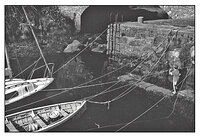
Streaks with an experimental developer

Puddle

Puddle

  • 2
  • 2
  • 46

Recent Classifieds

Forum statistics

Threads
202,720
Messages
2,844,648
Members
101,486
Latest member
thedetective06
Recent bookmarks
2
Well, this is elastic :smile: my view is a bit more restrictive (clik to enlarge):
At left of that you have nothing worth.
That's the whole point: if you overdevelop this short part left of your red brackets really hard, this "nothing worth" can turn into something barely printable.
 
That's the whole point: if you overdevelop this short part left of your red brackets really hard, this "nothing worth" can turn into something barely printable.

Anyway, it depends on flare (other scene regions with more light ?) and on local microcontrast. For sure we may not expect much image quality under 0.15D.

Of course "worth" is subjective, the film expense and that effort to obtain a barely printable image... we have the smartphone for that. Perhaps I'm speaking a bit in LF terms, to me it's difficult to shot an image that's not to be sound, I guess that when I shot MF or 35mm it's easier to press the button.
 
Anyway, it depends on flare (other scene regions with more light ?) and on local microcontrast.
If there are no pronounced highlights in the subject matter, then flare is a non-issue.
For sure we may not expect much image quality under 0.15D.
I showed examples. These were shot with a long tele lens on a very foggy day, so contrast wasn't high to begin with. Obviously grain is massive, but a real ISO 12800 film would have been grainy, too.

You might not like the results, but quite a few people use stand development and long toed film together with 4 digit EIs and are quite happy with the results. The statement "pushing does not gain speed" is true only together with "unless you accept a massive loss of image quality".
 
The statement "pushing does not gain speed" is true only together with "unless you accept a massive loss of image quality".

Speed is speed. Speed is defined from exposure at speed point, which is 0.1D over Fog+Base at CI 0.62. By developing CI 0.72 you won't modify much the speed point.

Me I also shot TX at EI 1600, but I'm well aware that I'm to loss at least 1.5 stops in the shadow latitude.
 
Speed is speed. Speed is defined from exposure at speed point, which is 0.1D over Fog+Base at CI 0.62. By developing CI 0.72 you won't modify much the speed point.
I just spent posting after posting explaining you my stand point, I posted images and curves to prove it - apparently all in vain. I'm done here.
 
I just spent posting after posting explaining you my stand point, I posted images and curves to prove it - apparently all in vain. I'm done here.


Rudeofus, there is no debate about what is pushing two stops, we all know what it is in theory and in practice.

Sure we agree that one thing is Pushing and another one is Increasing Film Speed.

Darkroom Cookbook:

"Increasing film speed is not the same as pushing ... is a process by which the film's ability to respond to low levels of light and record detail in shadow areas is increased ... such as the Hydrogen Peroxide Pushing Method or Acetic Acid Latensification, to create a true increase in film speed. Unfortunately, modern emulsions, whether they are conventional or flat-grained, rely on color dye sensitization to achieve their sensitivity as much as upon silver sensitivity. Color dyes do not respond to these speed increasing techniques. Hydrogen peroxide will do little or nothing and acetic acid latensification may ruin your film. I no longer recommend either."

It's clear what we do when pushing... we may optically print better the toe, but this is not increasing film speed by two stops.
 
It's clear what we do when pushing... we may optically print better the toe, but this is not increasing film speed by two stops.
You are correct: pushing does not alter the point of the H&D curve, at which it first leaves the straight horizontal line. However, since the toe slope is changed, and since the toe slope takes somewhere between one a three stops to reach mid tone slope, pushing effectively lowers the min usable effective exposure by one to three stops. For all practical purposes, that's a speed increase. You can probably gain even more, if you create a moving average over the image frame, which is essentially what poor scanners do.
 
pushing effectively lowers the min usable effective exposure by one to three stops.

Well, IMO more 1 stop than 3, think that meters aim to 3 1/3 stops over speed point, that's at 0.1D over F+B. In my experience from 0 to -2.5 stops underexposure we can print mostly the same without overdeveloping much, at least with linear films.

I've only pushed rolls, but never a sheet, IIRC. What I do a lot with sheets is pulling + compensation.
 
I think the bit which is being rather lost in here is that: despite the considerable efforts of several companies' R&D labs from the 1940's onwards, the best shadow speed boost that could be usefully achieved on materials meant for 'normal' photographic use is about 2/3 stop. I suspect that being able to grow and better sensitise finer and sharper (for a given speed) grain structures was overall found to be more productive than trying to get more speed through development alone.

As Rudi notes, being able to bend the toe slope steeper is really useful - especially with sheet film and flat lighting conditions. Also really important is the relationship to the paper curve - and that's where things usually get interesting for the folk who spend their time worrying about 'compensation' and consequently underdevelop their film to rather extreme extents...
 
Looks like processing it the same way I do Rodinal stand would be another thing to try.

If the issues you're facing get resolved by exactly following the workflow suggested in the flickr page on Anneman-Gainer developer, do let us know. If they still persist, giving a gentle inversion once every five minutes might help unless you are fixated on stand development.
 
If the issues you're facing get resolved by exactly following the workflow suggested in the flickr page on Anneman-Gainer developer, do let us know. If they still persist, giving a gentle inversion once every five minutes might help unless you are fixated on stand development.

I will. I just have to order more film before I can proceed.
 
Photrio.com contains affiliate links to products. We may receive a commission for purchases made through these links.
To read our full affiliate disclosure statement please click Here.

PHOTRIO PARTNERS EQUALLY FUNDING OUR COMMUNITY:



Ilford ADOX Freestyle Photographic Stearman Press Weldon Color Lab Blue Moon Camera & Machine
Top Bottom