I try to get a little "real world" with film testing, as I don't have a densitometer and I don't really see the need for one (I know, shoot me you graph-paper guys!)
For starters, some posts here saying "rate your film slower" - I know there's various beliefs about getting shadow up over various curves and so on, but if a film delivers the shadows I want at or near box speed, I'm good, and I'd rather test specifically for that. Rodinal 1+50 consistently requires at least an extra half stop for me, DD-X and box-speed is often fine.
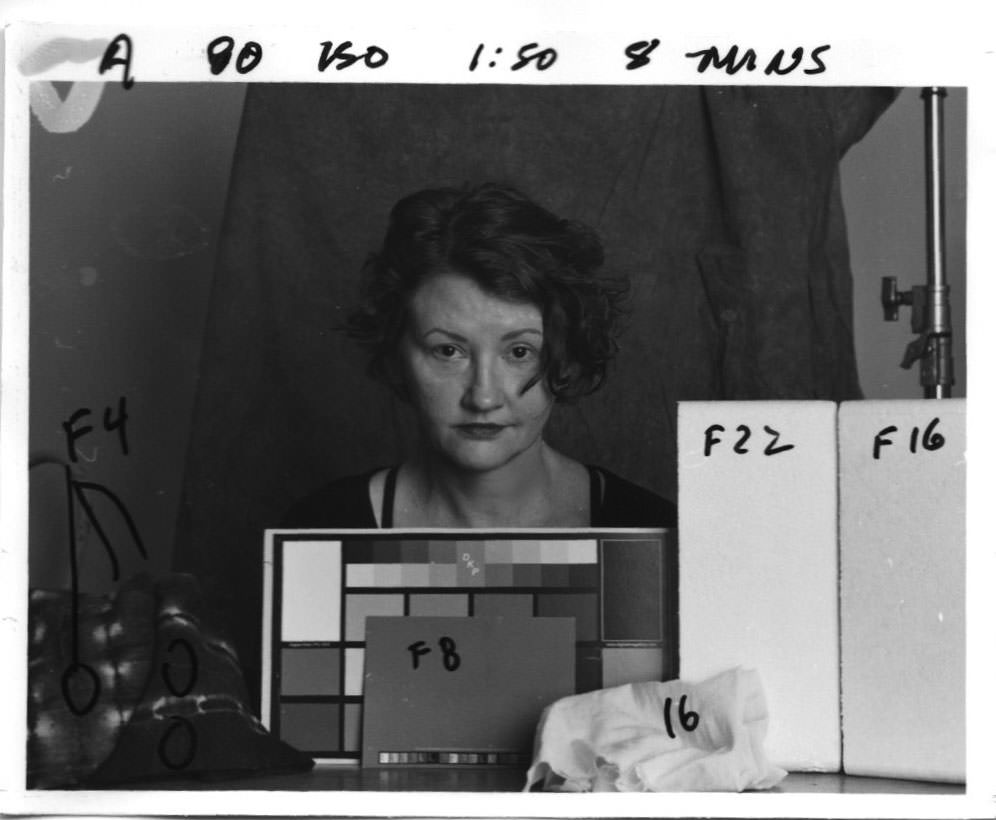
I set up a still life and meter the whole thing, sometimes throw in my nice Mrs. to see skin tones, shoot at box speed and also third or half stop slower increments, take my best guess at processing. I choose the ISO that holds the shadows I want. I do my enlarger tests with unexposed/developed leader to set exposure (for 120 film) or using the edge of 4x5. Find where film base + fog just reaches black with a 2.5 filter. If I'm holding shadow texture 3 stops brighter than my base exposure, my development is good. If I'm showing texture in deep shadows (like dark knit fabrics or dark hair), my ISO is correct for me.
I'm doing a lot with liquid emulsions that are fixed grade, so that requires testing as well, having data to shoot negs specifically for grade 3.5 and so on.
In this test (desktop office scanner so not the best look at the test print), I've got texture even in her dark sweater and in the styrofoam block marked f22. Seems to be all I need. The half-stops in the test chart are handy to suss out if development is off and by how much; they're handy if I want to dial in specific push or pull times - how much development shift does it take to move the highs 1/2 or 1 stop is very clear with those squares.
I know that ain't the most high-tech way to do this, but dang, it works just fine for me! This is Acros, ISO 80, Rodinal 1+50, 8 minutes; it's a little flat as a test print, but everything I need is in the neg for me to choose whatever contrast I want in the final:



 )
)